


Essential Certifications to Look for When Selecting a Manufacturer in Mexico
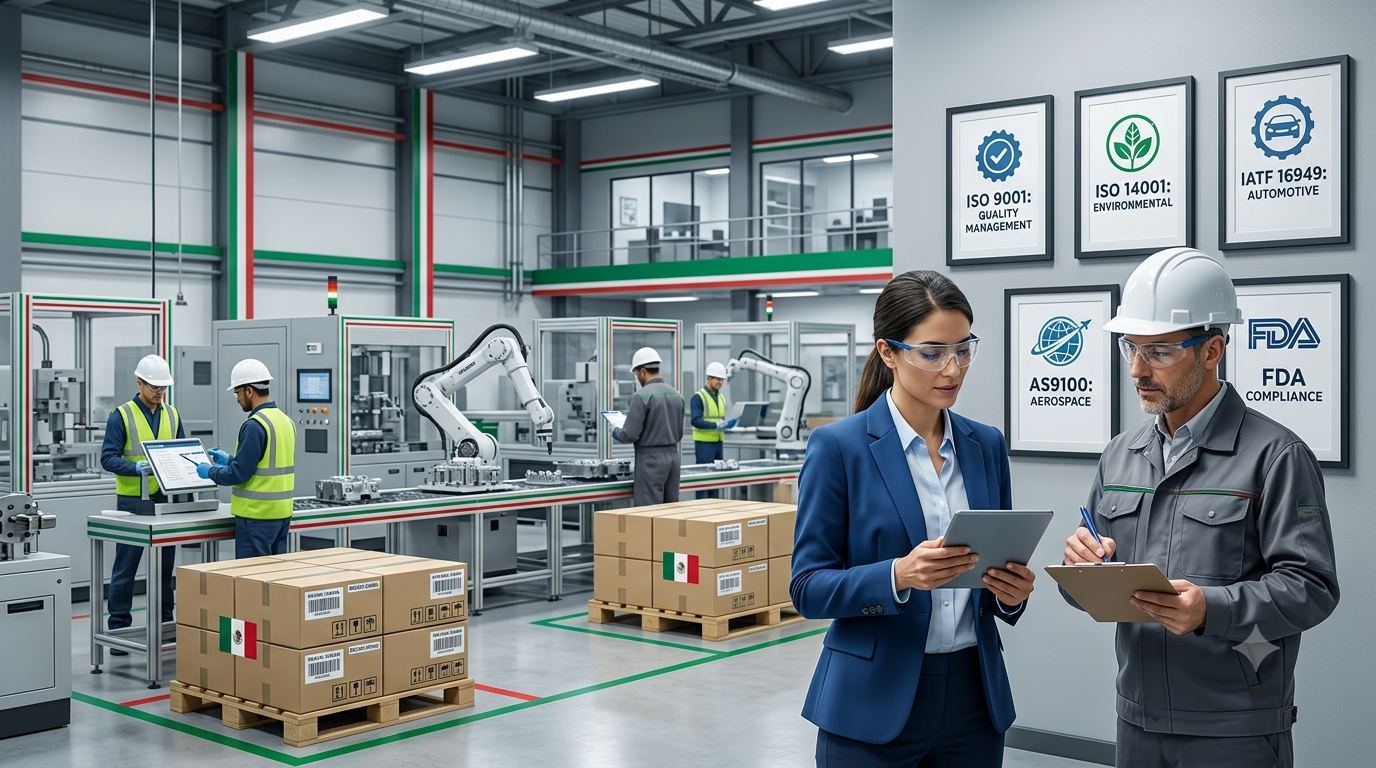
A single missing certification once cost an automotive parts buyer an entire product line recall — not because the manufacturer built a bad part, but because they'd never actually passed the industry-specific audit they claimed to hold. The buyer had seen a logo on a website and assumed that was proof enough.
That mistake is more common than most buyers realize. Certifications get treated as a checkbox — something to glance at and move past — when they should be treated as one of the most concrete, verifiable signals available during the entire selection process.
Understanding manufacturer certifications in Mexico isn't about memorizing acronyms. It's about knowing which ones actually matter for your specific product, how to verify they're current, and what gaps in certification history should make you pause before signing anything.
In this guide, you will learn:
-
The core certifications relevant across different manufacturing industries
-
How to verify a certification is genuine and current, not just claimed
-
Which certifications matter most for specific product categories
-
Common mistakes buyers make around certification verification
-
A real-world example of a certification gap catching a serious problem early
-
Practical tips for building certification checks into your vetting process
Why Certifications Matter More Than Buyers Assume
A certification isn't just a badge — it's evidence that an independent third party has reviewed a manufacturer's processes against a defined standard and found them compliant. That distinction matters enormously. A manufacturer telling you they "follow strict quality processes" is making a claim. A manufacturer showing you a current ISO 9001 certificate is showing you proof that claim has been externally verified.
Certifications also tend to correlate with operational discipline more broadly. Manufacturers willing to invest the time, cost, and internal process rigor required to earn and maintain certification generally extend that same discipline to areas the certificate doesn't directly cover — documentation, training, and consistency.
That said, certifications aren't a perfect substitute for due diligence. They tell you a facility met a standard at the time of the last audit — not that they're still meeting it today, and not that every part of a specific order will be flawless. They're one strong signal among several, not a guarantee on their own.
Core Certifications to Understand
ISO 9001: The Universal Baseline
ISO 9001 is the foundational quality management certification applicable across virtually every manufacturing industry. It verifies that a company has documented, repeatable processes for quality control, corrective action, and continuous improvement.
If a manufacturer doesn't hold ISO 9001 at minimum, that's worth understanding clearly — some legitimate smaller operations simply haven't pursued certification yet, but for any meaningful production volume, its absence should prompt deeper questions about their internal quality systems.
IATF 16949: Automotive-Specific Standards
Building on ISO 9001, IATF 16949 adds automotive industry-specific requirements around defect prevention, supply chain risk management, and continuous improvement metrics. If you're sourcing automotive parts or components — even Tier 2 or Tier 3 supply — this certification is generally non-negotiable for serious automotive buyers, since most OEMs require it contractually from their own suppliers.
ISO 13485: Medical Device Quality Management
For any medical device or healthcare-related product, ISO 13485 verifies compliance with the rigorous documentation, traceability, and risk management standards regulators expect. Medical device manufacturing carries some of the highest stakes of any category — a quality failure isn't just a business problem, it's a patient safety issue — making this certification especially important to verify carefully.
AS9100: Aerospace and Defense Standards
AS9100 builds on ISO 9001 with aerospace-specific requirements around configuration management, risk assessment, and product safety. Mexico has become a significant aerospace manufacturing hub, particularly around Querétaro, and AS9100 certification is essentially a baseline requirement for serious aerospace sourcing.
C-TPAT: Customs and Supply Chain Security
The Customs-Trade Partnership Against Terrorism certification focuses on supply chain security rather than product quality directly, but it matters enormously for cross-border logistics. C-TPAT certified manufacturers typically experience faster, more predictable customs clearance, reducing the risk of shipment delays at the border.
IMMEX Program Certification
Though not a quality certification in the traditional sense, IMMEX status allows manufacturers to import materials duty-free for assembly and export. If your supply chain depends on this structure, verifying active IMMEX status is just as important as verifying quality certifications.
Actionable Takeaway: Build a simple reference sheet of which certifications are genuinely relevant to your product category before starting your search. This prevents both under-verifying critical certifications and over-indexing on ones that don't actually apply to your industry.
How to Verify a Certification Is Real and Current
This is where many buyers stop short, and it's exactly where problems tend to hide.
Request the actual certificate document
A certification claim on a website or sales deck means very little on its own. Ask for the actual certificate, which should include the issuing body's name, certificate number, scope of certification, and expiration date.
Confirm the issuing body is accredited
Legitimate certifications come from accredited certification bodies. If you don't recognize the issuer, a quick search can confirm whether they're a recognized accreditation body or an obscure entity offering questionable "pay-to-play" certificates.
Check the certification scope carefully
Certifications often apply to specific processes, product lines, or facility locations — not necessarily the company's entire operation. A manufacturer might be certified for one production line but not the one that would actually handle your order. Always confirm the scope matches what you're sourcing.
Verify the expiration and last audit date
Certifications require periodic re-auditing to remain valid. A certificate that's technically still "active" but hasn't been re-audited in several years deserves a direct question about why.
Actionable Takeaway: Treat certification verification as a standard step in every vetting process, not an optional extra reserved for larger contracts. The five minutes it takes to confirm a certificate's authenticity can prevent a much larger problem down the line.
Matching Certifications to Your Industry
|
Industry |
Most Relevant Certifications |
|
Automotive parts and components |
IATF 16949, ISO 9001, ISO 14001 |
|
Medical devices |
ISO 13485, FDA registration (if applicable) |
|
Aerospace and defense |
AS9100, ITAR compliance (if applicable) |
|
Electronics and consumer goods |
ISO 9001, RoHS/REACH compliance |
|
Food-contact or packaging products |
ISO 22000, FSSC 22000 (if applicable) |
|
Cross-border logistics-sensitive goods |
C-TPAT, IMMEX |
Common Mistakes and Warning Signs
-
Accepting a logo instead of documentation. Website badges are easy to display and don't require verification. Always request the underlying document.
-
Assuming certification covers the entire facility. Scope limitations are common and easy to miss without asking directly.
-
Ignoring expired or lapsed certifications. A manufacturer citing a certification from several audit cycles ago may no longer actually hold it.
-
Overlooking industry-specific requirements. General ISO 9001 alone isn't sufficient for regulated categories like medical devices or aerospace components.
-
Failing to ask about corrective action history. Certification audits sometimes result in findings requiring corrective action; understanding this history shows how seriously a manufacturer takes ongoing compliance, not just the initial certificate.
Skipping certification verification doesn't usually cause an immediate visible failure — it becomes a serious problem only when something actually goes wrong, and by then, discovering the certification wasn't valid is far too late to matter.
Real-World Example: The Certification Gap That Prevented a Crisis
A medical device company was finalizing a contract with a manufacturer in Tijuana that prominently advertised ISO 13485 certification across its marketing materials. During the final due diligence stage, the buyer's quality assurance lead requested the actual certificate rather than relying on the website claim.
The document that arrived showed the certification scope was limited to a specific product category the manufacturer had previously produced — not the injection-molded components the buyer intended to order, and not the specific production line that would handle the new contract.
Rather than walking away entirely, the buyer negotiated a revised timeline that included the manufacturer completing a scope expansion audit before production began. That additional three-month delay was frustrating in the short term, but it prevented the company from shipping medical components manufactured on an uncertified line — an outcome that could have triggered regulatory consequences far more costly than the delay itself.
The certification claim wasn't false, exactly. It was simply incomplete in a way that only careful verification revealed.
Certification Verification vs. Taking Claims at Face Value
|
Approach |
What It Involves |
Risk Level |
|
Taking certification claims at face value |
Trusting website badges or verbal confirmation |
High — scope gaps and expired certificates often go undetected |
|
Requesting and verifying documentation |
Reviewing actual certificates, scope, and audit dates |
Low — issues surface before contracts are signed |
Expert Tips for Certification Due Diligence
-
Build certification verification into your standard RFQ process, not as an afterthought once you've already narrowed your list.
-
Ask about upcoming re-certification audits. A manufacturer approaching a renewal deadline may be more motivated to maintain strong compliance during your early production runs.
-
Request corrective action reports from the most recent audit, when available. These often reveal more about real operational discipline than the certificate itself.
-
Don't assume bigger companies are automatically better certified. Certification investment varies more by industry focus and leadership priority than by company size alone.
-
Revisit certification status periodically during the relationship, not just before signing. Certifications can lapse mid-contract if a manufacturer misses a renewal audit.
Frequently Asked Questions
Which certification matters most when evaluating a manufacturer in Mexico? It depends entirely on your industry. ISO 9001 is a broadly relevant baseline, but automotive, medical device, and aerospace buyers should prioritize the industry-specific certifications relevant to their product category.
How can I verify a manufacturer's certification is genuine? Request the actual certificate document, confirm the issuing body is accredited, and check that the scope and expiration date match your specific production needs.
Is IMMEX certification the same as a quality certification? No. IMMEX relates to duty-free import/export privileges for manufacturing and re-export, not product quality management. Both matter, but they serve different purposes.
What should I do if a manufacturer's certification doesn't cover my specific product line? Ask directly about scope expansion timelines, or consider requiring third-party quality inspections until certification scope is formally updated to include your product.
Do smaller manufacturers in Mexico typically hold fewer certifications? Often, yes, particularly newer or smaller operations still building out formal quality systems. This isn't automatically disqualifying, but it does warrant closer manual verification of their actual quality processes.
Final Thoughts
Certifications are one of the clearest, most verifiable signals available when evaluating manufacturer certifications in Mexico, but only when buyers take the extra step of actually confirming them rather than accepting a claim at face value. The manufacturers worth partnering with are the ones who provide that documentation readily and without hesitation.
If certification verification feels outside your team's expertise, especially for regulated industries, bringing in a quality consultant or third-party auditor is a smart investment. A little extra scrutiny at this stage is far cheaper than discovering a certification gap after production has already begun.

 Arabic
 French
 Spanish
 Portuguese
 Deutsch
 Turkish
 Dutch
Dutch
 Italiano
 Russian
 Romaian
 Portuguese (Brazil)
 Greek
Greek
