


MNRF vs. Fractional CO2 Laser for Indian Skin Types: Which Acne Scar Treatment Wins?
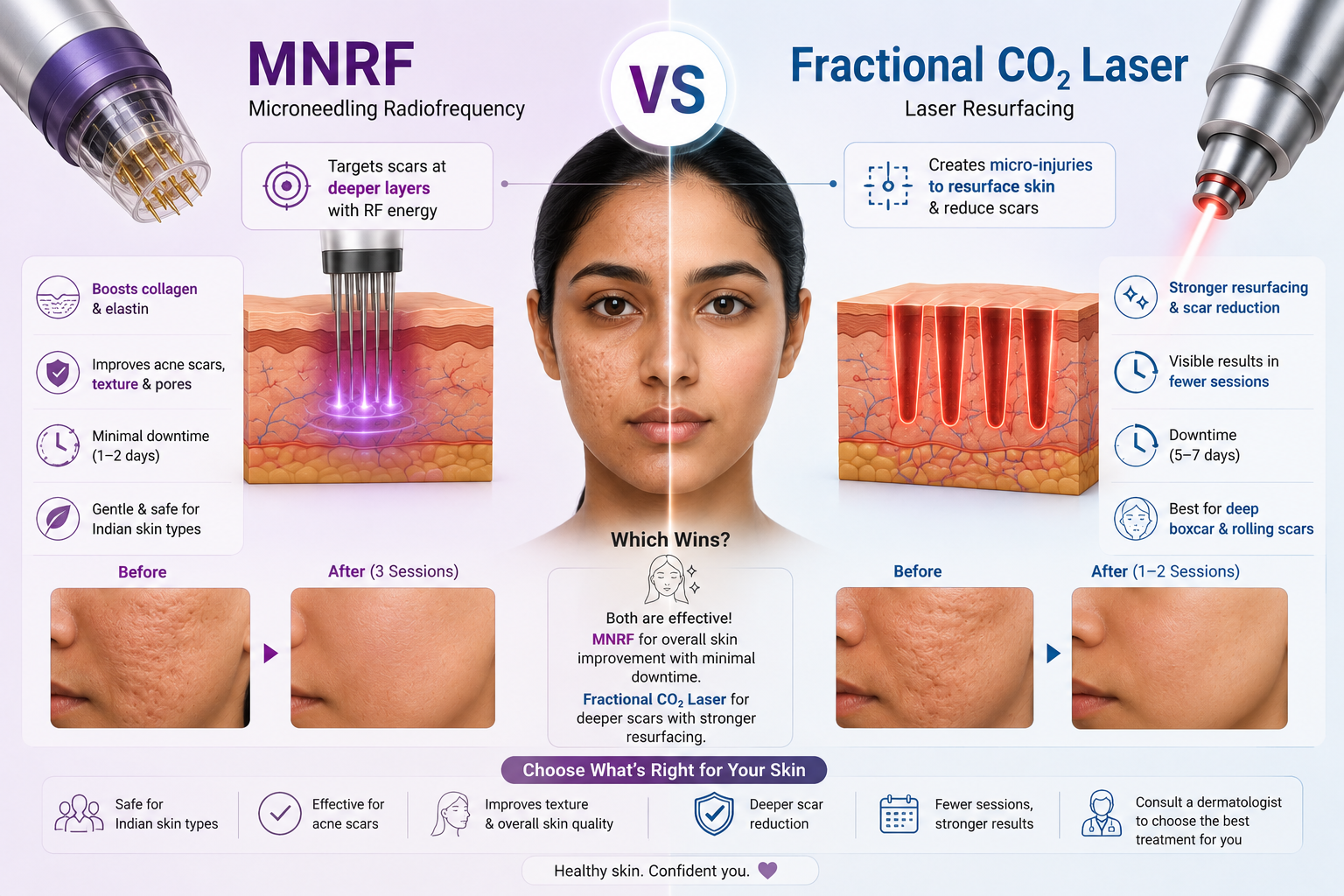
Dealing with active acne is frustrating enough, but the pitted scars and uneven texture left behind can linger long after breakouts clear up. If you have been researching procedural options to smooth out acne scars, you have likely come across two heavyweights in clinical dermatology: MNRF (Microneedling Radiofrequency) and Fractional CO2 Laser Resurfacing.
Both treatments rebuild skin from within by stimulating new collagen, but they work through completely different mechanisms.
For patients in India—where skin tones typically fall under Fitzpatrick Types III to V—choosing the wrong technology can mean prolonged redness, hyperpigmentation (dark spots), or uncomfortable downtime.
Below, Dr. Ayesha Faizan, leading dermatologist in Raipur, breaks down the medical differences between MNRF and Fractional CO2 Laser so you can make an informed choice for your skin.
Understanding Your Acne Scars First
Our trusted and experienced dermatologist in Raipur rarely relies on a single device for complete scar correction. Real acne scars are usually a mix of different depths and types.
Rolling Scars: These are wide shallow depressions with smooth sloping edges. They make the skin look wavy and uneven when seen in light.
Boxcar Scars: These are oval depressions with steep clearly defined edges. They are similar to the chickenpox scars.
Ice-Pick Scars: These are narrow pin-like holes that go into the deeper layers of the skin.
Since these scars form, inside the skin surface creams and salon facials cannot fix them. Medical-grade collagen remodeling is needed.
1. What is Microneedling Radiofrequency (MNRF)?
MNRF combines ultra-fine, gold-plated microneedles with controlled radiofrequency heat energy.
During the procedure, microscopic needles gently penetrate the skin to a precisely set depth (ranging from 0.5 mm to 3.5 mm). Once the needles are inside the dermal layer, thermal radiofrequency energy is delivered directly into the deep tissue, completely sparing the top surface of the skin (epidermis).
Why MNRF is really good for skin:
Epidermal Safety
Because the heat is delivered below the surface, the melanin-rich top layer of Indian skin remains largely undisturbed.
Near-Zero Risk of PIH
Post-Inflammatory Hyperpigmentation (PIH)—the dark patches that often form after skin trauma—is extremely rare with MNRF.
Minimal Downtime
When people get this treatment they usually have some redness on their skin for a day or two like 24 to 48 hours. This redness is not really bad, it is pretty mild. So people can go back to their work routines really quickly. The Minimal Downtime is a plus because people do not have to take a lot of time off from work. They can get the treatment. Then go back to their normal life like doing their job in a short amount of time. The Minimal Downtime is what makes this treatment so great, for people who have lives.
Target Concerns
Target concerns are things like rolling scars, boxcar scars that are not too deep pores on the face and skin that is a little loose. The target concerns include rolling scars and mild to boxcar scars and also enlarged facial pores and mild skin laxity. Target concerns are issues such as rolling scars.
What is Fractional CO2 Laser Resurfacing?
Fractional CO2 Laser is a resurfacing treatment. It sends columns of concentrated laser energy into the skin vaporizing tiny areas of damaged tissue while leaving surrounding microscopic islands untouched to help healing happen faster.
As the small wounds heal, new smooth surface skin grows on top while major collagen rebuilding takes place underneath.
Pros & Considerations for Indian Skin:
High Resurfacing Power: It provides dramatic smoothing of superficial skin texture irregularities and sharp-edged boxcar scars.
Requires Expert Calibration: Because CO2 lasers create surface heat, treated Indian skin is at a higher risk of developing temporary dark spots (PIH) if energy settings are not carefully calibrated by a qualified dermatologist.
Longer Downtime: Expect 5 to 7 days of peeling, scabbing, and redness. Strict sun protection post-treatment is mandatory.
Side-by-Side Comparison: MNRF vs. Fractional CO2 Laser
The Verdict: Which Treatment Wins for Your Skin?
There is no universal "winner"—the best acne treatment depends entirely on your specific scar pattern, lifestyle, and skin type:
Choose MNRF if:
-
You have a medium to dark Indian skin tone and want to eliminate the risk of post-treatment dark spots.
-
You cannot afford 5+ days of visible peeling or taking time off work.
-
Your main concern is rolling scars, pitted texture, or open pores.
Choose Fractional CO2 Laser if:
-
You have shallow boxcar scars or severe surface roughness.
-
You can commit to 5–7 days of indoor recovery and strict sun protection.
-
Your treatment is monitored and performed directly by an experienced dermatologist.
The Dermatologist's Approach: Why Combination Therapy Works Best
At our clinic, when patients consult our team for advanced skin treatments, Dr. Ayesha Faizan rarely relies on a single device for complete scar correction. Real acne scars are usually a mix of different depths and types.
We use these methods to fix types of scars:
* Subcision is used to help with deep scars that are being pulled down by fibrous bands.
* MNRF is used to build up collagen in the skin, which is important for people with Indian skin tones.
* TCA CROSS is used to target narrow scars that look like ice picks.
* Targeted Peels or Laser Toning are used to get rid of marks that are left on the skin after acne. Dr. Ayesha Faizan and her team at the Raipur clinic use these methods to help people with acne scars. The 360° Combination Protocols are customized to help each person get the results.
Want to get rid of acne scars and have skin?
Acne scars can really hurt your confidence. The thing is, every person has skin so you need a doctor to look at your skin and tell you what to do, not just some standard treatment.
You should go see Dr. Ayesha Faizan and get your skin checked. She can help you figure out what is going on with your skin.
You can find Dr. Ayesha Faizan at her clinic in Civil Lines across from Vrindavan Hall, in Raipur, Chhattisgarh.
You can also visit her website at dermatologistinraipur.in to learn more about Dr. Ayesha Faizan and what she can do for your skin.

 English
 Arabic
 French
 Spanish
 Portuguese
 Turkish
 Dutch
Dutch
 Italiano
 Russian
 Romaian
 Portuguese (Brazil)
 Greek
Greek
