


Bridal Jewellery That Reflects Your Personality, Not Just the Trends
Most bridal jewellery advice tells you what's trending this season. Almost none of it asks what you're actually drawn to, or where that comes from. Trend-driven jewellery dates fast. Jewellery chosen because it genuinely reflects you, your taste and your family's background, doesn't.
What actually shapes someone's bridal jewellery style?
Three things, usually in conflict with each other: personal taste, family or community heritage, and whatever's trending the year you're getting married. Most brides default to the third one because it's the easiest to find on Instagram. The first two take more work to figure out, which is exactly why they produce a better result.
How does cultural heritage actually show up in jewellery choice, not just in theory?
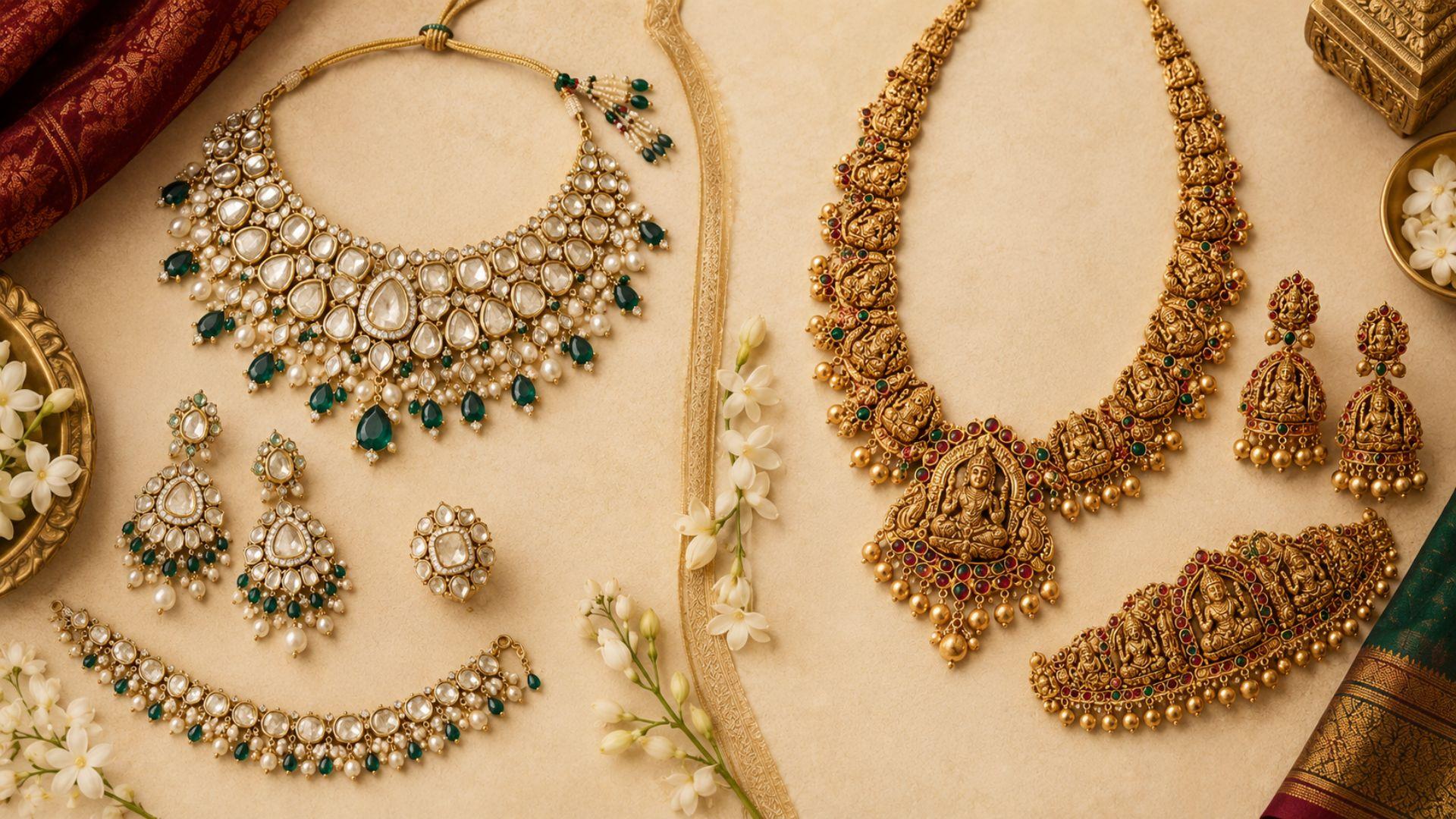
Concretely, not vaguely. Polki and Kundan jewellery trace back to Rajput and Mughal royal courts, with Jaipur and Bikaner still the main craft hubs today, and it remains strongly associated with North Indian bridal style. Temple jewellery comes from a different lineage entirely, rooted in South Indian deity adornment and classical dance tradition across Tamil Nadu, Karnataka, Andhra Pradesh and Kerala.
Neither is "more bridal" than the other. They come from different places, which is exactly why a bride from a Tamil family and a bride from a Rajasthani family can both be dressing traditionally while wearing jewellery that looks nothing alike.
This matters more than it used to. Intercommunity marriages and diaspora weddings mean a lot of brides are now choosing between their own family's tradition, their partner's family's tradition, or something that blends both. Temple jewellery in particular is harder to source outside India compared to Polki, which matters if you're planning this from abroad.
Should you stick to your own family's tradition, or can you mix?
You can mix. Plenty of brides already do, and a mixed set doesn't automatically look inconsistent if the metal tone and formality level stay coherent across pieces. What doesn't work is picking one piece from each tradition with no connecting thread, then hoping it reads as "eclectic" instead of "unplanned." If you want to combine traditions, decide on a dominant one and treat the other as an accent, not an equal split.
What if you don't actually know your own style yet?
Most brides don't, not with any precision, until someone asks the right questions. Before a styling session, worth figuring out for yourself:
- What jewellery have you already worn and genuinely loved, not just complimented on?
- Is there a family piece you want to include, rework, or build the rest of your look around?
- If your family and your partner's family come from different regions, whose tradition are you leaning toward, or are you blending?
- When you picture your wedding photos years from now, does the jewellery feel like you, or like whatever was popular the year you got married?
That last question does most of the work. Jewellery chosen purely on trend tends to feel dated within a few years. Jewellery chosen because it means something to you doesn't age the same way.
Where does this fit into an actual consultation?
This is the "style discovery" part specifically, not the whole process. It happens early, usually right after the first discovery call about your events and budget, and before the physical measurements get taken (face shape, undertone, that kind of thing, that's a separate step called style ID mapping). Getting the personality and heritage question answered first is what makes the rest of the process, shortlisting, try-ons, final picks, actually fit who you are instead of just fitting the brief.
If your family's background runs toward Polki, Kundan or a specific regional set you're not sure how to work with, that's worth sorting out before you start shortlisting anything.
Shaadinama's free 1:1 styling session starts with exactly this conversation, what you're drawn to and where it comes from, before anything gets shortlisted by function or budget.

 English
 Arabic
 French
 Spanish
 Portuguese
 Deutsch
 Turkish
 Italiano
 Russian
 Romaian
 Portuguese (Brazil)
 Greek
Greek
