


From Connected to Intelligent: How AI Is Reshaping IoT Connectivity Management Platforms in 2026
A logistics company tracks 200,000 sensors across trucks, containers, and warehouses. The SIMs are active and the devices are online. Yet leaders still ask the same question: what do we do with all this data? Connectivity got the devices talking. It did not turn their conversations into decisions.
This is where the IoT Connectivity Management Platform is changing. Once a tool for activating SIMs and watching data usage, it is becoming the foundation for building and running AI-powered IoT applications. For CXOs and IT leaders, the question has shifted from "Can we connect our devices?" to "How fast can we turn device data into business outcomes?"
Click Here For More Information: https://qksgroup.com/market-research/qks-ai-maturity-matrix-leveraging-ai-in-iot-cmp-for-accelerated-application-development-and-deployment-2026-10515
Market Overview: From Managing SIMs to Enabling Intelligence
QKS Group defines an IoT Connectivity Management Platform (CMP) as a centralized system that manages device connectivity across cellular, Wi-Fi, LPWAN, and satellite networks. It lets enterprises deploy, monitor, and control devices with real-time visibility into performance, data usage, and network status.
Core capabilities include:
- Device provisioning and SIM lifecycle management
- Network diagnostics and performance monitoring
- Security controls and policy enforcement
- Automatic network selection that respects regulatory and geographic constraints
- Support for diverse communication protocols
- Analytics and AI-driven insights
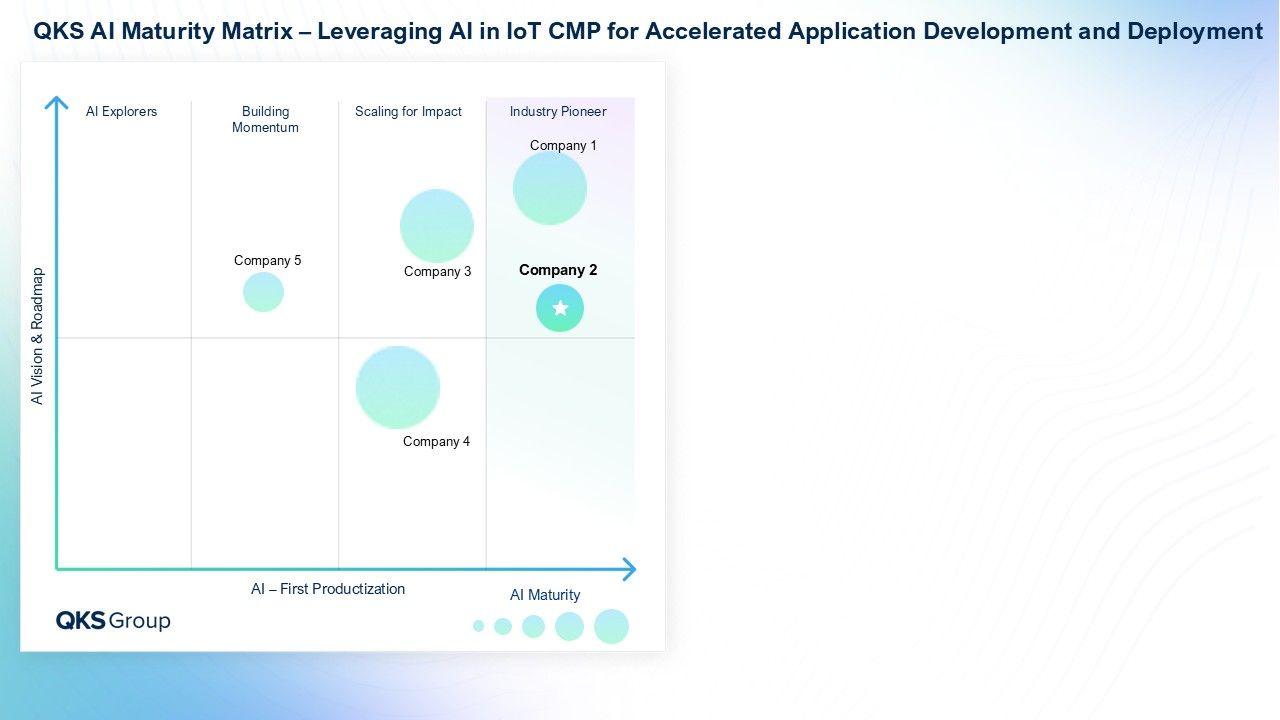
Adoption now spans manufacturing, logistics, utilities, transportation, retail, healthcare, and smart infrastructure. As deployments grow, so does the volume and complexity of data. QKS Group's AI Maturity Matrix™ evaluates vendors such as AT&T, Orange Business, Soracom, Verizon, and Vodafone on how deeply AI is built into their platforms, not just how often it appears in a press release.
Key Challenges Businesses Face
Scaling IoT is harder than launching a pilot. Common obstacles include:
- Connectivity without insight. Platforms keep devices online but leave data analysis to other tools.
- Fragmented technology stacks. Connectivity, data, analytics, and application layers often come from different vendors.
- AI skills shortages. Few enterprises have data scientists and engineers to build custom models for every use case.
- Complex integration. Connecting device data to business systems takes months of effort.
- Global compliance. Roaming rules, data residency, and local regulations vary by country.
- Security exposure. Every added device widens the attack surface.
- Slow time to value. Long development cycles delay returns on IoT investments.
Key Trends and Innovations
Generative AI inside the platform. Instead of writing code for every dashboard or rule, teams describe what they need and the platform helps build it.
Natural language analytics. Operations managers can ask questions about fleet performance, data usage, or connectivity issues in plain language and get answers without a data analyst.
Low-code development. Visual tools let engineers and business teams assemble IoT applications faster, with less custom coding.
Intelligent orchestration. AI selects the best network, flags anomalies, and automates workflows such as SIM switching or policy changes.
Predictive connectivity. Models anticipate network failures, abnormal usage, and device issues before they disrupt operations.
Cloud-native architecture. Elastic scalability supports millions of devices across regions.
Embedded governance. Responsible AI controls, audit trails, and access policies are becoming part of the platform design.
Benefits and Business Impact
When AI is truly embedded, the returns show up quickly:
- Faster application development. Teams move from idea to deployment in weeks instead of months.
- Higher developer productivity. Generative tools and low-code environments reduce repetitive work.
- Lower connectivity costs. Smart network selection and usage analytics reduce waste and overage charges.
- Improved reliability. Predictive insights cut downtime and support calls.
- Stronger security. Automated policy enforcement and anomaly detection protect devices at scale.
- Business agility. Enterprises can launch new connected services without rebuilding the stack.
Real-World Use Cases
Fleet and logistics. A transport operator uses AI-driven analytics to spot connectivity drops in cold-chain trailers and reroute data through an alternate network, protecting shipment integrity.
Utilities. A utility monitors thousands of smart meters across regions. The platform detects abnormal data patterns and flags faults before outages spread.
Manufacturing. A factory group builds a predictive maintenance app using low-code tools, combining device connectivity data with machine telemetry.
Healthcare. A provider managing remote patient monitoring devices relies on policy controls and compliance features to keep data secure and connectivity stable.
Retail. A chain manages point-of-sale terminals and smart shelves worldwide, using natural language queries to troubleshoot store-level issues quickly.
How to Choose the Right Solution
Look past feature lists and ask how much intelligence is truly built into the platform. Consider these criteria:
- AI-first strategy. Is AI central to the product roadmap, or added as an afterthought?
- Native Generative AI. Check what is available today and in production.
- Workflow automation. Assess how much operational work the platform handles on its own.
- Developer experience. Look for low-code tools, APIs, and quick onboarding.
- IoT data intelligence. Evaluate how well device telemetry becomes usable insight.
- Deployment readiness. Confirm global coverage, scalability, and integration options.
- Governance. Ask about security, transparency, and responsible AI controls.
- Market adoption. Customer references and real deployments matter more than promises.
QKS Group's AI Maturity Matrix™ offers an independent lens on these dimensions, helping buyers shortlist vendors with more confidence.
Future Outlook (2025–2028)
Over the next few years, connectivity will become a baseline expectation. Differentiation will come from intelligence. Expect AI copilots to guide platform administration, agent-based automation to handle routine network operations, and low-code tools to become standard.
Enterprises will also demand tighter governance as AI touches more operational decisions. Vendors that embed intelligence deeply, prove it with customer outcomes, and keep integration simple will lead the market. Those relying on connectivity alone will struggle to justify their value.
Download Sample Report Here: https://qksgroup.com/download-sample-form/qks-ai-maturity-matrix-leveraging-ai-in-iot-cmp-for-accelerated-application-development-and-deployment-2026-10515
Conclusion
IoT success is no longer measured by how many devices are connected. It is measured by how quickly connected data becomes action. A modern IoT Connectivity Management Platform with embedded AI shortens development cycles, improves reliability, and helps enterprises scale with control.
For technology leaders, the path forward is practical. Audit your current connectivity stack, identify where manual effort and fragmentation slow you down, and evaluate vendors on real AI maturity. QKS Group's AI Maturity Matrix™ is a strong place to start.

 English
 Arabic
 Spanish
 Portuguese
 Deutsch
 Turkish
 Dutch
Dutch
 Italiano
 Russian
 Romaian
 Portuguese (Brazil)
 Greek
Greek
