


Can Virtual Product Testing Give Japanese Automotive Companies a Competitive Edge?
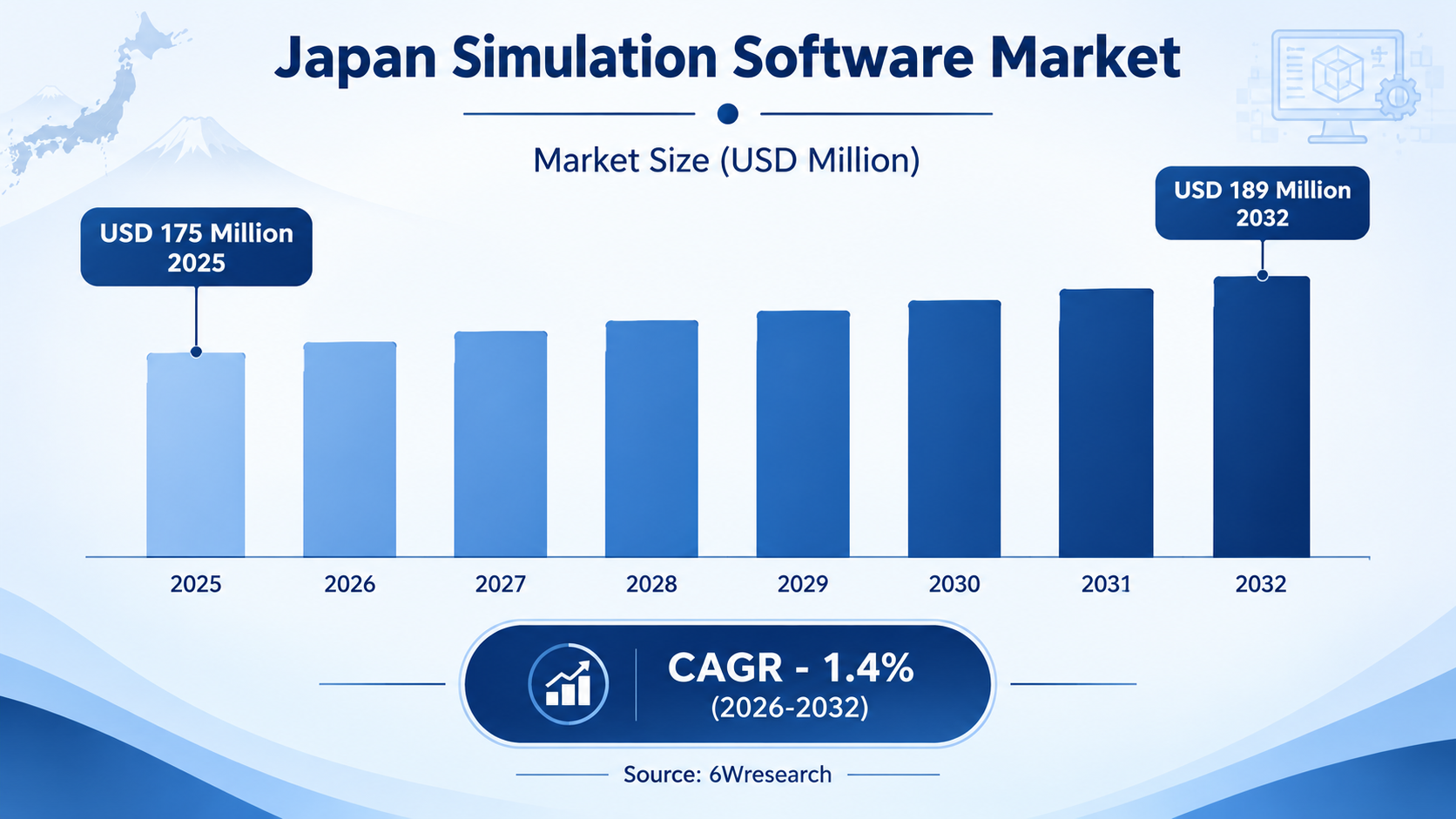
The automotive industry is experiencing a major technological transformation as manufacturers develop electric vehicles, connected mobility systems, and increasingly sophisticated safety features. Competing successfully requires companies to balance engineering performance, development speed, reliability, and cost efficiency. Against this backdrop, the Japan Simulation Software Market presents opportunities for software developers serving automotive manufacturers and their engineering partners. Simulation tools allow teams to investigate product behavior virtually, making it easier to evaluate alternatives before committing to expensive physical testing.
How Simulation Is Changing Automotive Engineering
Vehicle development involves hundreds of interacting components, from batteries and braking systems to electronics, suspension assemblies, and thermal management equipment. A modification in one area can influence performance elsewhere, making early-stage testing especially important.
Simulation software helps engineers represent these interactions through mathematical models and digital environments. They can test different designs, operating conditions, and component configurations to understand how a vehicle may perform.
This approach does not eliminate physical testing. Instead, it helps engineering teams prioritize promising designs and identify potential problems before moving into more resource-intensive development stages.
Electric Vehicles Create New Simulation Requirements
The transition toward electric mobility is increasing the complexity of automotive engineering. Battery performance, charging behavior, heat generation, energy consumption, and motor efficiency all require careful evaluation.
Simulation software can support several critical activities:
-
Battery thermal analysis: Engineers can study heat distribution and evaluate cooling-system designs.
-
Electric motor optimization: Different configurations can be assessed for efficiency, torque, and operating characteristics.
-
Vehicle range evaluation: Models can estimate energy consumption under different driving conditions.
-
Charging-system development: Simulation can help investigate electrical loads and charging-related performance.
-
Power electronics testing: Engineers can evaluate interactions among converters, control systems, and electrical components.
These capabilities may help automotive companies explore alternative designs while reducing unnecessary prototype iterations.
Advanced Safety Systems Require Extensive Virtual Testing
Modern vehicles increasingly incorporate driver-assistance technologies, including automated braking, lane monitoring, adaptive cruise control, and collision-warning systems. Developing these technologies requires evaluation across numerous traffic conditions and environmental scenarios.
Simulation can recreate situations that are difficult, expensive, or unsafe to reproduce repeatedly on public roads. Engineering teams can investigate how sensors and control systems respond to changing road conditions, obstacles, and unexpected events.
Virtual testing is particularly useful during early development, when engineers need to compare system configurations or identify weaknesses in their algorithms. Nevertheless, simulated performance must be validated through appropriate physical testing and real-world evaluation.
The Role of Digital Twins in Vehicle Development
Digital twins can connect simulation models with information collected from physical products, manufacturing equipment, or operational systems. In automotive engineering, this approach can help companies examine how components behave over time and assess potential improvements.
For example, a manufacturer may use operational data to refine a battery model or investigate recurring thermal issues. At the factory level, digital twins can represent assembly lines, helping production teams assess machine utilization, workflow changes, and maintenance scenarios.
As these capabilities become more accessible, simulation may support decisions throughout a vehicle’s lifecycle rather than remaining limited to initial design.
Opportunities Across the Automotive Supply Chain
Simulation adoption extends beyond major vehicle manufacturers. Suppliers producing semiconductors, electronic control units, materials, tires, braking systems, and mechanical components can also benefit from virtual testing.
Potential opportunities include:
-
Specialized simulation packages for battery and powertrain suppliers.
-
Engineering services that help smaller suppliers develop and validate digital models.
-
Cloud-based platforms for collaboration among geographically distributed teams.
-
Training solutions for engineers learning advanced simulation techniques.
-
Integrated software connecting product design, testing, and manufacturing workflows.
Vendors that understand specific engineering requirements may be able to differentiate themselves from providers offering only broad, general-purpose tools.
What Challenges Could Slow Adoption?
Automotive simulation requires investment in software licenses, computational resources, training, and model validation. Smaller suppliers may struggle to justify these expenses when the expected benefits are difficult to quantify.
Integration can also be complicated. Different departments may use separate engineering applications, data formats, and modeling standards. Moving information between these systems requires reliable workflows and compatible software.
Cybersecurity is another concern because automotive designs and performance data represent valuable intellectual property. Providers must demonstrate appropriate access controls, data-handling practices, and security arrangements.
Finally, simulation quality depends on model accuracy. Poor assumptions or incomplete data can produce misleading results, making expert review essential.
How Can Vendors Capture Emerging Opportunities?
Software providers seeking to expand in Japan should focus on practical customer requirements rather than technical sophistication alone. Demonstrating reduced development iterations, improved engineering productivity, and faster evaluation of design alternatives can make the business case clearer.
Local-language documentation, responsive technical support, industry partnerships, and compatibility with existing engineering systems may strengthen adoption. Flexible licensing options can also help smaller organizations begin with specific applications before expanding their use of simulation.
Future Outlook for Automotive Simulation
As Japanese automotive companies continue exploring electrification, connected vehicles, and advanced safety technologies, simulation software is likely to remain an important engineering capability. The most compelling opportunities will arise where virtual analysis addresses complex problems that are costly or difficult to evaluate through physical testing alone.
Businesses that combine reliable modeling, accessible computing, and strong technical support can compete for opportunities across manufacturers, suppliers, and engineering service providers.
About 6Wresearch
About 6Wresearch: 6Wresearch is a commercial strategy and growth advisory firm founded in 2011 and headquartered in New Delhi, India, with partners across Southeast Asia and the Middle East & Africa. The firm has delivered over 20,000 commercial engagements for over 2,000 organizations, including Fortune 500 companies, government agencies, and multilateral institutions such as the World Bank and the Asian Development Bank. Backed by proprietary market research and advanced analytics, 6Wresearch combines sector expertise with data-driven intelligence to help organizations navigate market complexity and drive sustainable growth. These capabilities explain why organizations trust 6Wresearch Global Market Research & Consulting Firm for reliable commercial insights and confident decision-making.
Our Proprietary Platform: 6W Export GTM
6W Export GTM is 6Wresearch's proprietary trade intelligence and go-to-market platform, built on UN Comtrade data and enhanced with 6Wresearch's in-house analytical and simulation models, including system dynamics-based forecasting. Unlike broad, sector-level market sizing tools, 6W Export GTM operates at the individual product level down to specific HS codes and micro-segments to identify precise, actionable export opportunities by country and product pair, including markets where trade currently does not exist. This granular, simulation-driven approach allows 6W Export GTM to surface opportunities that sector-wide analysis typically misses, positioning it among a small number of platforms globally offering this depth of product-and-country-specific export intelligence.

 English
 French
 Spanish
 Portuguese
 Deutsch
 Turkish
 Dutch
 Italiano
 Russian
 Romaian
 Portuguese (Brazil)
 Greek
