


Cross-Border Payments: How Businesses Can Manage Currency and Settlement Challenges
Excerpt
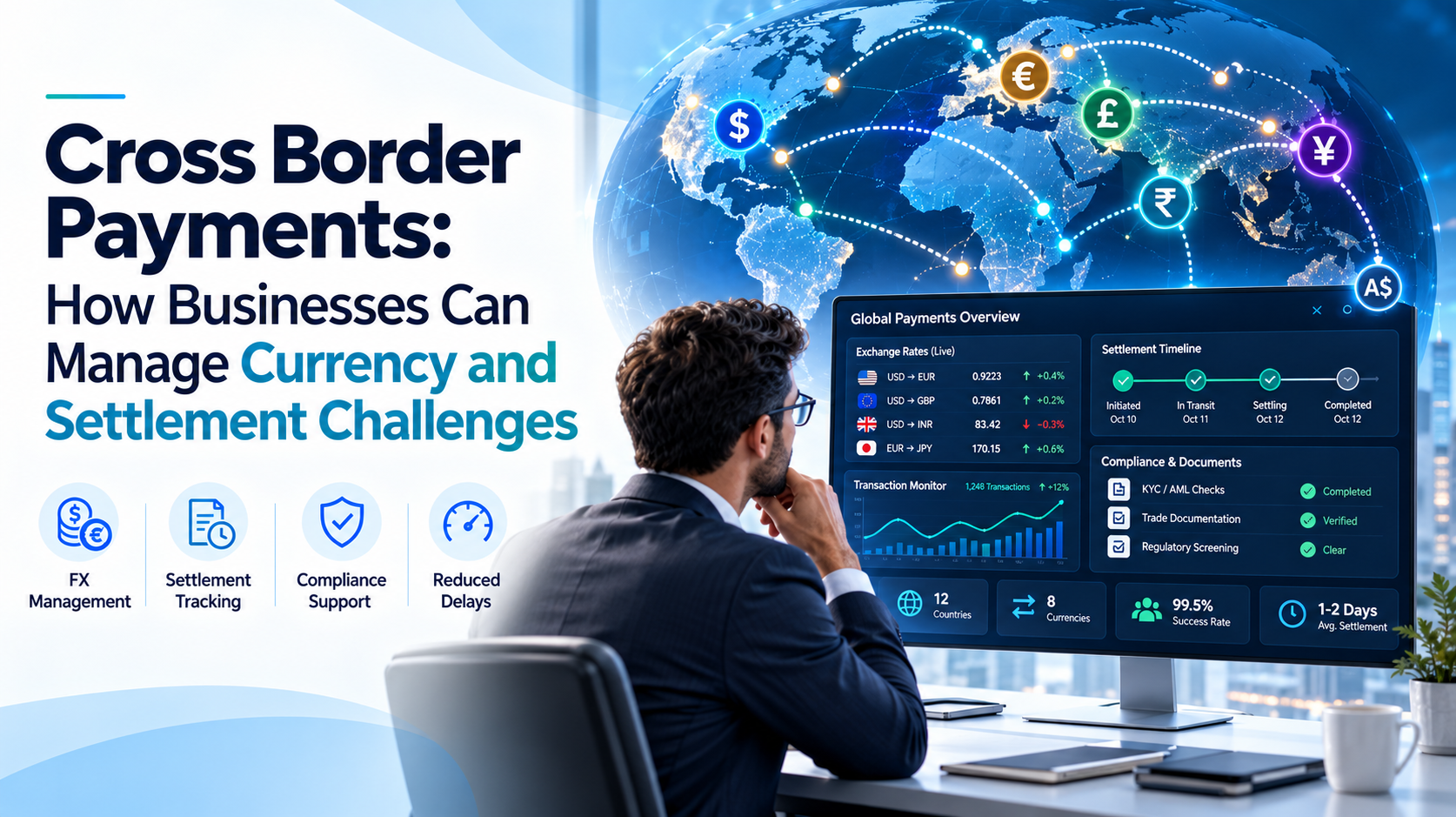
International transactions introduce additional challenges involving currencies, conversion, settlement times, and payment tracking.
Businesses need reliable cross border payments infrastructure to manage these complexities without creating unnecessary operational friction.
A structured payment strategy can help companies improve predictability, financial visibility, and control as they expand globally.
Introduction
International expansion gives businesses access to new customers, suppliers, partners, and markets. However, the financial side of global operations is often more complicated than domestic business activity.
A company may invoice customers in one currency, pay suppliers in another, and maintain accounting records in its home currency.
Currency conversion is only one challenge.
Businesses must also manage settlement timelines, transaction fees, reconciliation, payment tracking, and different banking environments.
Reliable cross border payments infrastructure can help businesses manage these factors more efficiently.
By selecting appropriate payment solutions, companies can create more predictable international transaction processes and reduce the operational workload associated with global payments.
Why Cross-Border Payments Are More Complex
Domestic payments usually operate within a single financial ecosystem.
International transactions may involve different currencies, banking networks, payment providers, regulations, and settlement processes.
This can create challenges involving:
-
Currency conversion
-
Exchange-rate movement
-
Settlement delays
-
Transaction costs
-
Payment tracking
-
Reconciliation
-
Regulatory requirements
Companies should understand these issues before scaling international operations.
A suitable business payment solution can help organize the payment process and provide greater visibility into transaction activity.
Understanding Currency Challenges
Currency is one of the most obvious complications in international business.
Suppose a company sells services to customers in several countries. Customers may prefer to pay using their local currencies, while the company may want to receive settlements in another currency.
Conversion can affect the final amount the business receives.
Exchange rates can also change between the invoice date and settlement date.
Businesses should therefore understand:
-
Which currencies they can accept
-
Which currencies they can settle in
-
When conversion takes place
-
How conversion costs are calculated
-
How currency information appears in reporting
Clear policies reduce uncertainty and help finance teams plan more effectively.
Multi-Currency Payment Capabilities
Companies operating internationally may benefit from payment systems that support multiple currencies.
Multi-currency capabilities can make transactions more convenient for customers and business partners.
They may also reduce unnecessary complexity when a company expands into additional countries.
However, businesses should not assume that every currency arrangement works the same way.
They should review supported currencies, settlement options, applicable charges, and operational requirements with the provider.
Settlement Timing and Cash Flow
Settlement timing is another major consideration in business payments.
A customer may complete a payment today, but that does not always mean the funds become immediately available to the business.
Settlement schedules can affect working capital.
Businesses need sufficient cash to pay:
-
Employees
-
Suppliers
-
Logistics providers
-
Marketing expenses
-
Taxes
-
Technology costs
-
Other operational expenses
If international settlements are unpredictable, cash-flow planning becomes more difficult.
Companies should understand expected settlement timelines before selecting a payment provider.
Why Settlement Visibility Matters
Knowing when money will arrive can be almost as important as knowing how much money will arrive.
A business should ideally have access to information about:
-
Transaction completion
-
Settlement processing
-
Expected settlement dates
-
Settlement currency
-
Fees or adjustments
-
Failed or delayed payments
Better visibility helps finance teams forecast available cash more accurately.
Modern payment solutions can support this process through organized reporting and transaction status information.
Managing B2B Cross Border Payments
International supplier and partner transactions have additional requirements.
B2b cross border payments may involve larger payment amounts, detailed invoices, contractual terms, and strict payment schedules.
Businesses need to know whether payments have been processed correctly and whether suppliers have received the expected amount.
Efficient B2B payment management can improve relationships with:
-
Manufacturers
-
Distributors
-
Consultants
-
Technology vendors
-
Logistics providers
-
International service companies
Predictable payments can strengthen supplier trust and reduce unnecessary communication around outstanding invoices.
Using Pay-in Services for International Collections
Collecting money internationally can be as challenging as sending it.
Structured Pay-in services help businesses organize incoming transactions across supported digital payment channels.
For growing companies, Pay-in capabilities can contribute to:
-
Faster customer collections
-
Improved payment tracking
-
Better transaction records
-
More efficient reconciliation
-
Greater cash-flow visibility
Businesses should evaluate available collection methods based on the markets they serve.
Online Payment Solutions for International Customers
Payment preferences vary across markets.
A payment method that is widely used in one country may be less common elsewhere.
Businesses entering new regions should understand how their customers prefer to pay.
Flexible online payment solutions can allow companies to provide payment experiences that align more closely with local expectations.
Reducing payment friction can support transaction completion and improve the overall customer experience.
Reducing Reconciliation Complexity
Currency conversion and international settlement can make reconciliation more difficult.
The invoiced amount, customer payment amount, and final settlement amount may not always appear identical because of currency conversion or applicable fees.
Finance teams need sufficiently detailed transaction records to understand these differences.
A structured payment system can provide payment references that help businesses match transactions with orders or invoices.
This reduces manual investigation and improves accounting accuracy.
Evaluating the True Cost of International Payments
Businesses should not evaluate international payment providers only by looking at one advertised fee.
The total cost may include several elements.
Companies should review:
-
Transaction fees
-
Currency conversion costs
-
Settlement charges
-
Platform charges
-
Integration costs
-
Other applicable service fees
Understanding the full cost allows businesses to compare payment solutions more accurately.
It also helps management understand how payment costs affect margins.
Automation and International Payments
Automation can reduce some of the administrative work associated with global payments.
For example, businesses may automate:
-
Transaction recording
-
Payment confirmation
-
Reconciliation
-
Financial reporting
-
Customer notifications
Automation becomes increasingly valuable as transaction volumes increase.
A scalable business payment solution should support efficient workflows rather than forcing finance teams to manage every transaction manually.
How Uniteller Can Be Evaluated
Businesses considering providers such as Uniteller should evaluate capabilities against their own operational requirements.
Important questions may include:
-
Which markets are supported?
-
Which currencies can be processed?
-
What settlement options are available?
-
What reporting capabilities are provided?
-
How are transactions tracked?
-
Which integration options are available?
Provider selection should always be based on the company's payment flows and target markets rather than brand recognition alone.
Building a Cross-Border Payment Strategy
Businesses can make international payments easier to manage by creating a defined payment strategy.
The strategy should cover:
-
Target markets
-
Required currencies
-
Payment methods
-
Expected transaction volume
-
Settlement requirements
-
Reporting and reconciliation
-
Supplier and partner payments
-
Customer collection requirements
This gives businesses a clearer framework for evaluating payment infrastructure.
Conclusion
Currency and settlement challenges are a natural part of international business, but they do not need to create excessive operational complexity.
Reliable cross border payments infrastructure can help businesses manage currency differences, improve settlement visibility, and create more predictable financial workflows.
Efficient business payments, b2b cross border payments, online payment solutions, and structured Pay-in services can support both collections and outgoing transactions.
When choosing a business payment solution, companies should evaluate currency support, settlement processes, reporting, security, scalability, and total costs.
Businesses considering providers such as Uniteller should focus on selecting payment infrastructure that supports efficient international operations today while remaining flexible enough for future growth.

 English
 Arabic
 French
 Spanish
 Portuguese
 Deutsch
 Turkish
 Dutch
 Italiano
 Russian
 Romaian
 Greek
