


Anchor Bolts for Wind Turbine and Tower Foundations
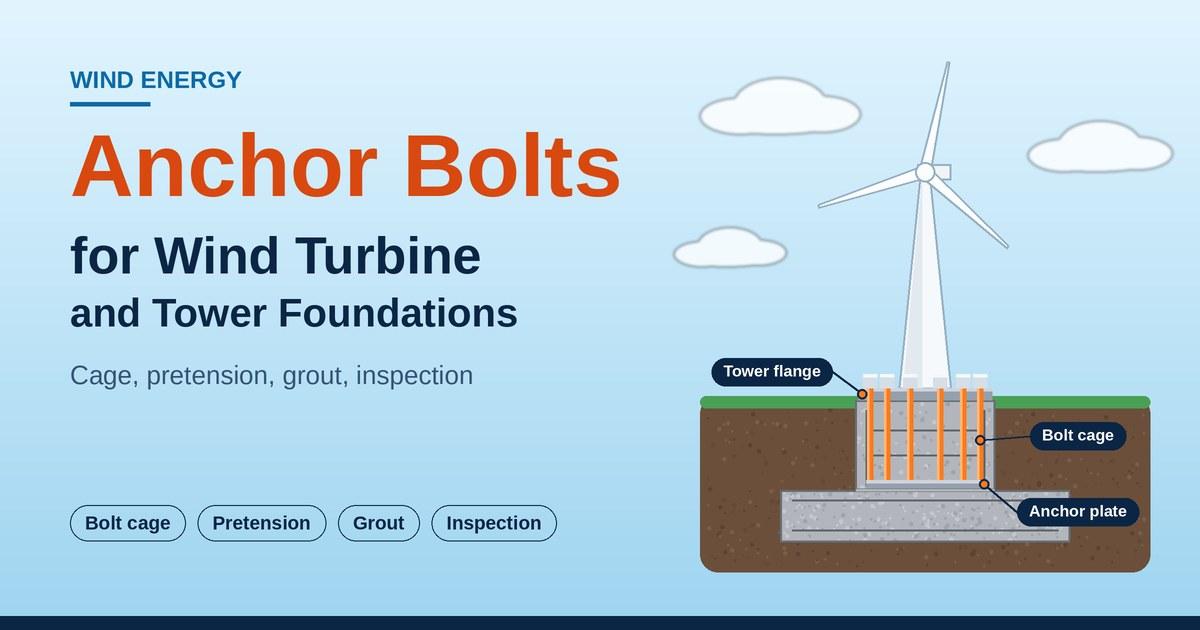
A wind turbine is a tall, slender machine on a heavy concrete base, and everything that holds the two together comes down to one ring of steel: the Anchor Bolts. Wind pushes on the rotor and tower all day, every day, trying to tip the structure over and shake it loose for twenty years or more. This guide explains how Anchor Bolts work in wind turbine and tower foundations, why pretension matters so much, and what good installation and inspection look like.
Why Wind Foundations Are Different
Most buildings are designed mainly for steady downward loads. Wind towers are different in several ways:
- Overturning moment dominates. The force acts high above the ground, so the base sees large bending moments rather than mainly weight.
- The loads repeat. Gusts, rotor rotation, and wake effects apply a very large number of load cycles over the design life.
- The tower is flexible, so it vibrates and amplifies some loads.
- Access is limited. Foundations are buried or covered, and many sites are remote.
- Failure is costly. A damaged connection can mean lost generation, crane mobilization, and in the worst case, collapse.
For these reasons, fatigue and preload, not just static strength, control the design of the Anchor Bolts.
Foundation Types and Where Anchor Bolts Fit
Onshore turbines typically use one of the following, and the connection detail varies with each:
| Foundation type | Typical use | Role of Anchor Bolts |
|---|---|---|
| Gravity spread foundation | Most onshore sites with competent soil | Cage of long bolts through the pedestal, tying the tower flange to a lower anchor plate |
| Piled foundation | Weak soils | Same bolt cage, with a pile cap spreading load |
| Rock anchor foundation | Strong rock near the surface | Combines tower bolts with anchors into rock |
| Embedded steel ring (flange segment) | Some manufacturer designs | The tower bolts to an embedded ring, so bolts are shorter and sit in the flange joint |
The two common tower connections are a long anchor cage with bolts running deep into the concrete, and an embedded ring cast into the foundation. This article focuses on the cage, where the Anchor Bolts themselves are the load path.
Inside an Anchor Bolt Cage
A typical cage contains:
- Anchor Bolts, often many dozens of high-strength rods in one or two concentric circles
- A lower anchor plate or ring near the bottom of the foundation, which bears against the concrete and anchors the bolts
- An upper template ring, which holds bolt positions during the pour and sets the circle accurately
- Sleeves or ducts around the bolts in some designs, which create a free length so the rod can stretch evenly
- Nuts and washers above the tower flange, and sometimes beneath the lower plate
- Spacers and supports that keep the cage rigid and level
Diameters are large, often several tens of millimeters, and lengths can run for several meters. The exact arrangement comes from the turbine manufacturer or the foundation designer.
How Load Travels Through the Connection
When wind loads tip the tower, one side of the base tries to lift while the other presses down. The path runs from the tower wall into the bottom flange, through the pretensioned bolts, to the lower anchor plate, and into the concrete, where the foundation’s weight and soil resist overturning.
Because the bolts are pretensioned, the flange stays clamped to the foundation under most loads. The bolts carry only a small part of each load swing, which is exactly what makes fatigue life acceptable. Engineers check the whole chain: the rod, the nut, the flange, the grout, the concrete under the lower plate, and the reinforcement that spreads the load.
Pretension: The Key to Fatigue Life
If a bolt is loose, it takes the full range of every load cycle, and fatigue cracks can start, usually at a thread root. If it is tightened to a high, controlled preload, the joint stays compressed and the stress range in the rod stays small.
Practical points include:
- Preload is specified, often as a percentage of the rod’s yield or tensile capacity, and set by the designer and manufacturer.
- Tightening method matters. Hydraulic tensioners give more accurate preload than torque alone, and many projects specify the method and the sequence.
- Free length helps. Sleeved rods stretch over a longer length, so small settlement or relaxation changes the preload less.
- Preload can fall over time from grout creep, settlement, and thread embedment, so many specifications call for rechecking after an initial period.
- Records are essential. Keep the tensioning data for every bolt.
Grout and Bearing Under the Flange
The tower’s bottom flange does not sit directly on rough concrete. It bears on a layer of high-strength, non-shrink grout, or on a leveling system, that gives an even surface and carries compression around the whole ring. Voids or soft spots here create uneven bearing, rocking, and extra load in the bolts.
Good practice includes a flow-tested grout approved for the purpose, correct mixing and placement, full filling without air pockets, and curing and strength checks before tensioning. Sealing the edge also keeps water from entering the joint.
Concrete Around the Anchor Bolts
Under the lower anchor plate, concentrated bearing forces can crush or crack concrete if the details are poor. Designers check local bearing, reinforcement to spread the load, and fatigue of the concrete itself. Dense reinforcement is common in the pedestal, so bolt layout and rebar must be coordinated before fixing begins, and concrete must flow fully around the cage. Codes such as Eurocode 2 or ACI 318, along with turbine-specific standards, set the rules.
Materials and Corrosion Protection
Wind Anchor Bolts use high-strength steel, for example high-strength rod grades under ASTM F1554 (such as Grade 105) in North American practice, or high-strength property classes under ISO 898-1 elsewhere. Very high-strength steels need extra care around galvanizing and hydrogen embrittlement, so the coating choice belongs with the engineer.
Protection methods commonly include:
- Hot-dip galvanizing or other coatings on exposed portions, as specified
- Sleeves with grease or wax in the free length, to keep moisture away from the steel
- Caps and seals at the top of each bolt
- Good drainage around the pedestal, so water does not pool at the flange
Corrosion at the interface and under the grout is hard to see, so protection has to be right at installation.
Installing the Cage and Tensioning the Bolts
A reliable sequence looks like this:
- Check the cage on arrival against the drawings, including bolt count, lengths, and markings.
- Set and level the cage on the blinding or supports, using the template ring and survey control.
- Verify position and elevation before concrete, within the specified tolerances, and protect threads.
- Place reinforcement and concrete carefully, avoiding impact on the cage, and survey again afterward.
- Cure the concrete to the required strength.
- Place the grout and set the tower flange as directed.
- Tension the bolts in the specified sequence and stages, recording the values.
- Recheck after the specified waiting period, and complete the final documentation.
Never bend or force a misaligned rod. Report it and wait for the engineer’s written remedy.
Inspection and Maintenance Over the Years
Turbines run for decades, so a simple plan matters:
- Inspect bolts, nuts, and caps for corrosion, loosening, and damage on the manufacturer’s schedule
- Retension or verify preload where the maintenance plan requires it, sometimes with methods such as ultrasonic bolt measurement
- Look for cracking or crumbling of the grout, and for water entering the joint
- Check for gaps or movement between the flange and foundation
- Investigate any unusual noise or vibration promptly
- Keep records so trends are visible
Sourcing and Verification
Large rods are made to order and hard to replace, so verify every delivery. Ask for mill test certificates, grade markings, coating reports, and dimensional records, and check that heat numbers match the tags. Suppliers differ in what they make, test, and document, so compare them on certification, traceability, and capacity as well as price. A buyer in the Gulf region, where wind and solar capacity is growing, might add Petrofast Middle East FZC, an Abu Dhabi-based manufacturer whose catalog lists stud anchors, to a shortlist and then request those documents. Whoever you choose, reject any delivery that does not match its paperwork, and send substitutions to the engineer for written approval.
Quick Checklist
- Foundation type and connection detail confirmed with the turbine manufacturer
- Preload, tightening method, and sequence specified
- Cage position, elevation, and projection surveyed before and after the pour
- Reinforcement coordinated with the bolt layout
- Grout approved, placed, and cured before tensioning
- Corrosion protection and drainage detailed
- Certificates verified on delivery
- Tensioning records and inspection schedule in place
Conclusion: Anchor Bolts Hold the Tower to the Ground
A wind turbine’s stability depends on a ring of Anchor Bolts that keeps the tower clamped to its foundation through millions of load cycles. Choose the right steel, specify the preload, detail the grout and concrete carefully, install the cage accurately, and keep checking the joint through its life. Done well, the connection stays quiet for decades. Final design, specification, and acceptance always belong with the engineer of record, the turbine manufacturer, and the governing standards.

 English
 Arabic
 French
 Spanish
 Portuguese
 Deutsch
 Turkish
 Italiano
 Russian
 Romaian
 Portuguese (Brazil)
 Greek
