


Can Aquaculture Innovation Accelerate Vietnam’s Medicated Feed Additives Market?
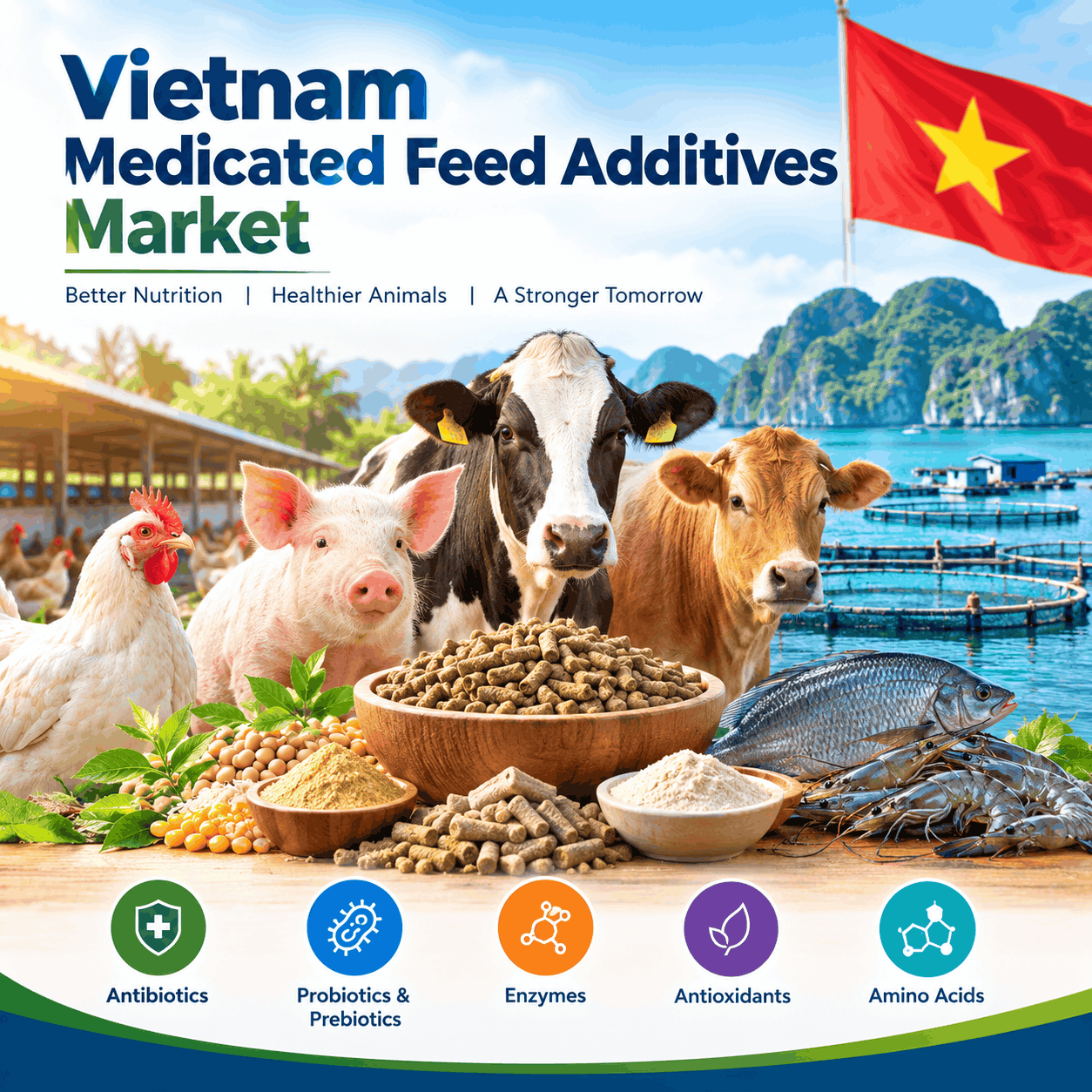
Vietnam has established a significant position in the global aquaculture industry, supported by its extensive coastline, inland water resources, and growing seafood production activities. Fish and shrimp farming contribute to domestic food supplies, employment, and export-oriented agricultural businesses. As aquaculture producers focus on improving farm productivity, animal health, and feed efficiency, the Vietnam Medicated Feed Additives Market is gaining attention as an important part of the country's evolving animal nutrition landscape. Specialized feed ingredients are increasingly relevant for maintaining aquatic animal health, supporting digestive functions, and addressing disease-related production challenges.
Unlike terrestrial livestock farming, aquaculture operates within a water-based production environment where feed management, water quality, stocking density, and disease control are closely connected. These conditions create specific requirements for feed formulations and veterinary healthcare products. Consequently, manufacturers are exploring innovative additive solutions designed for fish and shrimp farming operations.
Why Is Aquaculture Important to Vietnam's Feed Additives Industry?
Vietnam's aquaculture sector includes several commercially important activities, particularly shrimp and fish cultivation. Pangasius farming and shrimp production contribute to seafood processing and export supply chains, making consistent production quality an important priority.
Several developments are encouraging demand for specialized aquatic feed products:
-
Growing Seafood Demand: Domestic consumption and international seafood trade encourage producers to maintain consistent farming operations.
-
Intensive Farming Practices: Commercial aquaculture operations require carefully managed nutrition and health programs.
-
Disease Management: Farmers must address bacterial infections, parasitic problems, and other health challenges that can affect aquatic species.
-
Feed Efficiency: Feed represents a major operational consideration, encouraging producers to improve nutritional utilization.
-
Export Quality Requirements: Seafood businesses must maintain appropriate production, traceability, and food safety standards.
These factors are creating opportunities for manufacturers offering species-specific nutritional and healthcare solutions.
Which Aquatic Species Are Influencing Product Demand?
Different aquaculture species require specialized feeding strategies based on their biological characteristics and production environments.
1. Shrimp Farming
Shrimp cultivation is an important component of Vietnam's aquaculture industry. Shrimp producers must manage water quality, stocking density, feed availability, and disease risks.
Specialized feed formulations containing appropriate enzymes, probiotics, and other nutritional ingredients can support digestive health and feeding management. Probiotic applications are also being explored for their potential role in maintaining microbial balance within aquaculture systems.
2. Pangasius Farming
Pangasius is commercially important to Vietnam's seafood production and processing industry. Farmers require balanced feed formulations that support growth and efficient nutrient utilization.
Enzymes and amino acids can contribute to nutritional management by improving the availability of specific nutrients and helping meet dietary requirements.
3. Other Fish Species
Tilapia and other commercially farmed fish also create demand for specialized feed products. Their nutritional requirements vary according to species, growth stage, farming conditions, and production objectives.
Manufacturers therefore need to develop formulations that reflect differences in aquatic animal physiology rather than applying identical products across all species.
How Do Feed Additives Support Aquaculture Health?
Several additive categories have applications in aquatic animal nutrition.
Probiotics: These beneficial microorganisms are receiving attention because of their potential to support intestinal microbial balance and digestive health. Depending on the formulation, they may also be used in water management strategies.
Prebiotics: Prebiotic ingredients can support selected beneficial microorganisms in the digestive system. Their use can complement broader nutritional management programs.
Enzymes: Enzymes help break down specific feed components, supporting nutrient availability and improving feed formulation efficiency.
Amino Acids: These nutritional components are important for protein synthesis, tissue development, and growth. Balanced formulations help meet species-specific dietary requirements.
Antioxidants: Antioxidants help protect feed ingredients against oxidative deterioration, contributing to feed quality preservation.
Antibiotics: Veterinary antimicrobial products may be required for treating susceptible bacterial infections under appropriate supervision. Their use must comply with applicable regulations, approved indications, and food safety requirements. They should not be considered substitutes for water quality management or biosecurity.
What Are the Major Disease Management Challenges?
Aquaculture production faces several health-related challenges that can affect productivity and operating costs.
Shrimp farming can be affected by diseases such as white spot disease and acute hepatopancreatic necrosis disease. Fish production can also experience bacterial infections and parasitic problems.
These conditions demonstrate why farmers need integrated disease management rather than depending exclusively on medicated feed.
Important management practices include:
-
Regular monitoring of water quality and environmental conditions.
-
Appropriate stocking density and farm hygiene.
-
Careful selection and storage of aquatic feed.
-
Early identification of unusual animal behavior and disease symptoms.
-
Veterinary consultation and laboratory diagnosis when required.
-
Responsible use of approved veterinary medicines.
Feed additives can complement these practices, but they cannot independently prevent every disease or replace effective farm biosecurity.
What Challenges Are Limiting Wider Adoption?
Despite promising applications, aquaculture feed additive manufacturers face several market challenges.
The first is affordability. Advanced formulations may increase operating expenses, particularly for small and medium-sized aquaculture farms.
The second involves product stability. Certain microorganisms and nutritional ingredients can be affected by manufacturing conditions, storage temperatures, and feed processing methods. Maintaining product quality throughout distribution is therefore important.
Regulatory compliance is another major consideration. Aquatic veterinary products must meet applicable requirements concerning approved substances, registration, labeling, and permitted applications. Export-oriented producers also need to consider relevant residue limits and importing-country food safety standards.
Furthermore, farmers may have limited technical knowledge regarding species-specific dosage and feeding practices. This creates a need for better technical support and farmer education.
How Can Manufacturers Capture Aquaculture Opportunities?
Companies operating in Vietnam can strengthen their position by focusing on product specialization and technical innovation.
-
Develop formulations designed for shrimp, pangasius, tilapia, and other farmed species.
-
Expand research into aquatic probiotics, prebiotics, and enzyme technologies.
-
Improve product stability and quality control during manufacturing and storage.
-
Collaborate with aquaculture specialists, veterinarians, and research institutions.
-
Strengthen distribution networks in major seafood-producing regions.
-
Provide farmers with practical guidance on nutrition, water quality, and responsible product application.
These strategies can help manufacturers address the requirements of Vietnam's diverse aquaculture industry.
What Opportunities Could Shape the Future?
The future of Vietnam's aquaculture feed additives industry will increasingly depend on scientific research, responsible animal healthcare, and improved farming technologies.
Interest in functional feed ingredients, microbial solutions, and species-specific formulations may encourage manufacturers to diversify their portfolios. At the same time, digital monitoring systems and improved water management technologies can help farmers make more informed decisions regarding nutrition and animal health.
Businesses that combine technical innovation with affordable products and reliable distribution will be well positioned to participate in the changing aquaculture landscape.
Who We Are
About 6Wresearch: 6Wresearch is a commercial strategy and growth advisory firm founded in 2011 and headquartered in New Delhi, India, with partners across Southeast Asia and the Middle East & Africa. The firm has delivered over 20,000 commercial engagements for over 2,000 organizations, including Fortune 500 companies, government agencies, and multilateral institutions such as the World Bank and the Asian Development Bank. Backed by proprietary market research and advanced analytics, 6Wresearch combines sector expertise with data-driven intelligence to help organizations navigate market complexity and drive sustainable growth. These capabilities explain why organizations trust 6Wresearch Global Market Research & Consulting Firm for reliable commercial insights and confident decision-making.
Our Proprietary Platform: 6W Export GTM
6W Export GTM is 6Wresearch's proprietary trade intelligence and go-to-market platform, built on UN Comtrade data and enhanced with 6Wresearch's in-house analytical and simulation models, including system dynamics-based forecasting. Unlike broad, sector-level market sizing tools, 6W Export GTM operates at the individual product level down to specific HS codes and micro-segments to identify precise, actionable export opportunities by country and product pair, including markets where trade currently does not exist. This granular, simulation-driven approach allows 6W Export GTM to surface opportunities that sector-wide analysis typically misses, positioning it among a small number of platforms globally offering this depth of product-and-country-specific export intelligence.

 Arabic
 French
 Spanish
 Portuguese
 Deutsch
 Turkish
 Dutch
 Italiano
 Russian
 Romaian
 Portuguese (Brazil)
 Greek
