


Electrically Conductive Fabric Market to Reach USD 976.8 Million by 2034 at 9.8% CAGR
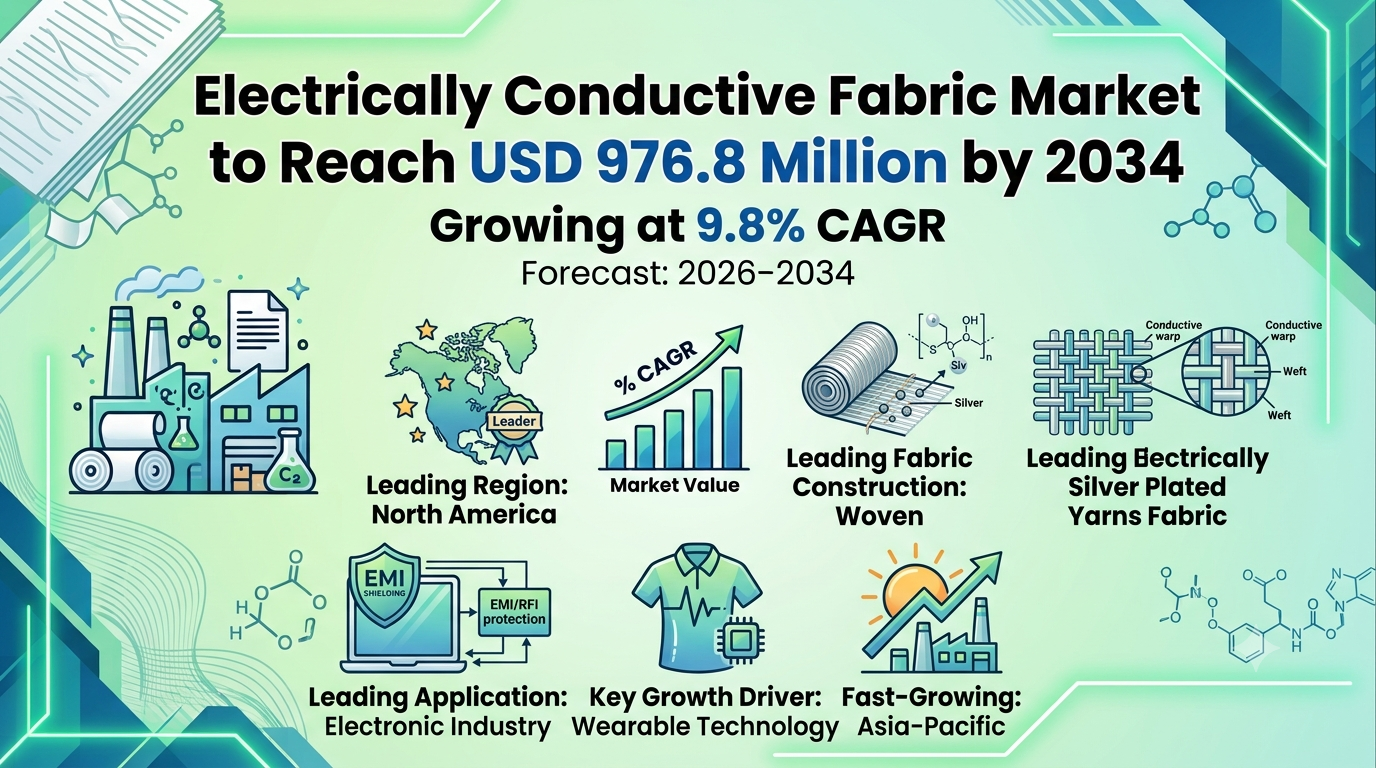
Global Electrically Conductive Fabric Market is gaining attention across electronics, telecommunications, healthcare, automotive, military and defense, wearable technology, and smart textile applications. Electrically conductive fabrics are advanced textiles engineered with conductive materials such as metallic fibers and coatings to provide electrical conductivity while maintaining fabric flexibility. These specialized materials are widely used for electromagnetic interference (EMI) shielding, static dissipation, and signal transmission. Increasing demand for wearable technology, smart textiles, electronic components, and advanced shielding solutions is shaping the market.
According to 24ChemicalResearch, the Global Electrically Conductive Fabric Market was valued at USD 412.5 million in 2025 and is projected to grow from USD 450.1 million in 2026 to USD 976.8 million by 2034, registering a compound annual growth rate (CAGR) of 9.8% during the forecast period.
Read the Complete Global Electrically Conductive Fabric Market Report:
https://www.24chemicalresearch.com/reports/290310/global-electrically-conductive-fabric-forecast-market
Market Overview
The Electrically Conductive Fabric Market continues to evolve with increasing demand for electromagnetic interference shielding, wearable electronics, smart textiles, and advanced industrial materials. These specialized fabrics combine traditional textile structures with conductive materials such as silver-coated nylon, copper-based yarns, and stainless steel filaments.
Electrically conductive fabrics provide electrical conductivity while maintaining flexibility, making them suitable for applications requiring EMI shielding, static dissipation, and signal transmission.
The market is also being shaped by the growing adoption of wearable technology, healthcare monitoring devices, automotive electrification, and Internet of Things (IoT) applications. Manufacturers are investing in graphene-infused fabrics and sustainable conductive materials to enhance conductivity, durability, and application possibilities.
24chemicalresearch.com
Read the Complete Global Electrically Conductive Fabric Market Report:
https://www.24chemicalresearch.com/reports/290310/global-electrically-conductive-fabric-forecast-market
Market Growth Drivers
1. Rapid Growth in Wearable Technology
The growing wearable technology industry is creating substantial demand for electrically conductive fabrics. These advanced textiles enable the integration of electronic components into clothing and accessories while maintaining comfort and flexibility.
Smart garments equipped with conductive fabrics can monitor health metrics, track fitness activities, and provide connectivity. Their ability to support electrical pathways within textile structures makes them important materials for next-generation wearable devices.
2. Military and Defense Applications
Military and defense sectors are increasingly adopting electrically conductive fabrics for electromagnetic shielding and sensor integration in combat gear.
Smart uniforms incorporating conductive textiles can support soldier health monitoring, thermal regulation, and communication systems. Increasing investments in advanced military textiles are creating opportunities for manufacturers of high-performance conductive fabrics.
3. Healthcare Innovation and Medical Wearables
Healthcare innovation represents another major growth driver. Hospitals and healthcare providers are increasingly implementing conductive fabric-based systems for remote patient monitoring.
These materials enable continuous health data collection while maintaining patient comfort. The aging global population and increasing prevalence of chronic diseases are further supporting the adoption of smart textile solutions in healthcare applications.
24chemicalresearch.com
Manufacturing Costs and Market Challenges
The Electrically Conductive Fabric Market faces challenges related to high manufacturing costs, technical complexity, durability limitations, and regulatory compliance.
High Manufacturing Costs and Technical Complexity
Producing electrically conductive fabrics requires specialized manufacturing processes and expensive materials such as silver-coated yarns and carbon-based conductive polymers.
Integrating these materials into traditional textile production lines adds significant cost overhead. Premium conductive fabrics can cost up to 300% more than conventional textiles, limiting mass-market adoption outside specialized applications.
Manufacturers must balance material costs, production efficiency, and product performance to improve market competitiveness.
Durability and Wash Resistance
Maintaining electrical conductivity through repeated washing cycles presents significant technical challenges.
Current conductive coatings can degrade after 20–30 wash cycles, creating demand for advanced encapsulation technologies and more durable conductive treatments.
Manufacturers are focusing on improving wash resistance and maintaining electrical performance under commercial laundry conditions.
Regulatory Compliance and Standardization Issues
The Electrically Conductive Fabric Market faces regulatory requirements across different regions, particularly regarding electromagnetic compatibility and medical device regulations.
Products must comply with FCC regulations in the United States, CE marking requirements in Europe, and various international electrical safety standards.
The lack of global standardization creates additional compliance costs and may delay market entry for new products.
Opportunities in the Electrically Conductive Fabric Market
1. Emerging Applications in Automotive and Aerospace
The automotive industry represents an important growth opportunity for electrically conductive fabrics. These materials are increasingly being integrated into smart vehicle interiors for heated seating, touch controls, and health monitoring systems.
The growing development of next-generation vehicles is creating demand for materials that combine electrical functionality, flexibility, and passenger comfort.
2. Expansion of Wearable Electronics and Smart Textiles
The growing integration of electronic components into wearable devices is creating opportunities for electrically conductive fabric manufacturers.
These fabrics support interactive garments, health monitoring systems, and fitness tracking applications. Increasing adoption of IoT-enabled wearable devices is further expanding the potential applications of conductive textiles.
3. Technological Innovation and Sustainable Materials
Advancements in graphene-infused fabrics and sustainable conductive materials are creating opportunities for product innovation.
Manufacturers are focusing on improving electrical conductivity, flexibility, durability, and shielding effectiveness while developing environmentally conscious material solutions.
Research and development investments are supporting the expansion of conductive fabric applications across electronics, healthcare, automotive, and defense industries.
Market Segmentation
The Electrically Conductive Fabric Market is segmented by type, application, end user, fabric construction, and function.
By Type
-
Copper-based Yarns Fabric
-
Silver Plated Yarns Fabric
-
Steel Filaments Fabric
-
Carbon-based Yarns Fabric
-
Others
Silver Plated Yarns Fabric leads as a preferred choice for applications requiring superior conductivity and flexibility. Its thin silver coating provides low resistance and high shielding effectiveness across a broad frequency range.
Its corrosion resistance supports long-term performance in humid environments, while integration into textile structures enables applications in wearable electronics and precision medical devices.
By Application
-
Industrial & Commercial & Military
-
Medical & Healthcare
-
Electronic Industry
-
Others
The Electronic Industry dominates because of demand for lightweight EMI shielding solutions in compact electronic devices.
Conductive fabrics provide flexible barriers that protect sensitive components without adding significant bulk. Their adaptability supports applications ranging from circuit protection to antenna integration.
Medical and healthcare applications are also expanding through wearable monitoring devices and smart textile solutions.
By End User
-
Electronics Manufacturers
-
Military & Defense Organizations
-
Medical & Healthcare Institutions
-
Industrial & Commercial Enterprises
Electronics manufacturers represent the leading end-user segment, using conductive fabrics for gaskets, wraps, and internal shielding components that protect sensitive electronic equipment.
Military and defense organizations use these materials in shielding solutions and advanced uniforms, while healthcare institutions are adopting conductive textiles for medical monitoring applications.
By Fabric Construction
-
Woven
-
Knitted
-
Non-woven
-
Others
Woven construction leads because of its mechanical strength and consistent conductivity. Uniform metal distribution provides reliable shielding performance in applications such as military equipment and industrial enclosures.
Knitted and non-woven constructions also support specialized applications requiring flexibility and adaptable textile structures.
By Function
-
EMI/RFI Shielding
-
Static Discharge
-
Biometric Sensing
-
Thermal Management
-
Others
EMI/RFI shielding represents the leading functional segment because of increasing requirements for electromagnetic interference protection in electronic devices and connected technologies.
Conductive fabrics provide lightweight shielding solutions for flexible assemblies, gaskets, and shielding curtains. Static discharge and biometric sensing applications are also supporting the development of specialized conductive textiles.
Market Trends
1. Growth Driven by EMI Shielding Demand Across Industries
Increasing demand for electromagnetic interference shielding is an important trend shaping the Electrically Conductive Fabric Market.
Industrial, commercial, military, medical, healthcare, and electronics industries are increasingly integrating advanced conductive textiles into their products to support performance and regulatory requirements.
The growing use of electronic components and connected devices is further increasing demand for lightweight and flexible shielding materials.
2. Technological Advancements and Material Innovation
Continuous innovation in fabric materials is improving conductivity, durability, and overall product performance.
Copper-based yarns, silver-plated yarns, steel filaments, and carbon-based yarns are being developed to provide superior conductivity, low contact resistance, and effective shielding capabilities.
Manufacturers are also developing flexible and adaptable fabric variants, including pressure-sensitive adhesive tapes for easier application.
3. Expansion in Wearable Electronics and Smart Textiles
The growing integration of electronics into wearable devices is creating substantial opportunities for conductive fabrics.
These materials are increasingly used in interactive garments, healthcare monitoring systems, and IoT-enabled smart textiles.
The development of sustainable and eco-friendly conductive fabric materials is also gaining attention as manufacturers focus on environmental sustainability.
24chemicalresearch.com
Regional Outlook
North America
North America is a mature and influential market for electrically conductive fabrics, supported by demand from electronics, healthcare, and defense industries.
The region benefits from advanced manufacturing capabilities and increasing adoption of electromagnetic interference shielding solutions for wearable devices, medical textiles, and military applications.
The United States and Canada are driving market development through the integration of conductive fabrics into automotive electronics and smart textiles.
Research and development activities are also supporting the development of sustainable conductive materials and customized shielding solutions.
Europe
Europe is experiencing steady market development, supported by demand from healthcare and electronics industries.
Countries such as Germany and the United Kingdom are important markets for conductive textiles used in EMI shielding, medical devices, wearable technology, and defense applications.
Innovations in copper-based and silver-plated yarns are supporting smart textile applications. Regulatory compliance and sustainable production are also influencing regional market developments.
Asia-Pacific
Asia-Pacific is witnessing rapid growth in the Electrically Conductive Fabric Market, particularly in China and Japan.
The region benefits from technological advancements, expanding electronics manufacturing, and increasing adoption of healthcare wearables.
Steel filament and carbon-based conductive fabrics are gaining attention across military and commercial applications.
Mass-production capabilities, innovation in conductive yarns, and increasing exports are positioning the region as an important manufacturing hub.
South America
South America offers growth opportunities, with Brazil and Argentina emerging as important markets.
Increasing adoption across electronics and healthcare sectors is supporting demand for conductive fabrics used in interference shielding and medical textiles.
Affordable conductive solutions, including adhesive tapes, are supporting industrial expansion. Investments in defense applications and wearable technology are also creating opportunities.
Middle East and Africa
The Middle East and Africa market is developing through increasing adoption across healthcare and defense sectors.
Countries in the region are investing in EMI shielding for electronics and medical monitoring fabrics.
Emerging smart textile applications and demand for durable, high-conductivity materials are creating opportunities for manufacturers. Strategic partnerships are also supporting market penetration across industrial and commercial applications.
24chemicalresearch.com
Competitive Landscape and Key Companies
The Electrically Conductive Fabric Market is characterized by established global manufacturers with strong technological expertise and extensive product portfolios.
Bekaert leads the market with advanced metallurgical solutions and a comprehensive range of conductive textiles. Laird focuses on specialized EMI shielding solutions, while Toray maintains an important position through its advanced material science capabilities.
3M offers diversified industrial applications, and Seiren focuses on specialized textile innovations. Shieldex and Holland Shielding Systems concentrate on electromagnetic protection solutions, while Emei Group is gaining traction through cost-effective production capabilities.
Metal Textiles and Parker Hannifin also participate in specialized industrial and military applications.
Key Companies Covered:
-
Bekaert
-
Laird
-
Seiren
-
3M
-
Toray
-
Emei
-
Metaline
-
31HK
-
Shieldex
-
KGS
-
Holland Shielding Systems
-
Metal Textiles
-
Parker Hannifin
-
Swift Textile Metalizing
-
HFC
-
ECT
Companies are focusing on technological innovation, material development, product performance, and expanding applications across electronics, healthcare, automotive, and defense industries.
What Does the Report Cover?
The Global Electrically Conductive Fabric Market Research Report 2026–2034 provides an analysis of global and regional market performance, including sales, sales volume, revenue forecasts, segmentation, production, and competitive developments.
The report covers:
-
Global market size and CAGR analysis
-
Historical market data from 2020 to 2025
-
Market forecasts through 2034
-
Market segmentation by type and application
-
Regional market analysis
-
Sales, consumption, export, and import data
-
Production methods and cost structure analysis
-
Capacity, production, utilization, pricing, and margins
-
Key company profiles and competitive positioning
-
Product specifications and sales performance
-
Market trends, drivers, challenges, and restraints
-
Mergers, acquisitions, and planned future projects
-
Regional consumption volume and value analysis
-
Demand analysis by application and type
-
Key player sales and market share
The report is a 146-page study, with customization available.
Key Report Highlights
-
Market Size (2025): USD 412.5 Million
-
Market Size (2026): USD 450.1 Million
-
Market Forecast (2034): USD 976.8 Million
-
CAGR (2026–2034): 9.8%
-
Base Year: 2025
-
Historical Period: 2020–2025
-
Forecast Period: 2026–2034
-
Report Length: 146 Pages
-
Leading Region: North America
-
Fast-Growing Region: Asia-Pacific
-
Leading Type Segment: Silver Plated Yarns Fabric
-
Leading Application: Electronic Industry
-
Leading End User: Electronics Manufacturers
-
Leading Fabric Construction: Woven
-
Leading Function: EMI/RFI Shielding
-
Key Market Trends: EMI shielding, wearable electronics, smart textiles, graphene-infused fabrics, and sustainable conductive materials
-
Key Growth Factors: Wearable technology, military and defense applications, healthcare innovation, and increasing demand for EMI shielding solutions
Frequently Asked Questions
1. What is the current size of the Electrically Conductive Fabric Market?
The Global Electrically Conductive Fabric Market was valued at USD 412.5 million in 2025.
2. What is the projected market size by 2034?
The market is projected to reach USD 976.8 million by 2034.
3. What is the expected CAGR of the market?
The market is expected to register a CAGR of 9.8% during the 2026–2034 forecast period.
4. What are the key growth drivers?
Key growth drivers include increasing demand for EMI shielding solutions, rapid growth in wearable technology, military and defense applications, healthcare innovation, and expanding smart textile applications.
5. Which region dominates the market?
North America holds a significant market position, while Asia-Pacific is witnessing rapid growth due to technological advancements and expanding industrial applications.
6. Which companies operate in the market?
Major companies include Bekaert, Laird, Seiren, 3M, Toray, Emei, Metaline, Shieldex, KGS, Holland Shielding Systems, Metal Textiles, and Parker Hannifin.
7. What are the emerging market trends?
Emerging trends include technological advancements in conductive materials, increasing use in wearable electronics, healthcare applications, smart textiles, and sustainable conductive fabric development.
Get the Complete Market Research Report
For detailed market forecasts, segmentation, regional analysis, competitive intelligence, and industry developments, access the complete Electrically Conductive Fabric Market research report.
Read the Full Report:
https://www.24chemicalresearch.com/reports/290310/global-electrically-conductive-fabric-forecast-market
Download the Free Sample Report:
https://www.24chemicalresearch.com/reports/290310/global-electrically-conductive-fabric-forecast-market
About 24ChemicalResearch
24ChemicalResearch provides market research and industry analysis covering chemicals, materials, specialty chemicals, and related industrial sectors. Its research reports offer insights into market size, growth forecasts, industry trends, competitive landscapes, segmentation, and regional developments.
Contact Us
24ChemicalResearch
Website: https://www.24chemicalresearch.com
Phone: +91 9169162030
Email: help@24chemicalresearch.com

 English
 Arabic
 French
 Spanish
 Deutsch
 Turkish
 Dutch
 Italiano
 Russian
 Romaian
 Portuguese (Brazil)
 Greek
