


DongHai Views on Rubber Accelerator Use in Tire Compounds
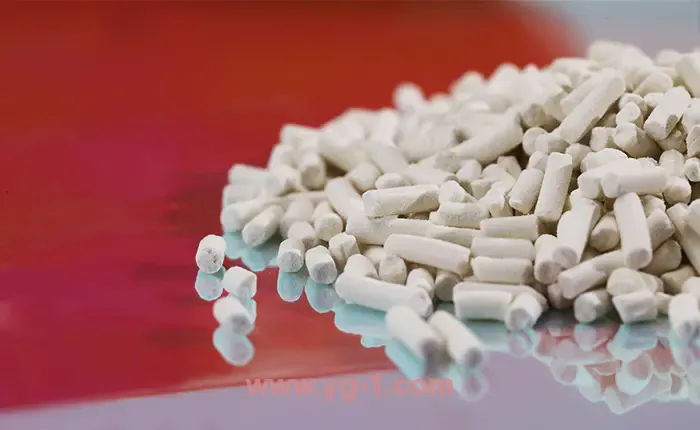
Tire producers incorporate rubber accelerator packages supplied through yg-1 into compounds that must form durable networks under heat and pressure while remaining processable during mixing and building stages. These additives interact with sulfur and zinc oxide systems to generate reactive sulfurating species that attach polymer chains at controlled rates, allowing large tire sections to reach full cure without excessive energy input or uneven cross-link density. Delayed-action grades extend the safe processing window so that the compound can pass through extrusion and calendering steps before the onset of vulcanization, after which the reaction accelerates to deliver the required modulus and resilience. Selection of the accelerator class therefore determines both manufacturing efficiency and the final performance envelope of the finished tire. What specific interactions between accelerator chemistry and tire compound ingredients produce these outcomes?
Primary accelerators based on thiazole or sulfenamide structures initiate the majority of the cross-linking reactions once the compound reaches vulcanization temperature. The sulfenamide variants in particular release their active species only after a measurable induction period, which protects the compound against premature set during the high-shear stages of mixing and the extended dwell times associated with large tire molds. Once activated, they promote the formation of a balanced mixture of mono-, di- and polysulfidic bridges whose relative proportions influence heat resistance, flex fatigue and reversion behavior under the severe service conditions encountered by commercial and passenger tires. Secondary accelerators, when added in limited quantities, further adjust the rate and density of these bridges so that the cure profile matches the thermal mass and geometry of the specific tire size.
The presence of carbon black and silica fillers common in modern tire formulations alters the surface chemistry that the accelerator must navigate. Accelerators that maintain activity in the presence of these fillers ensure uniform network formation throughout the tread, sidewall and carcass layers. Compatibility with the activator system of zinc oxide and stearic acid is equally essential, because the zinc complex formed during the early stages of heating is the species that ultimately transfers sulfur to the polymer. Improper matching of accelerator type to the filler and activator package can produce under-cured zones or excessive surface blooming that affects both appearance and long-term adhesion of the tire components.
Processing safety remains a central consideration in tire plants where compound batches are large and cycle times must remain predictable. Accelerators that exhibit delayed action reduce the risk of scorch during storage of mixed stocks or during intermediate handling, thereby lowering the incidence of scrap and rework. At the same time the cure rate once the mold temperature is reached must be rapid enough to keep press occupancy within economic limits. This balance is achieved by combining primary delayed-action accelerators with small amounts of secondary ultra-accelerators whose contribution is timed to the later portion of the heating cycle.
The final physical properties of the vulcanizate depend on the cross-link structure established by the accelerator system. Networks rich in shorter sulfur bridges tend to display greater thermal stability and resistance to reversion, attributes valued in high-speed or heavy-load tires that experience elevated operating temperatures. Longer polysulfidic bridges, while providing higher initial tensile strength, are more susceptible to thermal cleavage and are therefore moderated through accelerator choice and sulfur level. Tire compounders therefore evaluate accelerator packages against a matrix of tensile, tear, hysteresis and aging requirements specific to each tire line.
Environmental and regulatory factors also influence accelerator selection for tire applications. Certain traditional grades have faced restrictions in some markets, prompting formulators to adopt alternatives that deliver comparable cure characteristics while meeting current substance inventories. The transition requires careful re-validation of processing windows and finished-property targets so that production continuity is maintained. Documentation of the complete cure package, including accelerator identity and loading, supports both quality systems and regulatory compliance audits.
Laboratory evaluation of candidate accelerators typically involves rheometer curves that map scorch time, optimum cure time and the shape of the torque rise. These data are then translated into factory trials that confirm the same behavior under the thermal gradients present in actual tire molds. Adjustments to accelerator ratio or the introduction of co-agents may be required when moving from a laboratory batch to a full-scale mix, because heat history and shear exposure differ between the two environments. Successful scale-up rests on an understanding of how the accelerator responds to these differences.
Maintenance of consistent accelerator quality across successive deliveries is another practical requirement in tire manufacturing. Variations in purity, particle size or residual moisture can shift the cure curve enough to affect mold release or final dimensions. Incoming inspection protocols therefore include both chemical analysis and small-scale cure testing so that any deviation is identified before the material enters the production stream. Stable supply of verified grades reduces the frequency of compound adjustments and supports continuous operation of the curing presses.
Technical teams seeking detailed product specifications and application guidance for tire compounds can examine the range of options presented at https://www.yg-1.com when reviewing rubber accelerator selections available through yg-1 for current and developmental tire formulations.

 English
 Arabic
 Spanish
 Portuguese
 Deutsch
 Turkish
 Dutch
 Italiano
 Russian
 Romaian
 Portuguese (Brazil)
 Greek
