


Geosynthetics Membranes Market to Reach USD 2.52 Billion by 2034 at 6.0% CAGR
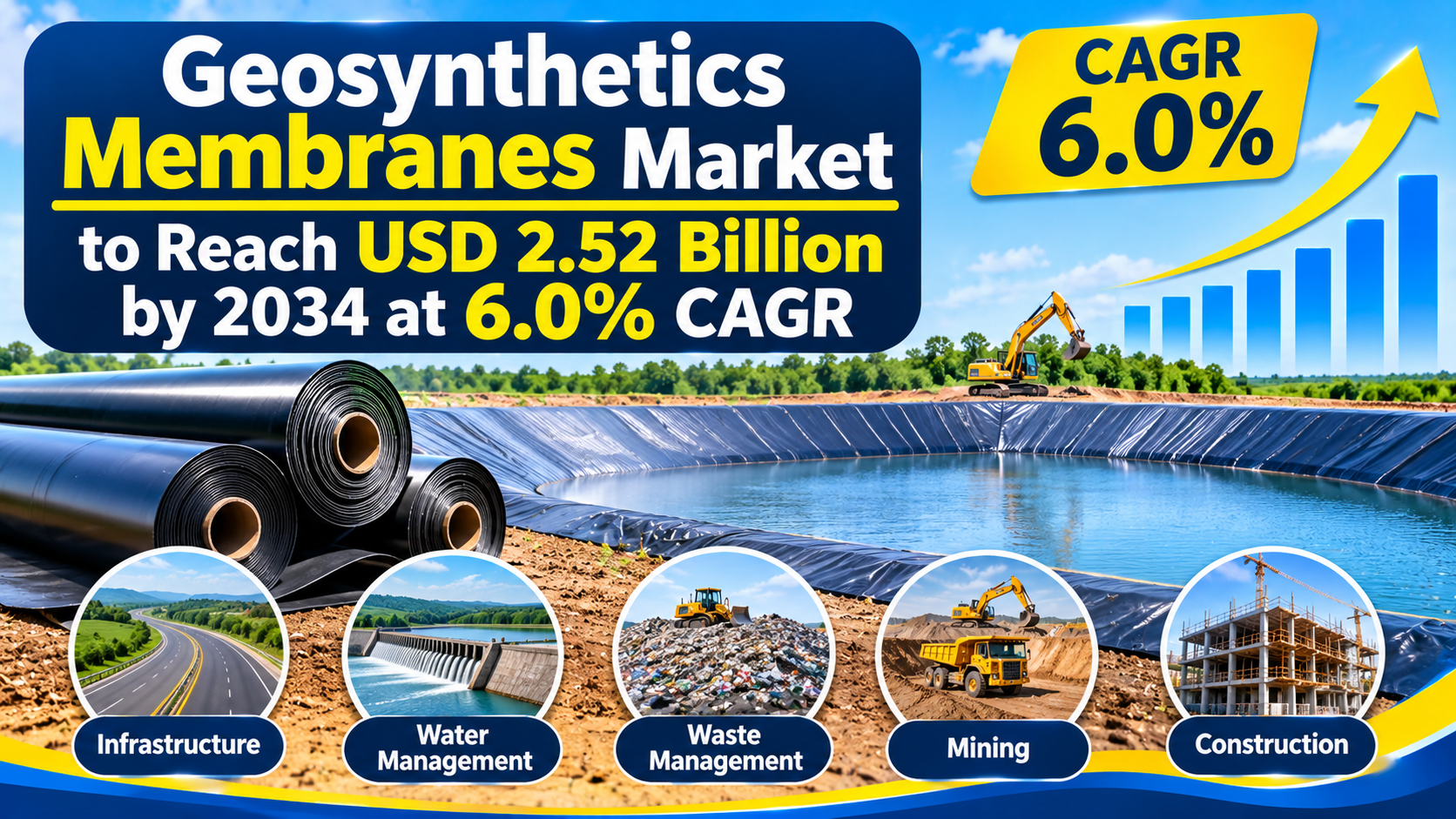
Global Geosynthetics Membranes Market is gaining attention across civil engineering, environmental protection, water management, mining, waste management, building and construction, and infrastructure development. Geosynthetic membranes serve as impermeable barriers across civil, environmental, and mining projects, delivering reliable fluid containment for water, leachate, and gases. Manufactured primarily from polymeric sheets such as PVC, HDPE, and LLDPE, these membranes offer chemical resistance, durability, and ease of installation, making them essential materials for modern infrastructure projects.
According to 24ChemicalResearch latest industry analysis, the global Geosynthetics Membranes Market was valued at USD 1.45 billion in 2025. The market is projected to grow from USD 1.55 billion in 2026 to USD 2.52 billion by 2034, exhibiting a compound annual growth rate (CAGR) of 6.0% during the forecast period. Reflecting intensified infrastructure spending and tighter environmental mandates, the market's growth outlook has been revised upward to 6.0%. Increasing investments in water management, waste containment, mining infrastructure, and climate-responsive infrastructure are supporting demand for high-performance geomembranes.
View the complete report: https://www.24chemicalresearch.com/reports/289224/geosynthetics-membranes-market
What Is Driving the Geosynthetics Membranes Market?
Three primary forces are supporting market expansion, including infrastructure development, stricter environmental regulations, and increasing adoption of advanced membrane technologies.
Infrastructure Expansion Fuels Demand
Government-led road, rail, and wastewater projects across emerging economies have created a steady pipeline of contracts requiring durable lining solutions. Geosynthetic membranes, especially high-density polyethylene (HDPE) variants, are preferred because they combine chemical resistance with long service life, helping municipalities reduce maintenance budgets.
The expansion of renewable-energy installations, including solar farms, is also increasing the need for waterproofing and erosion-control solutions that geomembranes readily provide. Growing investments in reservoirs, irrigation systems, transportation infrastructure, and wastewater facilities are further supporting market demand.
Regulatory Pressures Promote Adoption
Strict environmental standards imposed by agencies worldwide require the containment of hazardous leachates and the prevention of groundwater contamination. Compliance frameworks increasingly require engineered barriers that meet performance thresholds beyond those of traditional compacted clay liners.
Consequently, contractors and developers are adopting geosynthetic membranes as a cost-effective solution for meeting licensing requirements while minimizing environmental liabilities. Smart-city initiatives are also influencing material selection, with sensors embedded in geomembrane layers enabling real-time leak detection and proactive infrastructure management.
Growing Demand for Advanced and Modular Solutions
The shift toward modular and rapid-installation solutions is encouraging the adoption of reinforced and textured membrane variants. Manufacturers are investing in improved polymer formulations and surface modifications to meet the performance requirements of mining, offshore, and infrastructure projects.
Technological integration, including sensor-enabled monitoring systems, is adding value to membrane products and encouraging wider procurement across public-private infrastructure projects.
View the complete report: https://www.24chemicalresearch.com/reports/289224/geosynthetics-membranes-market
Market Challenges
Technical Complexity of Installation
Although geosynthetic membranes offer significant performance benefits, installing seamless membrane systems requires skilled labor and meticulous site preparation. Inconsistent weather conditions, particularly in coastal regions, can delay welding operations and increase project timelines and budgets.
Companies without trained installation teams may need to depend on subcontractors, increasing coordination risks and project complexity. Proper seam welding, surface preparation, and installation quality are essential for maintaining long-term impermeability.
Material Cost Volatility
Raw material prices for polymers such as HDPE and PVC have experienced significant fluctuations in response to global oil market movements. These price changes can compress manufacturers' margins, particularly for companies operating with limited pricing flexibility.
Manufacturers are therefore seeking improvements in extrusion processes and production efficiency to manage raw material costs and maintain competitiveness.
Supply-Chain Disruptions
Geopolitical tensions have contributed to bottlenecks in the shipment of specialized welding equipment and additives. Projects located in landlocked regions may experience delivery lead times extending beyond six months.
These disruptions can delay project completion and encourage clients to reconsider material choices or negotiate more aggressive procurement terms.
Market Restraints
High Initial Capital Outlay
Despite their long-term economic benefits, the upfront cost of procuring high-performance geosynthetic membranes remains a challenge for budget-constrained developers.
In projects where financing depends on short-term cash flow, decision-makers may choose cheaper and less durable alternatives, even when those materials can result in higher lifecycle expenses. This initial investment requirement can slow the adoption of premium membrane products, particularly in cost-sensitive markets.
View the complete report: https://www.24chemicalresearch.com/reports/289224/geosynthetics-membranes-market
Market Opportunities
Emerging Reuse and Recycling Technologies
Advancements in polymer recycling are creating new revenue opportunities for manufacturers willing to incorporate reclaimed materials into membrane production.
Pilot programs in Europe have demonstrated that recycled HDPE can meet the same tensile-strength standards as virgin resin, opening opportunities for cost-competitive products in price-sensitive markets.
The growing focus on circular manufacturing and sustainable material sourcing is encouraging manufacturers to explore recycled polymer blends and improve production efficiency.
Sensor-Embedded Membranes and Smart Monitoring
The integration of sensors into geomembrane layers creates opportunities for advanced leak detection and infrastructure monitoring. These technologies can provide real-time information about membrane performance and support proactive maintenance.
Growing investment in smart-city initiatives and modern municipal infrastructure is expected to encourage demand for membrane systems incorporating monitoring capabilities.
Infrastructure Development in Emerging Markets
Increasing infrastructure investments across Asia-Pacific are creating opportunities for geosynthetic membrane manufacturers. Government-backed water-security programs, wastewater projects, mining developments, and climate-resilient infrastructure initiatives are supporting demand.
The expansion of modular installation technologies and local manufacturing capacity can further improve product accessibility and reduce logistics costs.
High-Performance Reinforced and Textured Membranes
Mining and offshore projects require membrane products with enhanced tensile strength, puncture resistance, and chemical durability. Reinforced and textured membrane variants offer manufacturers opportunities to address these demanding applications through product differentiation and advanced polymer technologies.
Market Segmentation Insights
The Geosynthetics Membranes Market is segmented by type, application, end user, material structure, and technology. Each segment serves specific infrastructure and environmental requirements, creating different opportunities for manufacturers and suppliers.
By Type
The market includes PVC Membranes, HDPE Membranes, LLDPE Membranes, and Other Material Types.
PVC Membranes are widely regarded as a cornerstone of the market because of their versatility across diverse civil and environmental projects. Their chemical resistance and proven durability allow designers to rely on them for long-term containment solutions, including landfill liners and water-treatment ponds.
The flexibility of PVC membranes accommodates subgrade movements, reducing the risk of seam failure. Ongoing polymer enhancements have also improved UV stability, supporting their use in exposed applications without premature degradation.
By Application
Key application segments include Building & Construction, Water Management, Mining, Waste Management, and Others.
Water Management represents the most compelling application segment, driven by the universal need to safeguard water resources. Geosynthetic membranes provide reliable barriers for reservoirs, canals, irrigation ponds, and aquaculture facilities, preventing seepage under fluctuating hydraulic pressures.
Their long-term integrity supports strategic water-security initiatives, making them important in regions facing climate variability and population growth. The emphasis on infrastructure resilience and low maintenance further reinforces demand for high-performance membranes in water-related projects.
By End User
The market serves Government & Municipalities, Private Infrastructure Developers, and Industrial & Mining Corporations.
Government & Municipalities dominate the demand landscape because public infrastructure projects are subject to stringent regulatory frameworks prioritizing environmental protection and asset longevity. Procurement processes favor proven technologies that demonstrate compliance, reliability, and lifecycle cost advantages.
These organizations drive the adoption of premium-grade membranes for large-scale projects such as municipal landfills, regional water reservoirs, and flood-control systems.
By Material Structure
The market includes Reinforced Membranes, Non-Reinforced Membranes, and Textured/Surface-Modified Membranes.
Reinforced Membranes are preferred for high-stress installations where tensile strength and puncture resistance are essential. The integration of polyester scrim or high-tenacity yarns provides dimensional stability, allowing liners to withstand soil loads, settlement, and installation activities without distortion.
This structural strength is particularly important for tailings dams, heap-leach pads, and floating covers, where membrane failure could result in serious environmental and safety consequences.
By Technology
The market is segmented into Extrusion, Calendering, and Spreading & Coating.
Extrusion remains the dominant manufacturing approach because it produces seamless, homogeneous sheets with consistent thickness and material properties. The process enables the production of wide panels that minimize field seams, an important factor in maintaining long-term impermeability.
Extrusion also facilitates the incorporation of reinforcement fabrics and additives, supporting the development of high-performance membranes for modern infrastructure projects.
Regional Market Analysis
North America
North America is identified as the leading region in the report's strategic market outlook. The region benefits from infrastructure renewal, environmental regulations, and investments in water management and waste-containment systems.
The United States and Canada are focused on rebuilding aging water-treatment facilities and landfill systems while improving resilience against extreme weather events. Infrastructure investments are encouraging the installation of advanced polymer liners for dike integrity, shoreline protection, and stormwater retention.
Private-sector consortiums increasingly incorporate geosynthetic linings into projects combining soil stabilization, erosion control, and rapid deployment. Engineers are also shifting from traditional clay solutions toward high-density polyethylene sheets because of their long-term durability and cost efficiency.
Key regional highlights include:
-
Infrastructure investments supporting high-performance geomembrane installations.
-
Increasing adoption of advanced polymer liners.
-
Growing demand for landfill and water-treatment infrastructure upgrades.
-
Environmental reviews encouraging rigorous product testing.
-
Greater focus on long-term durability and asset management.
Asia-Pacific
Asia-Pacific is identified as an emerging region in the strategic market outlook and is also highlighted in the detailed regional analysis as the fastest-expanding regional market. The region accounted for approximately 44% of global sales in 2025, supported by infrastructure investments, domestic manufacturing expansion, and environmental regulations.
China's New Infrastructure program and India's water-security initiatives are driving demand for large-scale reservoir liners and irrigation canals. The broader Asia-Pacific corridor, including China, India, and ASEAN economies, is benefiting from major infrastructure developments involving maritime ports, river systems, construction, and climate-resilient projects.
Local manufacturing capabilities and installation expertise are reducing logistics costs and supporting regional market expansion.
Key regional highlights include:
-
Government-backed infrastructure spending supporting membrane installations.
-
Increasing investment in water-security and wastewater projects.
-
Growing domestic manufacturing capabilities.
-
Sustainability mandates encouraging advanced liner specifications.
-
Expanding demand from construction, mining, and municipal infrastructure.
View the complete report: https://www.24chemicalresearch.com/reports/289224/geosynthetics-membranes-market
Europe
Europe is leveraging circular-economy principles to strengthen geosynthetic membrane adoption. The European Green Deal and sustainability-focused procurement practices are encouraging the use of materials that can be recycled at the end of their service life.
Manufacturers are focusing on reducing synthetic waste, developing recyclable membrane products, and improving the environmental performance of production processes. Investors are also directing capital toward infrastructure projects aligned with carbon-neutral objectives.
Architectural and engineering companies are increasingly integrating lifecycle cost calculations into Building Information Modeling (BIM) workflows to evaluate membrane selection over extended project lifetimes.
Key regional highlights include:
-
Recyclability metrics increasingly influencing procurement decisions.
-
Sustainability certifications supporting product differentiation.
-
Greater emphasis on carbon-neutral supply chains.
-
Lifecycle cost modeling becoming part of infrastructure planning.
-
Collaboration between engineering companies and material manufacturers.
Middle East
The Middle East is creating new opportunities through the expansion of desalination facilities and water-management infrastructure. Desalination projects require chemically resistant membranes capable of withstanding brine exposure.
Increasing investment in water infrastructure and industrial projects is supporting demand for durable geomembrane products designed for demanding environmental conditions.
View the complete report: https://www.24chemicalresearch.com/reports/289224/geosynthetics-membranes-market
Competitive Landscape
The global Geosynthetics Membranes Market is characterized by established manufacturers competing through polymer expertise, production capacity, product innovation, distribution networks, and installation support.
Solmax and GSE Environmental represent major industry participants, with the report identifying their combined market share at approximately 35%. Other companies compete through specialized reinforcement technologies, advanced membrane systems, regional manufacturing capabilities, and application-specific products.
Major companies operating in the market include:
-
Solmax (Canada)
-
GSE Environmental (USA)
-
AGRU (Austria)
-
NAUE GmbH & Co. KG (Germany)
-
Koninklijke TenCate (Netherlands)
-
TENAX Group (Italy)
-
Officine Maccaferri (Italy)
-
Huesker Synthetic GmbH (Germany)
-
Huifeng Geosynthetics (China)
-
Shandong Haoyang Environmental (China)
-
Geofabrics Australasia (Australia)
-
Propex
-
DuPont
-
Tensar International
-
Freudenberg Group
-
Enviro Geosynthetics
-
ACE Geosynthetics
-
Feicheng Lianyi
-
Taian Modern Plastic
-
Shandong Hongxiang New Geo-Material
Solmax continues to maintain a strong market position through vertically integrated manufacturing, reinforced-film production, and installation support. Its HDPE and PVC geomembranes are developed for enhanced puncture resistance and UV stability.
GSE Environmental and AGRU compete through polymer-science capabilities and global distribution networks. NAUE and TENAX differentiate themselves through reinforcement technologies and integrated drainage-membrane systems.
Regional manufacturers such as Huifeng Geosynthetics and Shandong Haoyang Environmental are expanding production capacity to serve infrastructure demand across Asia. Geofabrics Australasia focuses on reinforced composite membranes for mining applications, while Officine Maccaferri and Huesker Synthetic are developing hybrid systems combining geotextile reinforcement with membrane liners.
Key Market Trends
Infrastructure Renewal and Environmental Regulation Strengthen Demand
Infrastructure renewal and stricter environmental regulations are strengthening demand for geosynthetic membranes. Mature economies are investing in the modernization of aging water-treatment facilities, landfills, and transportation infrastructure, creating opportunities for durable and low-maintenance liner solutions.
Environmental regulations across North America, Europe, and Asia-Pacific are also encouraging the use of high-performance barriers for containing leachate, mining tailings, and saline water.
Companies that demonstrate regulatory compliance while offering reduced installation times are increasingly competitive in public-sector infrastructure contracts.
Material Innovation and Polymer Advancements
Manufacturers are investing in polymer blends that combine the chemical resistance of high-density polyethylene (HDPE) with the flexibility of modernized polyvinyl chloride (PVC) formulations.
Recent product developments include UV-stabilized additives designed to extend outdoor service life beyond 30 years. These improvements address the long-term durability requirements of municipal and infrastructure customers.
Manufacturers are also focusing on reducing the carbon footprint of extrusion processes through the recycling of polymer waste. Some leading companies report that up to 20% of material input originates from post-consumer feedstock.
View the complete report: https://www.24chemicalresearch.com/reports/289224/geosynthetics-membranes-market
Regional Expansion and New Application Frontiers
Asia-Pacific continues to attract significant manufacturing investments and infrastructure demand. China's New Infrastructure program and India's water-security initiatives are supporting the deployment of large-scale reservoir liners and irrigation canals.
In the Middle East, expanding desalination facilities are creating opportunities for chemically resistant membranes. North America is experiencing demand from the modernization of existing landfills and the installation of reinforced membrane systems.
These regional developments are expanding market opportunities and encouraging manufacturers to align products and supply chains with local regulatory requirements.
View the complete report: https://www.24chemicalresearch.com/reports/289224/geosynthetics-membranes-market
Report Summary
The Geosynthetics Membranes Market is witnessing steady growth as infrastructure expansion, environmental regulations, and increasing demand for reliable fluid-containment solutions drive adoption. Growing investments in water management, waste management, mining, and construction are supporting the use of high-performance geomembranes.
Advancements in polymer formulations, reinforced membranes, recycling technologies, and sensor-enabled monitoring systems are creating new opportunities for manufacturers. North America holds a leading position in the strategic market outlook, while Asia-Pacific represents an important growth region supported by infrastructure development and expanding domestic manufacturing capabilities.
Key Report Highlights
-
The global Geosynthetics Membranes Market was valued at USD 1.45 billion in 2025.
-
The market is projected to grow from USD 1.55 billion in 2026 to USD 2.52 billion by 2034.
-
The market is expected to expand at a CAGR of 6.0% during the 2026–2034 forecast period.
-
North America is identified as the leading region in the strategic market outlook.
-
Asia-Pacific accounted for approximately 44% of global sales in 2025 and represents an important growth region.
-
PVC Membranes are widely used across civil and environmental projects because of their versatility, chemical resistance, and durability.
-
Water Management represents a key application segment, supported by demand for reservoirs, canals, irrigation ponds, and aquaculture facilities.
-
Government & Municipalities dominate the end-user demand landscape.
-
Reinforced Membranes are preferred for high-stress installations requiring tensile strength and puncture resistance.
-
Extrusion remains the dominant manufacturing technology.
-
Major industry participants include Solmax, GSE Environmental, AGRU, NAUE, Koninklijke TenCate, TENAX Group, Officine Maccaferri, Huesker Synthetic, Huifeng Geosynthetics, and Geofabrics Australasia.
-
Emerging opportunities include polymer recycling, sensor-embedded membranes, reinforced products, and modular infrastructure solutions.
-
The report provides insights into market size, growth forecasts, segmentation, regional developments, competitive analysis, industry trends, and future opportunities shaping the global Geosynthetics Membranes Market.
Frequently Asked Questions About the Geosynthetics Membranes Market
Q: What is the current size of the global Geosynthetics Membranes Market?
A: According to 24ChemicalResearch, the global Geosynthetics Membranes Market was valued at USD 1.45 billion in 2025 and is projected to reach USD 2.52 billion by 2034.
Q: What is the expected CAGR of the Geosynthetics Membranes Market?
A: The market is expected to grow at a compound annual growth rate (CAGR) of 6.0% during the 2026–2034 forecast period.
Q: Which region leads the Geosynthetics Membranes Market?
A: North America is identified as the leading region in the strategic market outlook, while Asia-Pacific is highlighted as a major regional growth market.
Q: What are the key growth drivers of the Geosynthetics Membranes Market?
A: Major growth drivers include infrastructure expansion, stricter environmental regulations, increasing water-management investments, and demand for reliable waste-containment solutions.
Q: Which type of geosynthetic membrane is widely used?
A: PVC Membranes are widely used because of their versatility, chemical resistance, flexibility, and durability across civil and environmental projects.
Q: Which application segment is particularly important?
A: Water Management is a key application segment, supported by demand for reservoirs, canals, irrigation ponds, and aquaculture facilities.
Q: Which end-user segment dominates the market?
A: Government & Municipalities dominate demand because of public infrastructure investments and stringent environmental requirements.
Q: What are the major challenges facing the market?
A: Major challenges include technical installation complexity, raw material price volatility, supply-chain disruptions, and high initial capital expenditure.
Q: What are the emerging opportunities in the market?
A: Emerging opportunities include polymer recycling, sensor-enabled leak detection, reinforced membrane technologies, and infrastructure development across emerging economies.
Q: Who are the leading companies in the Geosynthetics Membranes Market?
A: Key companies include Solmax, GSE Environmental, AGRU, NAUE GmbH & Co. KG, Koninklijke TenCate, TENAX Group, Officine Maccaferri, Huesker Synthetic GmbH, Huifeng Geosynthetics, Shandong Haoyang Environmental, and Geofabrics Australasia.
Q: What is the dominant manufacturing technology?
A: Extrusion is the dominant manufacturing technology because it produces homogeneous sheets with consistent thickness and helps minimize field seams.
View the complete report: https://www.24chemicalresearch.com/reports/289224/geosynthetics-membranes-market
Download the free sample report: https://www.24chemicalresearch.com/download-sample/289224/geosynthetics-membranes-market
Contact Us
Website: https://www.24chemicalresearch.com/
Asia: +91 9169162030

 English
 Arabic
 French
 Spanish
 Portuguese
 Deutsch
 Turkish
 Dutch
 Italiano
 Russian
 Romaian
 Greek
