


The Role of a 24V DC Flasher Buzzer in Industrial Automation Systems
Introduction
Industrial automation has changed how manufacturing facilities monitor machinery, control production activities, and manage equipment performance. Automated systems use sensors, controllers, relays, and electronic components to perform operations with limited manual intervention.
However, automation does not eliminate the need for human supervision. Operators and maintenance personnel still need to receive information when a machine develops a fault or when a process requires attention.
This is why signalling devices remain important in automated installations.
A 24V DC flasher buzzer can support industrial automation by providing simultaneous audible and visual indications. When activated through a suitable control circuit, it helps communicate selected alarm conditions to nearby personnel.
Understanding Alarm Signalling in Automation
Automation systems continuously receive information from different equipment and monitoring devices.
Sensors may detect temperature, pressure, position, speed, or other operating parameters. Controllers process this information and determine whether the equipment is operating within the programmed limits.
When a monitored condition requires attention, the control system can activate an alarm.
This alarm may operate a buzzer, warning lamp, display, or another notification device.
An integrated flasher buzzer provides two signalling functions through one compact component.
How a 24V DC Flasher Buzzer Supports Automation
In a typical automated installation, the signalling device is connected to an appropriate control output or switching circuit.
The operating sequence can be understood through the following example:
-
A sensor monitors a machine or process condition.
-
The controller receives information from the sensor.
-
The programmed logic identifies an abnormal condition.
-
The compatible output circuit activates the alarm.
-
The buzzer produces an intermittent sound.
-
The LED generates a flashing visual indication.
-
An operator notices the warning and follows the established response procedure.
The exact sequence depends on the automation design.
Importantly, the signalling device communicates an alarm. It does not independently diagnose the cause of the fault.
Applications in Different Automation Installations
1. Manufacturing Automation
Automated production lines involve multiple machines working together. If one section stops unexpectedly, the production process may be affected.
A combined warning device can notify operators when a selected machine alarm becomes active.
2. Packaging Equipment
Packaging systems use automated mechanisms for filling, sealing, labelling, and material handling.
An alarm can help communicate interruptions, equipment faults, or other programmed warning conditions.
3. Conveyor Automation
Conveyor systems transport products and materials between different production stages.
When an operational problem occurs, a warning device can help notify personnel responsible for monitoring the installation.
4. Process Control Systems
Industrial process control installations monitor operating parameters through electronic instruments and controllers.
An audible and visual alarm can communicate when a selected parameter reaches a programmed warning condition.
5. OEM Machinery
Original equipment manufacturers often design control panels around the specific requirements of their machines.
A compact signalling component can be incorporated into the panel to provide local warning indications.
6. HVAC Automation
Building management systems may use control circuits to monitor selected equipment conditions.
Suitable warning devices can communicate faults or notifications when incorporated into the system design.
Why 24V DC Signalling Is Relevant to Automation
DC control supplies are commonly used in industrial electronic control arrangements.
A 24V DC warning device can be considered when the control panel already provides a compatible supply.
Using a device designed for the available control voltage can help simplify component selection.
Nevertheless, the actual supply conditions and output compatibility should always be checked before installation.
Important Product Features
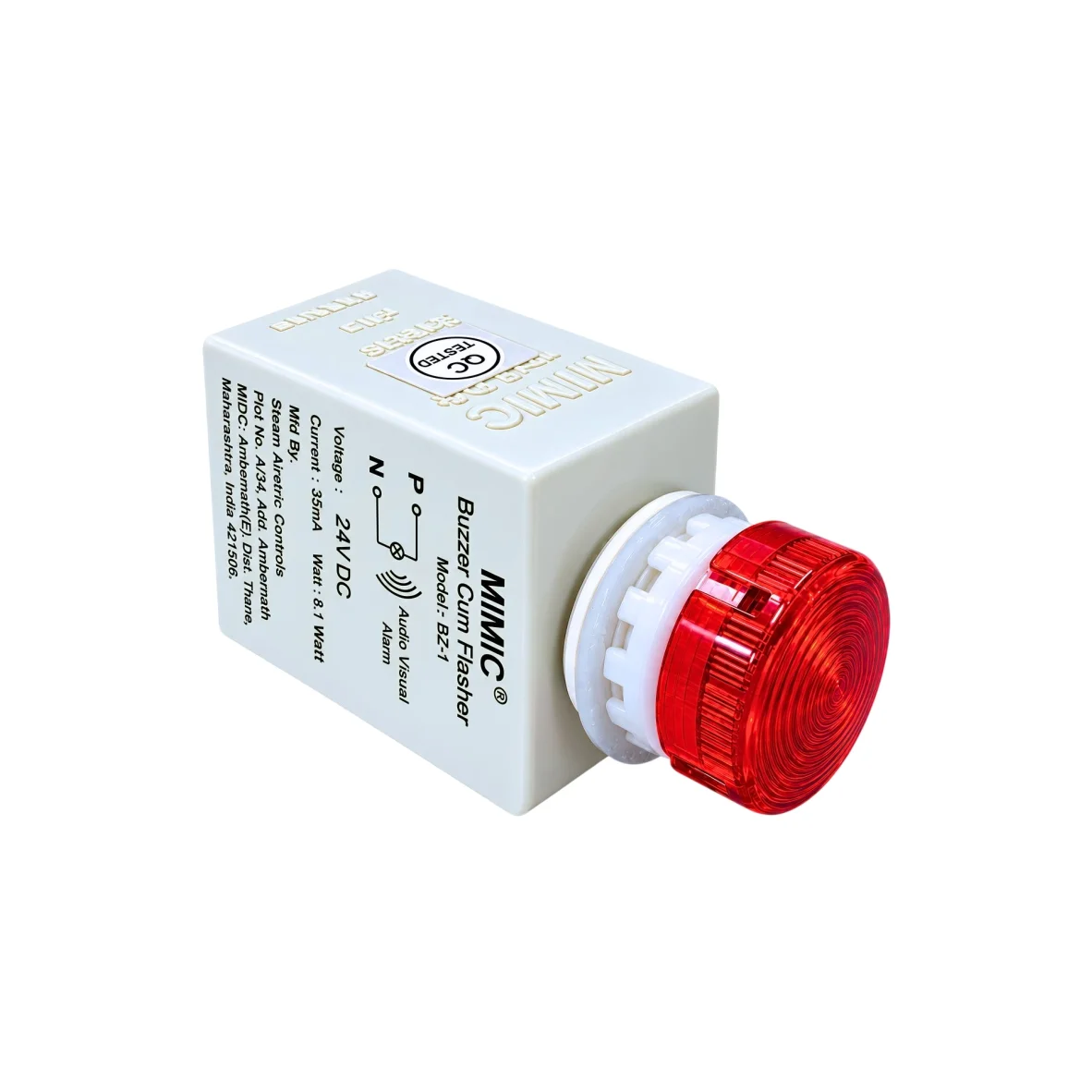
The Mimic BZ1 offers several specifications that can be evaluated for automation applications.
Audible notification: The device provides a specified sound output of 90 dB at one metre.
Visual notification: Its red LED flashes at 60 flashes per minute.
Simultaneous operation: The buzzer and LED operate together.
Panel integration: The device uses a 22.5 mm panel mounting cutout.
Construction: Its body uses flame-retardant PBT material, while the glowing cap is made from polycarbonate.
Electrical protection: Reverse-polarity protection is specified.
Operating duty: The unit is designed for continuous-duty operation.
These features provide a starting point for determining whether the product meets a particular automation requirement.
Improving Operator Awareness Through Combined Alerts
In automated facilities, operators may supervise multiple machines through centralised control panels.
An alarm that uses only a small visual indicator may not always attract attention, particularly when several indicators are installed close together.
An audible notification provides an additional method of communicating an active alarm.
Similarly, the flashing LED provides a visual reference that can help operators locate the warning device.
Using both methods can improve the overall visibility of selected alarm conditions.
However, alarm placement, signal differentiation, and control logic should be planned carefully. Critical alarms may require additional safety measures beyond a standard signalling device.
Integration with PLC and Relay Circuits
A flasher buzzer can be incorporated into different automation arrangements, depending on its electrical requirements.
For example, a PLC output may control the device through a suitable switching arrangement.
Alternatively, an alarm relay may activate the warning when a monitored fault condition occurs.
During integration, engineers should consider:
-
Available output voltage.
-
Output current capacity.
-
Electrical isolation requirements.
-
Correct polarity.
-
Alarm activation logic.
-
Wiring protection.
-
Manufacturer connection instructions.
The control output must be suitable for the electrical characteristics of the connected device.
Maintenance Practices for Industrial Warning Equipment
Warning devices should be included in regular panel inspection procedures.
A maintenance team can check whether the unit is securely mounted and whether the wiring connections remain in good condition.
The audible output and LED indication should also be tested using the appropriate alarm test procedure.
Furthermore, the alarm circuit should be reviewed whenever the automation program or machine control arrangement is modified.
This helps ensure that warning indications remain consistent with the intended operating logic.
Selecting the Right Product for Automation
When evaluating a signalling component, consider the following questions:
-
Does its operating voltage match the control supply?
-
Is its sound output suitable for the installation?
-
Is the flashing LED visible from the operator's position?
-
Does the mounting arrangement match the panel?
-
Is its front protection appropriate for the environment?
-
Can the control circuit operate it safely?
-
Does the device meet the required duty rating?
Answering these questions makes the selection process more systematic.
Why Consider Mimic Products?
Mimic Products offers the BZ1 24V DC Flasher Buzzer for compatible industrial signalling applications.
The product integrates an electronic buzzer and red flashing LED in a single unit. This arrangement can help simplify panel layouts while providing two forms of notification.
It can be considered by automation engineers, control panel manufacturers, OEM equipment manufacturers, and industrial maintenance teams.
Frequently Asked Questions
1. Can a flasher buzzer be used with a PLC?
Yes, provided the PLC output and switching arrangement are electrically compatible with the device.
2. What is the operating voltage of Mimic BZ1?
The BZ1 is designed for 24V DC operation.
3. Can it provide both sound and light?
Yes. The buzzer and red flashing LED operate simultaneously.
4. Where is it commonly used?
It can be considered for automation panels, packaging machinery, manufacturing systems, and process monitoring installations.
5. Does it require separate LED and buzzer components?
No. Both signalling functions are integrated into one unit.
Conclusion
Industrial automation depends on effective communication between machines, controllers, and operators. Although automated systems can detect many operating conditions, personnel still require suitable notifications when a fault or warning occurs.
An integrated audible and visual alarm provides a practical way to communicate selected conditions.
The Mimic BZ1 24V DC model combines these functions in a compact panel-mounted device suitable for compatible industrial automation applications.

 English
 Arabic
 French
 Spanish
 Portuguese
 Deutsch
 Turkish
 Italiano
 Russian
 Romaian
 Portuguese (Brazil)
 Greek
