


Utilities Turn to Predictive AI to Balance Renewable Energy Loads
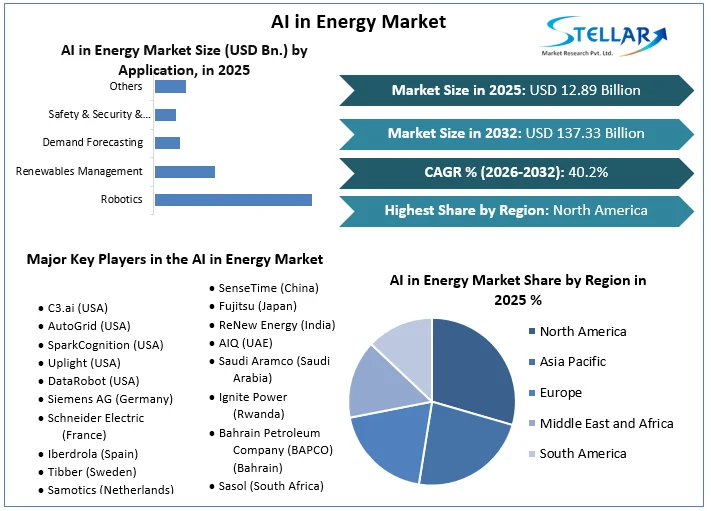
The global AI in Energy Market is surging toward a projected USD 137.33 billion by 2032, up from USD 12.89 billion in 2025 at a 40.2% compound annual growth rate (CAGR), according to Stellar Market Research. Power systems worldwide are entering a high-stakes operational shift as data-center load growth, variable renewable generation, and grid bottlenecks force utilities to treat software intelligence as core infrastructure rather than an add-on tool.
Power networks were built for predictable, one-way electricity flow from centralized plants to passive consumers, yet modern grids now juggle intermittent solar and wind, distributed storage, electric vehicle charging, and power-hungry AI compute clusters. That collision between rising power demand and physical grid limits is turning artificial intelligence from an efficiency experiment into a balance-sheet necessity. Energy executives are no longer asking whether AI can trim marginal operating costs; they are deploying predictive models, real-time load orchestration, and automated grid analytics to keep substations stable, defer costly line upgrades, and prevent curtailment when supply and demand swing sharply.
Key Findings from the Report
-
Market Scale & Trajectory: The market stood at USD 12.89 billion in 2025 and is forecast to reach USD 137.33 billion by 2032, expanding at a 40.2% CAGR across the 2026–2032 forecast window.
-
Dominant End-Use Segment: Utilities capture the largest revenue share due to climate-driven operational pressure, grid routing optimization, and rapid renewable integration across power networks.
-
Core Functional & Solution Scope: Coverage spans Solutions and Services, applications across Robotics, Renewables Management, Demand Forecasting, and Safety & Security & Infrastructure, and end uses across Energy Generation, Energy Transmission, Energy Distribution, and Utilities.
-
Regional Leadership vs. Momentum: North America leads near-term market scale on the back of advanced cloud infrastructure and large-scale analytics readiness, while China and broader Asia-Pacific accelerate smart grid and renewable AI deployments.
-
Grid Interconnection Urgency: AI-driven interconnection and load-management tools are gaining rapid traction to resolve bottlenecks when connecting large loads—such as data centers and solar farms—to existing power grids.
-
Investor & Buyer Takeaway: For energy buyers, infrastructure funds, and enterprise software vendors, high-growth returns cluster around software platforms and operational analytics that shorten interconnection queues, curb unplanned downtime, and protect grid reliability.
For further information, click the following link:https://www.stellarmr.com/report/req_sample/ai-in-energy-market/2853
Market Drivers and Restraints
Key Drivers
-
Surging Electricity Demand & Data Center Loads: Rapid expansion of AI compute campuses, electrification, and smart city infrastructure is increasing power system complexity and pushing operators toward automated load balancing and forecasting.
-
Renewable Integration & Grid Modernization: Rising shares of variable wind and solar power require real-time forecasting, routing efficiency, and congestion management that legacy manual grid controls cannot match.
-
Cloud & Analytics Maturity: Mature cloud computing ecosystems and transformer-based analytical models allow utilities to ingest high-volume sensor and operational datasets for faster decision-making.
Key Restraints
-
Legacy Grid & OT Integration Hurdles: Aging transmission and distribution hardware, fragmented operational technology (OT) systems, and high upfront modernization costs slow deployment—especially among smaller utilities and capital-constrained markets.
-
Data Quality, Cybersecurity & Talent Gaps: Inconsistent operational data, strict reliability and cybersecurity requirements on critical grid assets, and shortages of specialized AI-energy engineers continue to lengthen implementation timelines.
Technology, Regulation, and Sustainability Trends
Across the energy value chain, AI adoption is shifting from isolated pilot projects toward enterprise-wide operational intelligence. Utilities and energy tech providers are pairing machine learning, predictive analytics, and computer vision with cloud and hybrid architectures to monitor equipment health, anticipate grid stress, and streamline renewable dispatch.
Policy and sustainability mandates are reinforcing this shift as governments push cleaner power mixes, tighter emissions accountability, and resilient grid infrastructure. At the same time, rising electricity draw from digital infrastructure means sustainability goals increasingly hinge on pairing clean power generation with demand-side flexibility, grid-enhancing technologies, and measurable emissions and efficiency tracking.
Regional Insights
North America anchors early market adoption thanks to deep cloud computing infrastructure, active utility analytics programs, and acute grid interconnection demand from data centers and renewable projects. Utilities and grid innovators across the United States are focused on managing load growth, improving outage resilience, and speeding up grid access for large commercial and clean-energy additions.
Asia-Pacific—led by China alongside fast-moving regional power markets such as India—is a high-momentum growth engine. Aggressive investments in smart grids, digital metering, and renewable capacity expansion are driving strong demand for AI tools that coordinate distributed generation, manage peak loads, and modernize high-growth power networks.
Recent Industry Developments
-
OpenAI (2026): Launched its Grid Protectors initiative—starting with a planned Effingham County, Georgia campus agreement with Georgia Power for up to 1,000 MW of flexible demand response—establishing commercial mechanisms for AI data centers to scale down electricity draw during grid stress.
-
Firstsource Solutions and SEW.AI (2026): Formed a strategic partnership at the WE3 Global AI Summit to roll out Smart Revenue Operations and Smart Revenue Collections for energy and water utilities, pairing vertical AI with billing and collections workflows to reduce billing exceptions and improve cash recovery.
-
European Commission (2026): Unveiled its Strategic Roadmap for Digitalisation and AI in the Energy Sector and launched the AI.grids Community of Practice to advance pan-European grid AI models, cross-border energy data interoperability, grid-enhancing technologies, and sustainable data-center integration.
-
Schneider Electric (2025): Debuted its One Digital Grid Platform, integrating AI-enabled planning, operations, and asset management with cloud and on-premises flexibility to speed outage response and align digital grid models with real-world network conditions.
-
Enphase Energy (2025): Introduced its AI-powered IQ Energy Management system in France to automate household energy loads, lower electricity bills, and maximize residential solar self-consumption.
Competitive Landscape
Competition in the AI in Energy Market spans specialized energy-AI software vendors, industrial automation leaders, cloud providers, and analytics platforms. Established software and platform players—including C3.ai, AutoGrid, SparkCognition, Uplight, and DataRobot—compete alongside major industrial and cloud ecosystems by offering predictive maintenance, anomaly detection, demand forecasting, and grid optimization capabilities.
Rather than competing on isolated algorithms alone, leading vendors are differentiating through seamless integration with legacy utility systems, cloud-to-edge scalability, and partnerships with power generators, grid operators, and data center developers. Strategic alliances that combine domain-specific energy workflows with real-time telemetry and flexible load orchestration are becoming a decisive battleground for market share.
Analyst Commentary
"Grid operators are moving past experimental pilots because physical bottlenecks and power demand volatility leave no margin for guesswork," said a Senior Research Analyst at Stellar Market Research. "Through 2032, the biggest winners in AI for energy will be the platforms that turn fragmented grid telemetry into trusted, real-time control across generation, transmission, and flexible loads."
Future Outlook
Through 2032, demand for AI in energy is set to expand from point analytics into continuous, system-wide orchestration across power generation, grid operations, storage, and flexible commercial and residential loads. Capital investment will increasingly favor interoperable software, grid-enhancing technologies, and co-optimized energy-and-compute partnerships that reduce interconnection friction.
At the same time, tighter regulatory oversight on grid reliability, cybersecurity, and data governance will shape how models are trained, audited, and deployed on critical infrastructure. Vendors that pair verifiable operational ROI with strong security and seamless integration into existing utility workflows will capture disproportionate share as the market scales.
For further information, click the following link:https://www.stellarmr.com/report/req_sample/ai-in-energy-market/2853
About Stellar Market Research
Stellar Market Research is a multifaceted market research and consulting company with professionals from several industries. Some of the industries we cover include medical devices, pharmaceutical manufacturers, science and engineering, electronic components, industrial equipment, technology and communication, cars and automobiles, chemical products and substances, general merchandise, beverages, personal care, and automated systems. To mention a few, we provide market-verified industry estimations, technical trend analysis, crucial market research, strategic advice, competition analysis, production and demand analysis, and client impact studies.
Address
Phase 3, Navale IT Zone, S.No. 51/2A/2, Office No. 202, 2nd floor, Near, Navale Brg, Narhe, Pune, Maharashtra 411041
Email
sales@stellarmr.com
Mobile
+91 9607365656

 English
 Arabic
 French
 Spanish
 Portuguese
 Turkish
 Dutch
 Italiano
 Russian
 Romaian
 Portuguese (Brazil)
 Greek
