


Saffron Market Analysis 2026–2034: Growth Drivers, Market Segmentation, and Competitive Landscape
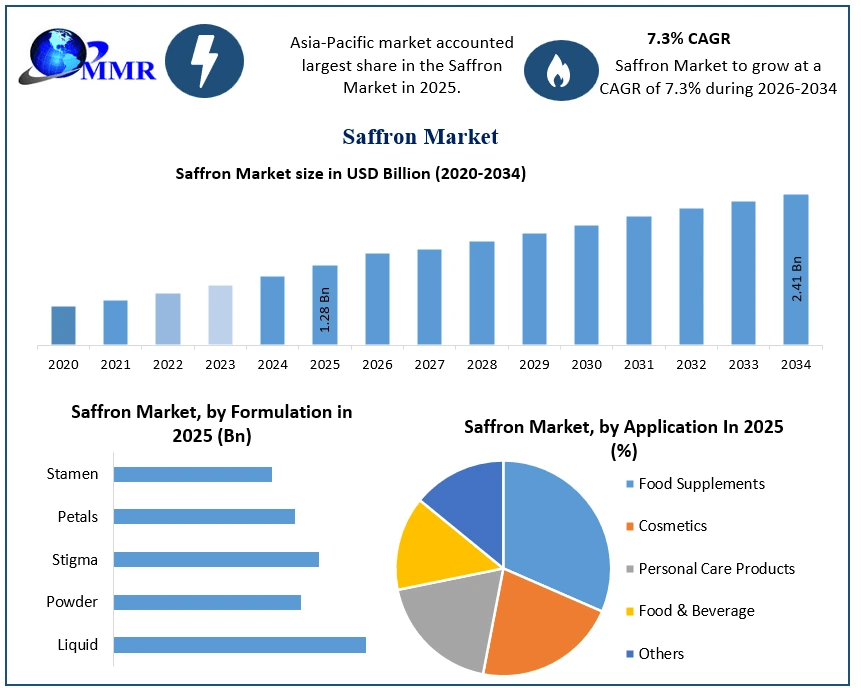
Saffron Market to Reach USD 2.41 Billion by 2034, Driven by Growing Demand for Natural Ingredients and Health Supplements
1. Market Estimation, Growth Drivers, and Opportunities
The global Saffron Market was valued at approximately USD 1.28 billion in 2025 and is anticipated to reach USD 2.41 billion by 2034, expanding at a CAGR of 7.3% throughout the forecast period of 2026–2034. Saffron, widely recognized as red gold, is a high-value spice extracted from the dried stigmas of the Crocus sativus flower. It is extensively utilized across the food and beverage, pharmaceutical, nutraceutical, cosmetics, and personal care industries due to its unique flavor, aroma, coloring characteristics, and beneficial bioactive properties. Rising consumer awareness of natural ingredients and the potential health benefits of saffron is significantly contributing to market expansion. Increasing demand for herbal supplements, antioxidant-rich products, and natural food additives is further accelerating its adoption across various industries. Moreover, the growing popularity of gourmet cuisine, saffron-based beverages, premium skincare products, and wellness supplements is creating attractive growth opportunities for manufacturers. Continuous improvements in cultivation practices, harvesting methods, extraction technologies, and processing techniques are also enhancing product quality and operational efficiency. Nevertheless, high cultivation expenses, unpredictable climatic conditions, raw material price fluctuations, and concerns regarding product adulteration may restrict market growth. Going forward, increasing investments in organic saffron farming, standardized extracts, functional food ingredients, nutraceutical formulations, and innovative cosmetic applications are expected to create significant business opportunities and support the long-term development of the global saffron industry.
To know the most attractive segments, click here for a free sample of the report: https://www.maximizemarketresearch.com/market-report/saffron-market/24308/
2. United States Saffron Market: Latest Trends and Investments in 2024
The United States saffron market is experiencing rising demand across the food processing, gourmet culinary, dietary supplement, and natural wellness sectors. Increasing consumer preference for authentic, premium-quality spices and botanical ingredients is encouraging suppliers to focus on product traceability, stringent quality standards, and attractive premium packaging. According to World Bank trade data, the United States imported approximately USD 18.21 million worth of saffron, totaling 49,536 kg, in 2024. Spain emerged as the largest supplier, contributing around USD 15.07 million to US saffron imports, followed by Afghanistan and Greece. This import pattern highlights the significant role of international suppliers in fulfilling domestic market demand. Meanwhile, emerging investment opportunities are concentrated in saffron-based nutraceutical products, branded extracts, advanced quality-testing solutions, and specialized food ingredients. Market participants are also adopting innovative extraction technologies and product authentication systems to enhance consistency, verify product quality, and strengthen consumer trust. Furthermore, growing interest in natural wellness solutions and premium food ingredients is expected to support continued investment in the US saffron value chain.
3. Saffron Market Segmentation: Leading Segments
By formulation, the global saffron market is categorized into powder, liquid, and thread. Among these, the thread segment accounted for the largest market share, primarily driven by its long-standing use in traditional cooking, premium culinary preparations, and high-quality spice applications. Saffron threads are widely preferred for their ability to preserve the spice’s distinctive aroma, rich color, and characteristic flavor, making them a favored choice among consumers and food manufacturers.
By application, the food segment emerged as the dominant category, with its volume share expected to reach 45% by 2034. This leadership is attributed to the widespread use of saffron in traditional dishes, confectionery, bakery products, beverages, and gourmet cuisines. Additionally, growing consumer demand for natural coloring and flavoring ingredients is supporting the adoption of saffron across the global food and beverage industry.
4. Saffron Market Competitive Analysis
The global saffron market includes regional producers, specialty spice suppliers, exporters, and branded ingredient manufacturers competing through product quality, authenticity, sourcing capabilities, and innovation. Key companies identified in the market include Great American Spice, Mehr Saffron, HEA & Co, Golden Saffron Co., and Azafran de la Mancha. The available market information does not disclose individual market-share percentages or a verified ranking of these companies; therefore, these businesses are highlighted as key industry participants rather than confirmed top-five market-share leaders.
Companies are increasingly focusing on premium product development, traceability, and advanced processing technologies. Tata Consumer Products introduced Grade 1 Kashmiri saffron under its Himalayan brand, incorporating AI-enabled QR-code authentication to strengthen product transparency and consumer confidence. Activ'Inside has developed its patented Safr'Inside saffron extract using Techcare encapsulation technology to preserve the extract's natural composition and safranal content. Pharmactive Biotech Products has strengthened its position in the wellness segment through its Affron saffron extract, which is supported by a US patent for low-mood support. Additionally, Natac Group expanded its saffron extract capabilities through the acquisition of French biotechnology company INOREAL. These developments demonstrate how product innovation, quality authentication, research, and strategic acquisitions can strengthen competitiveness and expand saffron applications across global markets.
5. Regional Analysis: United States, United Kingdom, Germany, France, Japan, and China
The Asia Pacific region dominates the global saffron market, supported by established cultivation activities, traditional consumption patterns, and growing demand for premium spices and natural ingredients. India and China contribute to regional demand, while Iran and other Asian producers play important roles in the supply chain.
The United States represents an important consumption market, driven by increasing demand for premium spices, gourmet foods, natural supplements, and botanical extracts. Its dependence on imported saffron creates opportunities for international suppliers and specialty spice distributors.
The United Kingdom benefits from multicultural food consumption, growing interest in international cuisines, and demand for premium ingredients. Food safety requirements and product traceability standards encourage suppliers to maintain quality and authenticity.
Germany represents an important European market because of its established food processing, pharmaceutical, and natural health product industries. European food safety and labeling requirements support demand for properly tested and authenticated saffron products.
France benefits from its established culinary and cosmetics industries, creating opportunities for premium saffron ingredients in gourmet foods, skincare, and botanical formulations. Its biotechnology and natural ingredient sector also supports product innovation.
Japan offers growth opportunities through demand for premium food ingredients, functional foods, and high-quality botanical products. Strict food import and safety requirements encourage reliable sourcing and quality control.
China represents an important Asia Pacific market, supported by traditional applications of botanical ingredients, increasing consumer purchasing power, and expanding food and wellness industries. Domestic cultivation and research into agricultural technologies also offer opportunities to strengthen supply capabilities.
Country-specific shares of the global saffron market are not disclosed in the available report information; therefore, individual market-share percentages have not been estimated.
6. Conclusion
The global saffron market is positioned for steady expansion, supported by increasing demand for natural ingredients, premium food products, nutraceuticals, and botanical extracts. Growing applications in pharmaceuticals, cosmetics, and functional foods are expected to create additional revenue opportunities for manufacturers and suppliers. In the coming years, investment in sustainable cultivation, advanced extraction technologies, product authentication, and standardized saffron ingredients will be essential for strengthening market competitiveness. Companies that prioritize product quality, transparent sourcing, research and development, and innovative applications are likely to benefit from emerging opportunities. Overall, the expanding global preference for natural wellness products and premium culinary ingredients is expected to remain a major contributor to the long-term growth of the saffron market.
To know the most attractive segments, click here for a free sample of the report: https://www.maximizemarketresearch.com/request-sample/24308/
About us
Maximize Market Research publishes sector forecasts, competitive analysis, and consulting insight for teams evaluating demand, competition, pricing, and growth strategy across high-value industries.
MAXIMIZE MARKET RESEARCH PVT. LTD.
2nd Floor, Navale IT Park Phase 3
Pune Banglore Highway, Narhe
Pune, Maharashtra 411041, India
+91 9607365656
sales@maximizemarketresearch.com

 English
 Arabic
 French
 Spanish
 Portuguese
 Deutsch
 Turkish
 Dutch
 Italiano
 Russian
 Romaian
 Greek
