


Best Practices for Key Management in Enterprise Security.
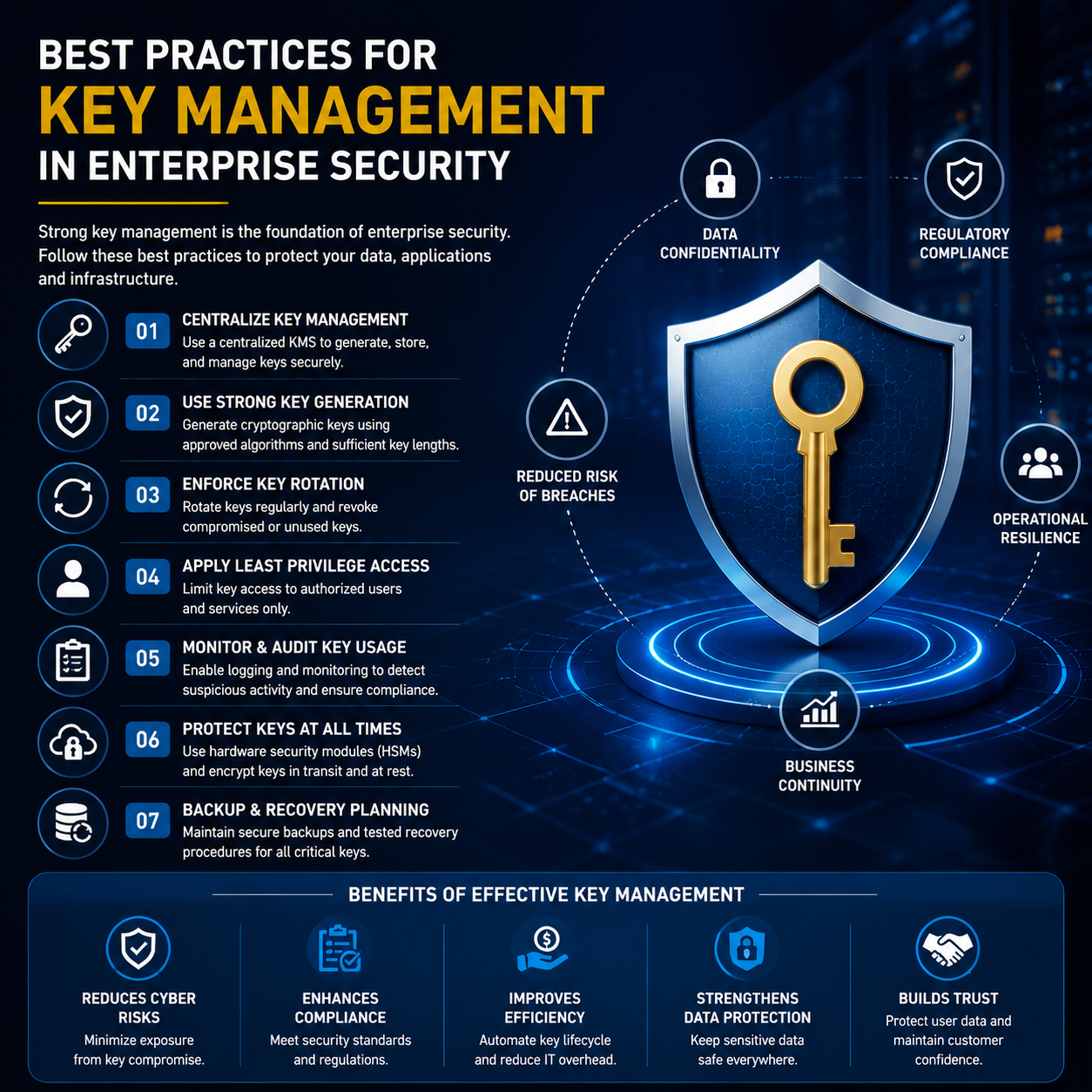
In today’s digital landscape, enterprises handle enormous volumes of sensitive data, including financial records, customer information, and proprietary business details. Protecting this data requires robust security measures, and encryption is one of the most effective tools. However, encryption is only as strong as the way encryption keys are managed. This is where key management solutions play a critical role in enterprise security.
Proper key management ensures that encryption keys are created, stored, rotated, accessed, and retired securely. Without effective practices, even the most advanced encryption techniques can be vulnerable to breaches. In this guide, we explore best practices for key management in enterprise security and highlight how organizations can reduce risks while maintaining compliance.
Understanding Key Management
Key management is the process of handling encryption keys throughout their lifecycle. It involves generating secure keys, controlling access, storing them safely, monitoring their use, rotating them periodically, and securely retiring old keys.
In cryptography, key management in cryptography ensures that symmetric and asymmetric keys are protected. Symmetric keys use the same key for encryption and decryption, while asymmetric keys rely on a public-private key pair. Proper handling of these keys is essential to maintaining data confidentiality and integrity.
Why Enterprises Need Strong Key Management
Enterprises often operate across multiple environments, including on-premise servers, cloud platforms, and hybrid systems. Sensitive data moves between these systems and users daily, making it a target for cyberattacks. Weak key management can result in:
-
Unauthorized access to sensitive information
-
Data breaches and financial loss
-
Non-compliance with regulatory standards
-
Loss of customer trust
Implementing key management solutions helps prevent these issues by securing encryption keys and controlling access throughout the organization.
Best Practices for Enterprise Key Management
1. Centralized Key Control
Centralizing key management allows enterprises to monitor all encryption keys from a single platform. Centralized control provides visibility, reduces administrative errors, and simplifies compliance reporting.
2. Role-Based Access
Not all employees or systems should have access to all keys. Role-based access ensures that only authorized personnel can use specific keys. This reduces insider risks and minimizes the potential for misuse.
3. Regular Key Rotation
Keys should not be used indefinitely. Regular rotation of encryption keys ensures that compromised keys do not expose sensitive data. Most key management solutions provide automated rotation schedules to maintain security consistently.
4. Secure Storage
Keys should be stored separately from encrypted data in secure environments such as hardware security modules or encrypted vaults. Proper storage prevents unauthorized access and ensures that keys remain protected even if data storage is compromised.
5. Backup and Recovery
Enterprises must have secure backup and recovery procedures for encryption keys. Losing a key can render encrypted data inaccessible. A proper key management system ensures that backups are encrypted and stored safely, allowing recovery without exposing sensitive information.
6. Monitoring and Auditing
Audit logs are essential for tracking key usage, access attempts, and changes. Monitoring key activity helps detect anomalies and supports regulatory compliance. Enterprises can quickly respond to potential security incidents using detailed audit trails.
7. Multi-Environment Integration
Many enterprises operate across cloud, on-premise, and hybrid infrastructures. Key management solutions should integrate across all platforms to maintain consistent security policies and reduce gaps in protection.
8. Compliance and Policy Alignment
Enterprises must comply with regulations such as GDPR, HIPAA, and PCI DSS. Key management practices should align with organizational policies and regulatory standards. This includes documenting access controls, rotation schedules, and audit records.
9. Use Trusted Solutions
Selecting a reputable key management provider is crucial. Enterprise solutions like Thales key management offer advanced features, centralized dashboards, automated rotation, and integration with cloud and on-premise systems. These tools provide robust security and reduce administrative complexity.
10. Educate Employees
Even with strong technology, human error can compromise security. Employees should be trained on key management practices, proper handling of encryption keys, and secure access protocols.
Benefits of Following Best Practices
By adopting these key management practices, enterprises can:
-
Protect sensitive data from unauthorized access
-
Reduce cybersecurity risks and insider threats
-
Maintain compliance with industry regulations
-
Ensure operational continuity during key loss or compromise
-
Build trust with customers, partners, and regulators
Effective key management creates a secure foundation that supports overall enterprise cybersecurity strategies.
Common Mistakes to Avoid
Enterprises should avoid these common mistakes in key management:
-
Storing keys alongside encrypted data
-
Granting excessive access privileges
-
Using outdated or weak encryption keys
-
Failing to monitor key usage or maintain audit logs
-
Ignoring backup and recovery procedures
Avoiding these errors strengthens security and reduces the risk of data breaches.
Conclusion
Key management is a critical component of enterprise security. Strong key management solutions help organizations protect sensitive data, maintain compliance, and reduce cybersecurity risks. By following best practices such as centralized control, role-based access, key rotation, secure storage, monitoring, and employee education, enterprises can create a robust encryption environment.
Solutions like Thales key management provide advanced features and integration capabilities, making it easier for large organizations to manage encryption keys across multiple environments. Implementing effective key management ensures that encrypted data remains secure, accessible to authorized users only, and compliant with industry regulations. Proper key management is not just a technical requirement—it is a strategic investment in enterprise data security.

 Arabic
 French
 Spanish
 Portuguese
 Deutsch
 Turkish
 Dutch
Dutch
 Italiano
 Russian
 Romaian
 Portuguese (Brazil)
 Greek
Greek
