


Why the Right Zoho Implementation Partner Impacts CRM Success
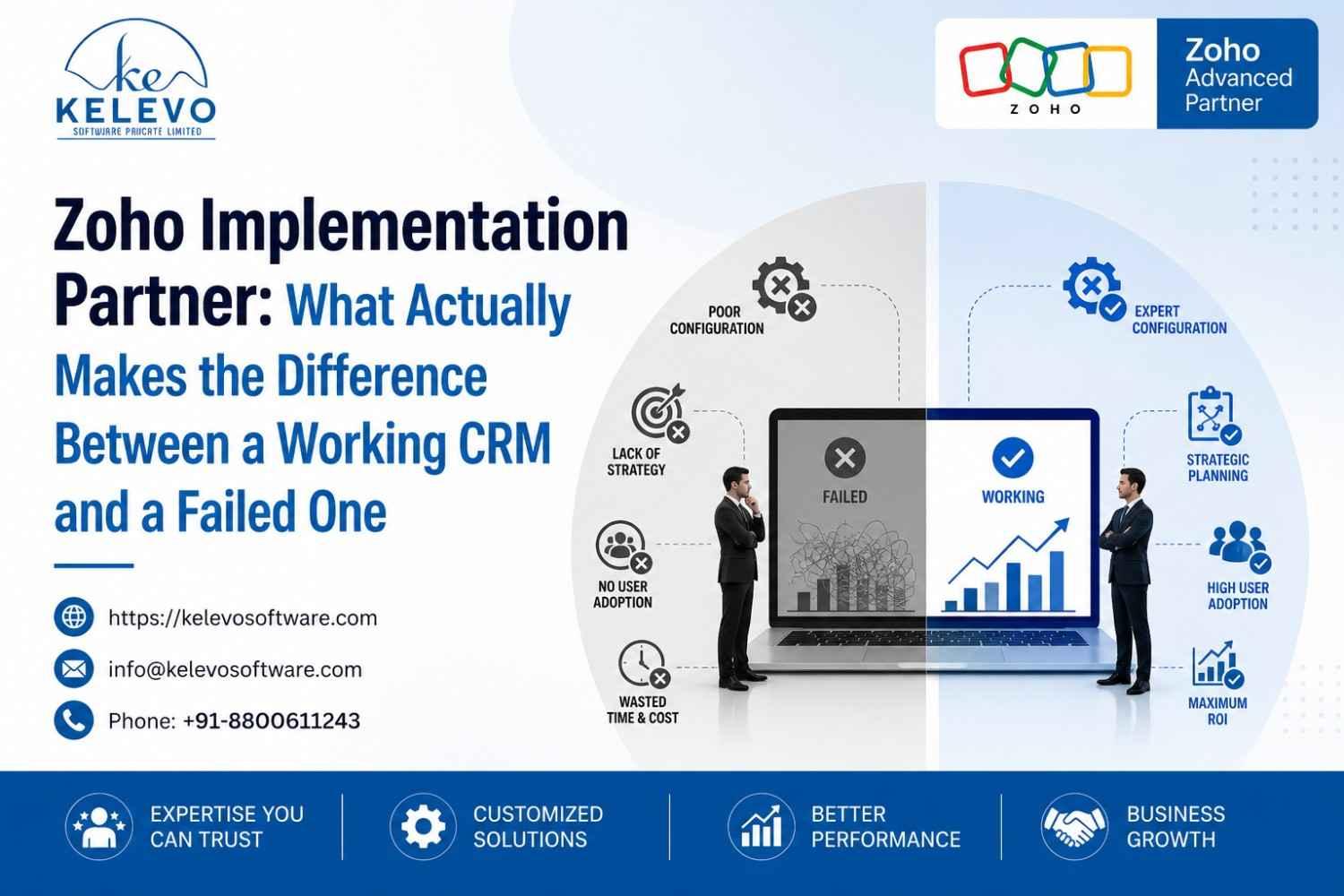
A CRM rollout usually starts with optimism. Leadership approves the budget, teams attend discovery sessions, and implementation timelines look achievable on paper. Then real operations enter the picture.
Sales teams want custom workflows. Management needs reporting. Existing data turns out to be incomplete. Departments disagree on processes they assumed were already standardized. This is often where a Zoho Implementation Partner becomes far more important than the software itself.
The technical setup rarely causes the biggest problems. Operational alignment does. Over the years, I have seen organizations purchase excellent software and still struggle for months because implementation decisions were made without understanding how the business actually operates.
Key Takeaways
-
CRM failures often originate from process gaps, not software limitations.
-
Data migration issues are frequently underestimated during planning.
-
Customization decisions can create long-term maintenance challenges.
-
Poor stakeholder alignment usually causes more delays than technical work.
-
An experienced Zoho Implementation Partner helps reduce operational risk, not just implementation effort.
The Software Is Rarely the Problem
Many organizations approach CRM implementation as a software deployment project. In reality, it is an operational change project disguised as a technology initiative.
A business may believe its sales process is well documented until implementation workshops begin. Suddenly different teams describe completely different customer journeys. Lead qualification varies by department. Reporting expectations conflict with actual workflows.
This is usually where projects become messy.
A capable Zoho Implementation Partner spends significant time understanding operational reality before building workflows. Rushing into configuration often creates technical debt that becomes expensive later.
I have seen organizations complete CRM deployment quickly and then spend months correcting automation rules, user permissions, duplicate records, and reporting structures. None of those issues originated from Zoho itself. They originated from assumptions made during planning.
This is why experienced implementation teams challenge requirements instead of simply accepting them.
Sometimes what a business requests is not what it actually needs.
What Businesses Commonly Ignore During CRM Implementation
The most expensive problems rarely appear during initial setup. They emerge several months later when users begin relying on the system daily.
Some recurring issues include:
-
Inconsistent customer data across departments
-
Poorly designed automation creating workflow conflicts
-
Reporting structures that fail under growing transaction volume
-
Excessive customization that complicates future upgrades
-
Lack of ownership after deployment goes live
Organizations often focus heavily on launch dates while giving limited attention to post-launch governance.
A CRM is not a static application. Processes evolve. Teams change. New products are introduced. Reporting requirements expand. Without proper governance, even a successful implementation can slowly become difficult to manage.
The strongest Zoho Implementation Company teams prepare clients for long-term operational management rather than simply delivering configuration work.
Why Enterprise CRM Projects Become More Complex Than Expected
The phrase "Zoho CRM Setup for Enterprise" sounds straightforward until integration requirements start appearing.
Most enterprise environments contain multiple systems. Accounting software, marketing platforms, customer support applications, inventory systems, and reporting tools all depend on data moving accurately between platforms.
The challenge is not connecting systems.
The challenge is maintaining data consistency across systems when business processes change.
For example, a small modification in lead qualification may affect reporting, automation triggers, customer onboarding workflows, and downstream integrations simultaneously.
One thing many teams underestimate is how quickly small changes create wider operational consequences.
An experienced Zoho Implementation Partner understands these dependencies early. Instead of treating integrations as isolated technical tasks, they evaluate how information moves through the organization.
This approach reduces future maintenance problems because architecture decisions are made with scalability in mind.
Many implementation failures are not immediate failures. They are delayed failures that appear six or twelve months later when growth exposes weaknesses in the original design.
The Cost Conversation Is Often Framed Incorrectly
Businesses frequently compare vendors based primarily on implementation fees.
That comparison rarely tells the whole story.
The initial project cost represents only one portion of the total investment. Ongoing maintenance, support requirements, future customization, retraining, and operational disruption often have a larger financial impact over time.
A lower-cost provider may appear attractive during procurement. However, if implementation shortcuts create reporting problems or inefficient workflows, operational costs increase quietly in the background.
I have observed situations where organizations spent more correcting implementation mistakes than they spent on the original deployment.
The Best CRM Implementation Company India businesses work with typically focuses on sustainability rather than speed alone.
Sometimes that means recommending fewer customizations.
Sometimes it means challenging unrealistic deadlines.
Sometimes it means delaying deployment until business processes become clearer.
Those decisions can feel uncomfortable during implementation, but they often prevent larger issues later.
What Experienced Zoho Partners Do Differently
The difference between average implementation providers and strong consulting teams is rarely technical capability alone.
Most providers can configure workflows.
The stronger providers understand business operations.
A mature Zoho Solution Partner or Zoho Implementation Company typically focuses on:
-
Process analysis before customization
-
Data quality assessment before migration
-
Governance planning before launch
-
User adoption strategy before deployment
-
Scalability considerations before integrations
This creates a different implementation experience.
Instead of building exactly what stakeholders request, experienced consultants often investigate why the request exists. That additional layer of analysis helps identify hidden operational issues that software alone cannot solve.
The result is usually a system that remains usable as the organization grows.
That outcome matters far more than completing deployment a few weeks earlier.
Vendor Selection Mistakes That Create Long-Term Problems
Choosing a Zoho Implementation Partner is often treated as a procurement exercise. It should be treated as an operational risk decision.
Organizations frequently prioritize feature demonstrations while overlooking implementation methodology.
Questions that matter include:
How does the partner handle changing requirements?
How do they manage stakeholder disagreements?
What happens when data migration reveals quality issues?
How is post-launch support structured?
How do they approach scalability planning?
These discussions provide more useful insights than software demonstrations alone.
The technical setup is rarely the hardest part. Managing long-term operational consistency usually is.
Partners who understand that reality tend to deliver better outcomes because they prepare clients for challenges beyond deployment day.
Conclusion
If there is one opinion I have developed after observing numerous CRM deployments, it is this: businesses spend too much time evaluating software and too little time evaluating implementation capability.
The most common mistake remains treating CRM implementation as a technology project rather than an operational transformation effort.
A useful takeaway is to examine process maturity before focusing on customization requests. Many workflow problems originate outside the software itself.
Looking ahead, CRM environments will become increasingly connected through automation, AI-driven workflows, and cross-platform integrations. Organizations that build clean operational foundations today will find future expansion far easier than those carrying years of implementation shortcuts.
FAQs
1. How long does a typical Zoho CRM implementation take?
Ans. Most projects take anywhere from a few weeks to several months depending on workflow complexity, integrations, data quality, and stakeholder availability. Business alignment usually affects timelines more than technical configuration.
2. Why do CRM implementations exceed planned budgets?
Ans. Additional customization requests, data migration challenges, integration complexity, and changing business requirements are common causes. These issues often emerge after implementation begins.
3. Is customization always beneficial in Zoho CRM?
Ans. Not necessarily. Excessive customization can increase maintenance effort and create future scalability challenges. The best implementations balance flexibility with simplicity.
4. What should businesses look for in a Zoho Implementation Partner?
Ans. Focus on operational understanding, implementation methodology, governance planning, support structure, and integration experience rather than technical capability alone.
5. Can a CRM fail even if the software is configured correctly?
Ans. Yes. User adoption issues, inconsistent processes, poor data quality, and unclear ownership can undermine an otherwise successful technical implementation.

 English
 Arabic
 French
 Spanish
 Portuguese
 Deutsch
 Turkish
 Dutch
Dutch
 Italiano
 Russian
 Romaian
 Portuguese (Brazil)
