


Application Lifecycle Management for Regulated Industries Market Trends Shaping the Future of Compliance
As industries become increasingly digital, the complexity of software development continues to grow. Organizations operating in highly regulated sectors such as aerospace, defense, automotive, medical devices, and advanced engineering face a unique challenge: they must accelerate innovation while simultaneously meeting strict regulatory requirements. In this environment, maintaining compliance, ensuring traceability, and managing risk are no longer optional—they are essential. This reality is driving significant growth in the Application Lifecycle Management for Regulated Industries Market, a sector that plays a critical role in enabling organizations to develop high-quality products while adhering to industry regulations.
Today, software is embedded into nearly every mission-critical product, from autonomous vehicles and aircraft systems to medical devices and industrial equipment. As software complexity increases, regulatory agencies and industry standards bodies demand greater accountability throughout the development lifecycle. Organizations must demonstrate that every requirement, design decision, code change, test result, and approval is documented and traceable. Application Lifecycle Management (ALM) platforms have emerged as a strategic solution to address these challenges.
The evolution of ALM in regulated industries reflects a broader shift toward integrated compliance-driven development. Modern ALM platforms go beyond traditional project management and software development tools. They provide a unified environment that connects requirements management, design, testing, validation, release management, and compliance documentation. This comprehensive approach helps organizations maintain complete visibility across the product lifecycle while reducing operational risks.
One of the primary drivers fueling the Application Lifecycle Management for Regulated Industries Market is the increasing complexity of regulatory frameworks. Industries such as healthcare, aerospace, and automotive must comply with stringent standards including FDA 21 CFR Part 11, ISO 26262, IEC 62304, DO-178C, and numerous regional regulations. These standards require organizations to maintain extensive documentation, validate processes, and demonstrate end-to-end traceability throughout product development.
Meeting these requirements manually is becoming increasingly difficult and resource-intensive. ALM platforms automate many compliance-related activities by enforcing structured workflows, maintaining audit trails, and ensuring that every change is properly reviewed and approved. This automation not only reduces administrative burden but also minimizes the risk of compliance violations.
Traceability remains one of the most important capabilities offered by modern ALM solutions. In regulated environments, organizations must establish clear relationships between requirements, designs, tests, defects, risks, and final product releases. Comprehensive traceability enables teams to quickly identify the impact of changes, demonstrate compliance during audits, and improve overall product quality.
The growing adoption of agile and DevOps methodologies is also influencing market growth. Traditionally, regulated industries were hesitant to adopt agile development practices due to concerns about compliance and documentation. However, modern ALM platforms bridge this gap by integrating agile workflows with robust governance and compliance controls. Organizations can now achieve greater development agility while maintaining regulatory adherence.
Another significant factor driving the market is the increasing importance of risk management. As products become more software-driven, the consequences of defects or failures can be severe. In industries such as medical devices or aerospace, software errors may result in safety risks, financial losses, or regulatory penalties. ALM platforms provide built-in risk management capabilities that help organizations identify, assess, monitor, and mitigate risks throughout the development lifecycle.
Digital transformation initiatives are further accelerating adoption across regulated sectors. Organizations are investing in advanced technologies to improve collaboration, enhance operational efficiency, and reduce product development cycles. Cloud-based ALM solutions, artificial intelligence, analytics, and automation capabilities are helping enterprises modernize development processes while maintaining compliance requirements.
Artificial intelligence is becoming increasingly valuable within ALM environments. AI-powered capabilities can automate requirement analysis, identify potential compliance gaps, recommend corrective actions, and enhance testing processes. Predictive analytics can also help organizations anticipate project risks and improve decision-making throughout the lifecycle. As AI technologies mature, they are expected to play an even greater role in strengthening ALM capabilities.
The Application Lifecycle Management for Regulated Industries Market is also benefiting from the growing need for cross-functional collaboration. Modern product development often involves multiple teams working across different geographic locations and disciplines. Engineers, developers, quality assurance specialists, regulatory experts, and project managers must collaborate effectively while maintaining strict process controls.
ALM platforms serve as a centralized hub that enables seamless collaboration across departments. By providing a single source of truth for project information, these platforms help eliminate communication gaps, improve visibility, and ensure consistency throughout the development process.
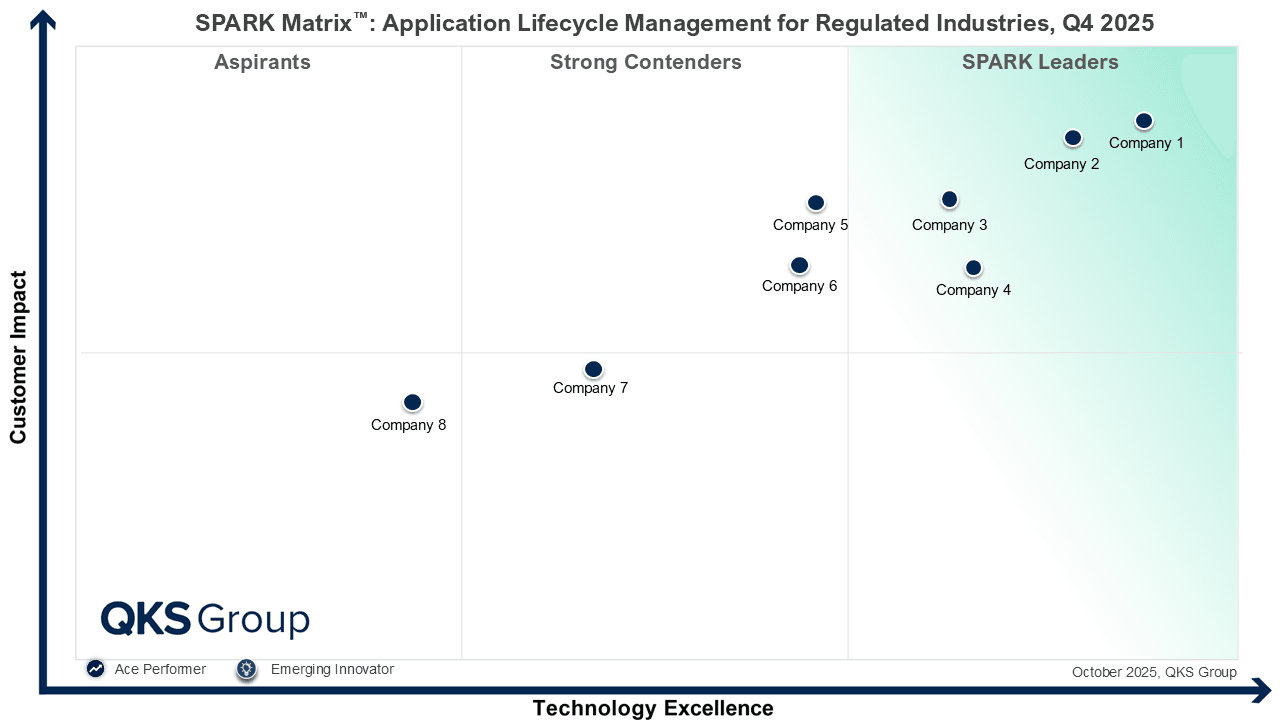
From a competitive perspective, the market is characterized by continuous innovation and strong vendor competition. QKS Group’s SPARK Matrix analysis evaluates leading vendors based on technology excellence and customer impact. Key vendors featured in the market include IBM, Inflectra, Jama Software, Kovair, OpenText, Perforce Software, PTC, and Siemens. These companies continue to invest in advanced capabilities such as cloud-native architectures, AI-powered analytics, integrated compliance management, and enhanced traceability frameworks.
Cloud deployment is emerging as a major trend within the market. Organizations increasingly prefer cloud-based ALM platforms due to their scalability, flexibility, and ability to support distributed teams. Cloud solutions enable faster implementation, simplified maintenance, and improved accessibility while maintaining security and compliance requirements.
Despite its strong growth trajectory, the market faces several challenges. Integration with legacy systems, evolving regulatory requirements, cybersecurity concerns, and organizational resistance to change can complicate implementation efforts. However, vendors are addressing these challenges through enhanced interoperability, robust security features, and user-friendly interfaces designed to accelerate adoption.
Looking ahead, the future of the Application Lifecycle Management for Regulated Industries Market appears highly promising. The continued convergence of software, hardware, and connected technologies will increase the need for comprehensive lifecycle management solutions. Emerging technologies such as artificial intelligence, digital twins, model-based systems engineering, and advanced automation will further transform how regulated organizations develop and manage products.
As compliance requirements become more stringent and product complexity continues to rise, organizations will increasingly rely on sophisticated ALM platforms to maintain quality, reduce risk, and accelerate innovation. The Application Lifecycle Management for Regulated Industries Market is therefore positioned as a critical enabler of modern product development, helping organizations balance regulatory compliance with the need for speed, efficiency, and continuous innovation in an increasingly competitive global landscape.

 English
 French
 Spanish
 Portuguese
 Deutsch
 Turkish
 Dutch
Dutch
 Italiano
 Russian
 Romaian
 Portuguese (Brazil)
 Greek
Greek
