


Load Balancing Fundamentals for Developers
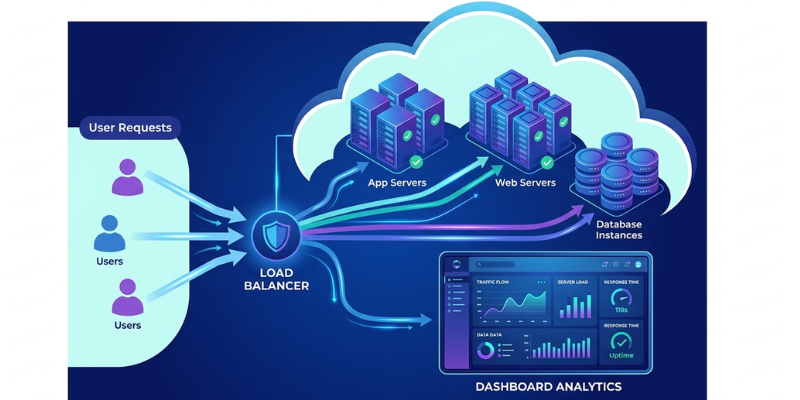
As web applications grow, they need to handle more users, more requests, and larger amounts of data. A single server can quickly become overwhelmed when traffic increases. This is where load balancing becomes an essential part of modern application architecture. It assists in spreading incoming traffic across several servers, making sure that no one server handles the entire load.
Understanding load balancing is important for developers who want to build scalable and reliable applications. It not only improves performance but also enhances availability and user experience. If you want to strengthen your web development skills and gain practical experience with scalable architectures, consider enrolling in the Full Stack Developer Course in Mumbai at FITA Academy to build real-world expertise.
What is Load Balancing
Load balancing involves distributing network traffic or application requests among several servers. Instead of sending all requests to one server, a load balancer directs traffic to different servers based on predefined rules and conditions.
Think of a busy supermarket with several checkout counters. If customers are directed to different counters instead of a single one, the waiting time decreases, and the shopping experience improves. Load balancing works in a similar way by spreading requests across available resources.
This approach helps applications remain responsive even when traffic levels increase. It also prevents server overload and reduces the chances of system failures.
Why Load Balancing Matters
Distributing loads is essential for ensuring the performance of applications. When traffic is evenly distributed, servers can process requests more efficiently. This results in faster response times and a smoother experience for users.
Another major benefit is high availability. In the event of a server failure, the load balancer is capable of directing traffic to the functioning servers. This ensures that the application remains accessible even during hardware or software issues.
Load balancing also supports scalability. As an application grows, additional servers can be added to the infrastructure. The load balancer automatically distributes requests among the expanded resources without affecting users.
Common Load Balancing Methods
Different load balancing strategies are used depending on application requirements.
One popular method is round robin. In this approach, requests are distributed sequentially across all available servers. Each server receives traffic in turn, making the distribution simple and predictable.
Another method is least connections. Here, incoming requests are sent to the server currently handling the fewest active connections. This can improve efficiency when workloads vary between requests.
Weighted load balancing is also commonly used. Servers with greater processing power receive a larger share of traffic, while less powerful servers handle fewer requests.
Developers who want to understand these concepts in depth and apply them to production environments can explore the Full Stack Developer Course in Kolkata to acquire practical experience through experiential projects and structured learning.
Types of Load Balancers
Load balancers can be implemented using hardware devices or software solutions.
Hardware load balancers are dedicated appliances designed specifically for traffic distribution. They are often used in large enterprise environments where performance demands are extremely high.
Software load balancers operate on conventional servers and cloud services. They are flexible, cost-effective, and widely used in modern cloud-native applications.
Cloud providers also offer managed load-balancing services. These services simplify operations and enable development teams to concentrate on creating applications rather than overseeing infrastructure.
Best Practices for Developers
Developers should design applications with scalability in mind from the beginning. Stateless application design is often recommended because it allows requests to be handled by any available server.
Monitoring is equally important. Regularly tracking server health, response times, and traffic patterns helps identify performance bottlenecks before they become serious issues.
It is also important to perform load testing. Simulating real-world traffic conditions allows teams to understand how their systems behave under pressure and make improvements before deployment.
Load balancing is a fundamental concept that helps modern applications achieve better performance, scalability, and reliability. By spreading the workload over several servers, companies can manage growing demand while providing a uniform experience for users. Whether you are building small web applications or large enterprise platforms, understanding load balancing can help you create more resilient systems. To deepen your understanding of scalable architectures and modern development practices, join the Full Stack Developer Course in Delhi and continue building valuable industry-ready skills.
Also check: What Full Stack Architecture Really Means

 English
 Arabic
 French
 Portuguese
 Deutsch
 Turkish
 Dutch
Dutch
 Italiano
 Russian
 Romaian
 Portuguese (Brazil)
 Greek
Greek
