


What Affects Rubber Extrusion Stability?
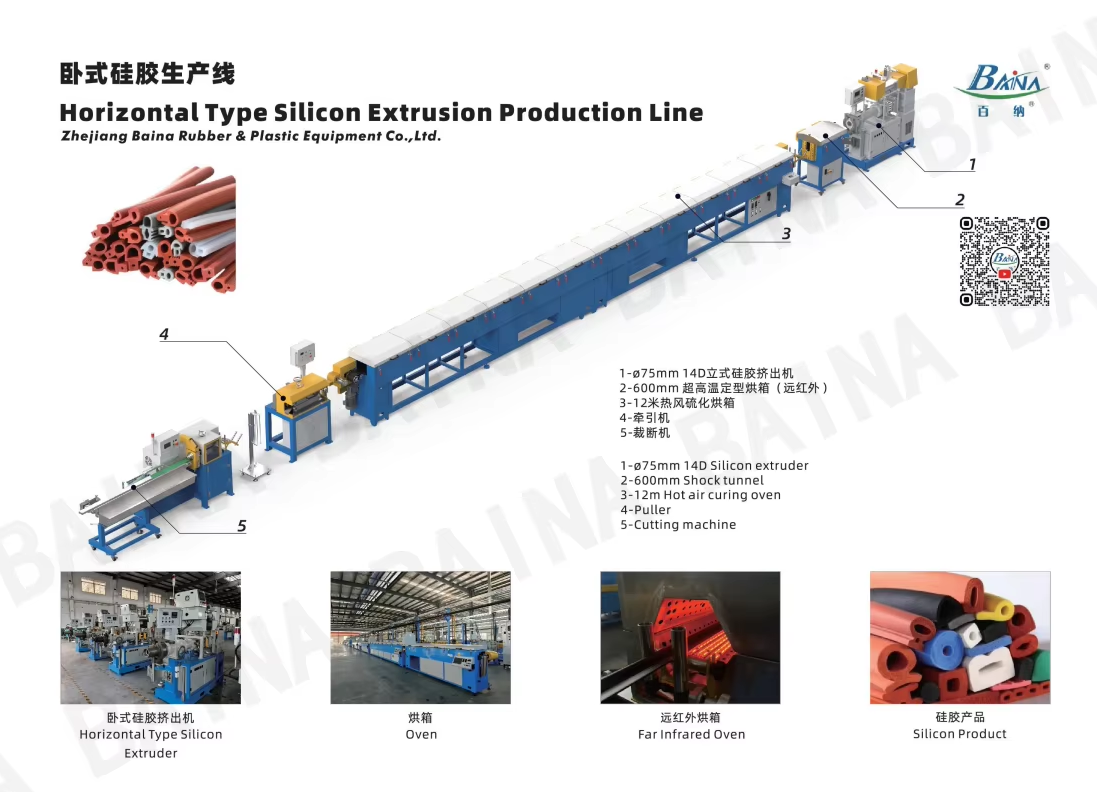
Continuous elastomer processing depends on strict control of mechanical, thermal, and rheological variables. Small variations in operating conditions can influence final geometry, surface finish, and physical performance of rubber profiles. Industrial extrusion systems are designed to manage these variables through multi-zone regulation and coordinated equipment response.
Temperature control is one of the most influential factors. Barrel heating zones are typically divided into 3–6 segments, each independently controlled within a range of 30°C to 120°C. Screw friction naturally increases compound temperature during processing, often raising internal melt conditions to 80°C–130°C before reaching the die head. Excessive heat can lead to premature vulcanization risk, while insufficient heat reduces plasticization efficiency.
Screw configuration determines material flow behavior. Standard L/D ratios range from 16:1 to 24:1 for precision extrusion systems. Compression ratios typically fall between 1.2:1 and 1.6:1 depending on compound elasticity. Higher compression improves density uniformity but increases shear heating, requiring balanced thermal management.
Pressure at the die head is another critical parameter. Typical operating pressure ranges between 5 MPa and 25 MPa. Stable pressure ensures consistent cross-sectional geometry. Fluctuations often lead to dimensional drift or surface irregularities. Die design compensates for elastic recovery, as rubber expands after exiting the shaping tool due to internal stress release.
Curing integration varies based on production requirements. Hot air tunnels remain widely used, with airflow temperatures controlled between 180°C and 280°C. Microwave curing systems provide internal heating efficiency, reducing vulcanization time by 20–40% in some configurations. Steam autoclaves are applied in hollow profile production, especially for hose structures requiring internal pressure support during curing.
Line speed coordination is essential. Puller systems regulate tension and synchronize output velocity with extrusion rate. Typical pulling force settings range from 50 N to 800 N depending on profile stiffness. Incorrect tension may cause stretching or compression defects, affecting dimensional accuracy.
Material selection also influences processing stability. EPDM compounds show high resistance to heat aging and are widely used in sealing profiles. NBR compounds provide oil resistance, suitable for hydraulic hose applications. Silicone materials offer flexibility at extreme temperature ranges from -60°C to 200°C, often used in electrical insulation tubing.
A rubber extrusion production line integrates these variables through centralized control systems. Modern configurations may include PLC-based monitoring, allowing adjustment of screw speed, temperature zones, and puller synchronization in real time. This reduces deviation during long production cycles and supports consistent batch output.
Cooling systems ensure structural stabilization after curing. Water spray channels or immersion baths reduce temperature gradients gradually to prevent internal stress formation. Cooling rates are controlled to avoid shrinkage deformation, particularly in thin-wall profiles.
Dimensional verification is increasingly automated. Non-contact laser scanners measure width, height, and curvature continuously. Data feedback loops enable automatic correction within seconds, maintaining stable output even during material changes.
The combined interaction of mechanical design, thermal regulation, and material behavior defines overall performance of extrusion systems. Each parameter contributes to final profile quality, making process coordination essential in industrial production environments.

 English
 Arabic
 French
 Spanish
 Deutsch
 Turkish
 Dutch
Dutch
 Italiano
 Russian
 Romaian
 Portuguese (Brazil)
 Greek
Greek
