


What Defines a Modern Extrusion System?
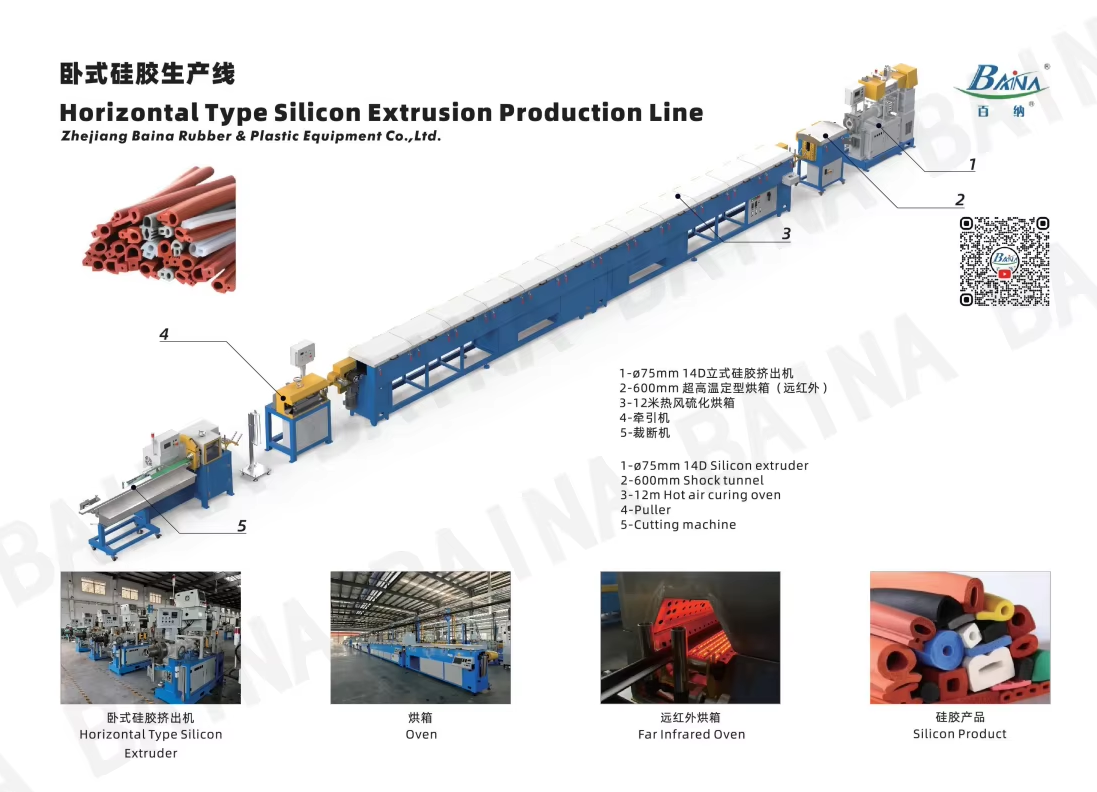
Rubber profile manufacturing relies heavily on continuous shaping technology where material consistency and dimensional stability determine final product performance. Industrial production environments often prioritize stable output, precise cross-section control, and adaptable compound handling. These requirements make extrusion-based systems widely adopted across sealing, automotive, construction, and hose manufacturing sectors.
A typical setup centers around screw-based conveying mechanics. The screw diameter usually ranges from 60 mm to 200 mm depending on production scale. Length-to-diameter ratios are commonly between 12:1 and 20:1 for cold-feed designs. Rotation speed generally operates within 10–90 rpm, allowing controlled shear and gradual plasticization of elastomer compounds. Barrel temperature zones are divided into 3 to 5 independent heating sections, often regulated between 40°C and 110°C depending on compound type such as EPDM, NBR, or silicone.
Material behavior plays a critical role during processing. Rubber compounds exhibit strong elastic recovery after exiting the die, a phenomenon commonly referred to as die swell. Swell ratios may vary from 10% to 40% depending on formulation viscosity and filler content. To compensate, die design must be adjusted with reduced aperture dimensions, ensuring final profiles remain within tolerance ranges of ±0.15–0.30 mm.
Downstream equipment is equally important. After shaping, the semi-finished profile passes through a curing stage, often using hot air vulcanization tunnels, infrared heating units, or continuous microwave systems. Temperature in curing tunnels typically ranges from 180°C to 300°C, depending on line speed and material chemistry. Cooling zones follow immediately, reducing surface temperature to below 40°C before cutting or winding.
A rubber extrusion production line integrates these stages into a synchronized workflow. Feeding systems, extrusion units, die heads, curing sections, cooling baths, and puller devices operate in continuous coordination. Line speed can vary from 5 m/min to over 80 m/min, depending on profile thickness and curing method.
Different screw designs also influence output quality. Pin-type cold feed screws enhance mixing efficiency by introducing lateral shear zones, improving dispersion of additives such as carbon black and plasticizers. Hot feed systems, while simpler in structure, are often used for lower viscosity compounds preheated on mills at 60–90°C.
Quality control is increasingly integrated into production lines. Laser measurement systems monitor profile geometry in real time, detecting deviations in width and wall thickness. Some setups include automatic feedback loops that adjust screw speed or die pressure to maintain stability during long production runs.
Industrial applications include door seals, automotive weatherstrips, conveyor belts, and industrial tubing. Each application requires tailored hardness levels, typically measured between 40–80 Shore A depending on mechanical demand.
A rubber extrusion production line therefore functions as a unified system rather than isolated machinery. Each stage influences the next, making parameter stability essential for consistent output quality.

 English
 Arabic
 French
 Spanish
 Deutsch
 Turkish
 Dutch
Dutch
 Italiano
 Russian
 Romaian
 Portuguese (Brazil)
 Greek
Greek
