


Are Spoked or Alloy Rims Better for Custom Builds?
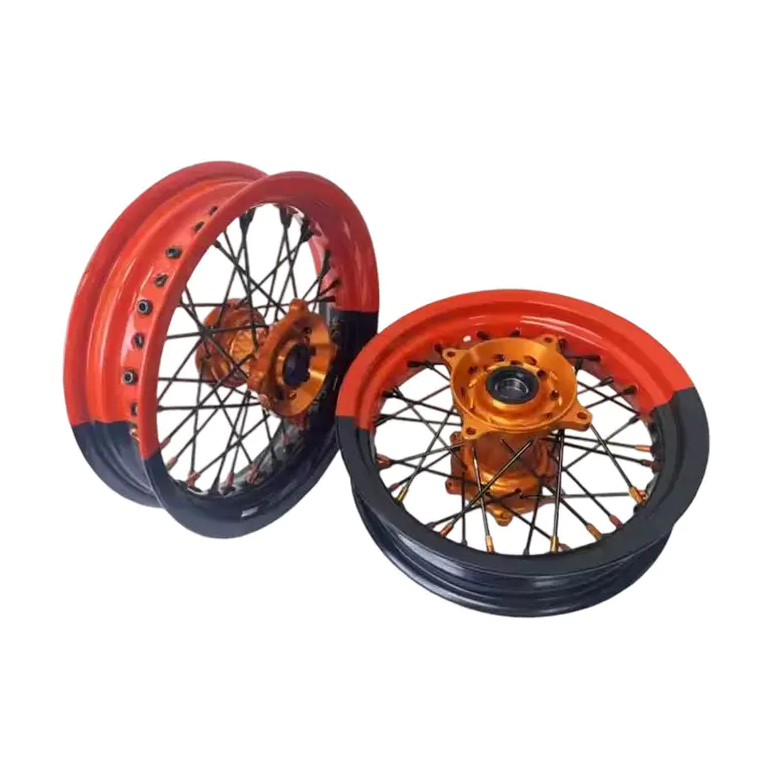
Motorcycle Rim Customization involves selecting rim structures that match riding conditions, mechanical requirements, and performance expectations. Among all customization variables, rim type selection has one of the strongest influences on durability and ride behavior.
Overview of rim categories
Three main rim types are commonly used:
Cast alloy rims
Forged alloy rims
Spoked rims
Each design uses different engineering principles and material behavior under load.
Cast alloy rim structure
Cast rims are produced by pouring molten aluminum into molds. This results in a uniform structure with consistent density.
Typical technical parameters:
Tensile strength: 180–230 MPa
Standard diameter range: 12–21 inches
Weight range: 6–8 kg (17-inch standard rim)
Cast rims are widely used in street motorcycles due to production efficiency and stable geometry.
In Motorcycle Rim Customization, cast rims are often modified with:
Powder coating thickness: 60–120 microns
Reinforced spoke arm design (for styling variants)
CNC-machined edge profiling
Forged rim performance characteristics
Forged rims are produced under high-pressure forging processes, refining aluminum grain structure.
Key parameters:
Yield strength: 250–320 MPa
Weight reduction: 10–25% compared to cast rims
Fatigue resistance: significantly improved under cyclic loading
Forged rims are commonly used in performance-oriented customization builds. The material density allows thinner rim sections while maintaining structural integrity.
Customization options include:
Variable spoke arm geometry
Hollow section machining
Weight balancing optimization within ±5 g tolerance
Spoked rim engineering structure
Spoked rims use a hub-and-spoke tension system. Each spoke carries a portion of the load, distributing stress across multiple points.
Typical specifications:
Spoke count: 36–72 spokes depending on application
Spoke material: stainless steel (common tensile strength ~800–1200 MPa)
Rim material: steel or aluminum alloy
Spoked rims are widely used in adventure and off-road motorcycles due to their flexibility under impact.
In Motorcycle Rim Customization, spoked rims may include:
Reinforced spoke nipples with corrosion-resistant coatings
Heavy-duty hub assemblies for torque load distribution
Tubeless conversion sealing systems
Performance comparison in customization context
Each rim type behaves differently under stress:
Cast rims: rigid, stable, predictable handling on paved roads
Forged rims: lightweight, high responsiveness, reduced rotational inertia
Spoked rims: flexible, impact-resistant, suitable for uneven terrain
Rotational inertia differences:
Cast rim baseline inertia: 100% reference
Forged rim inertia: ~85–90%
Spoked rim inertia: varies depending on build, often 95–105% of cast
Lower inertia improves acceleration response and braking efficiency.
Thermal and durability considerations
Heat dissipation differs significantly:
Forged aluminum: highest thermal conductivity (~160–180 W/m·K)
Cast aluminum: moderate (~120–150 W/m·K)
Spoked rims: depends on rim material, often lower overall conduction due to segmented structure
Durability under impact:
Spoked rims deform gradually under shock
Cast rims may crack under high point-load impact
Forged rims resist both deformation and cracking better than cast variants
Application in real customization scenarios
Motorcycle Rim Customization decisions depend on usage:
City riding: cast alloy rims for balance and maintenance ease
Performance riding: forged rims for weight efficiency
Mixed terrain: spoked rims for impact tolerance
Each configuration affects tire selection as well. Rim width and bead seat design determine compatibility with tire profiles such as 110/70R17 or 150/60R17 formats.
Conclusion of technical comparison
Rim selection in Motorcycle Rim Customization is a technical decision involving weight distribution, material strength, and structural behavior under load. Each rim type delivers different mechanical responses, making selection dependent on riding environment and performance expectations.

 English
 Arabic
 Spanish
 Portuguese
 Deutsch
 Turkish
 Dutch
Dutch
 Italiano
 Russian
 Romaian
 Portuguese (Brazil)
 Greek
Greek
