


Why Do Injection Parameters Matter in Bumper Molding?
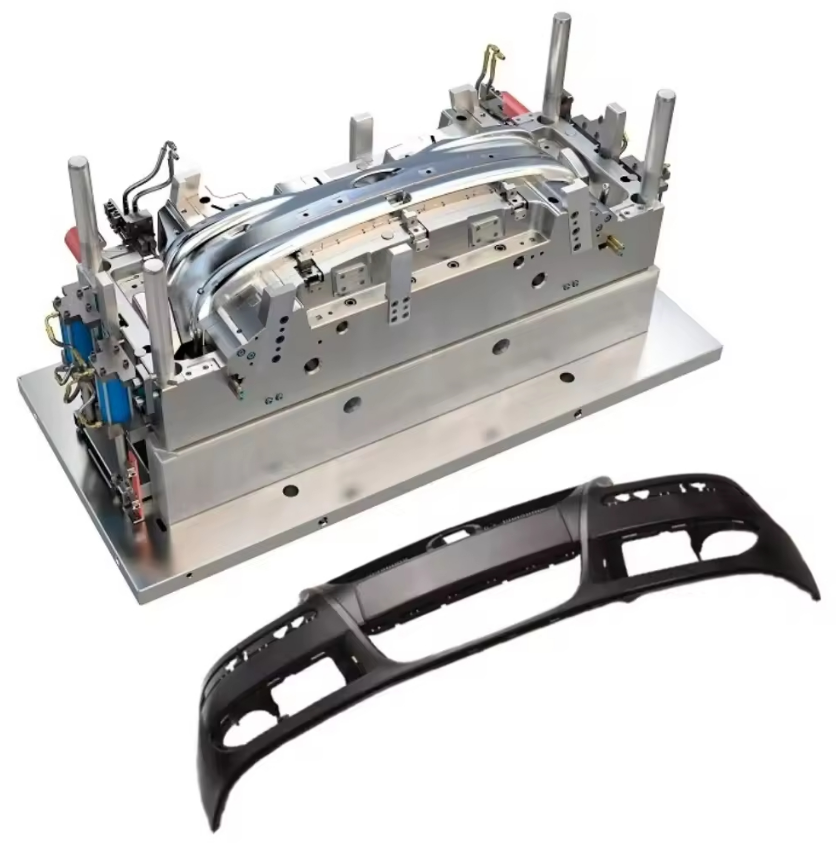
The performance of automotive exterior parts is strongly influenced by how injection molding conditions are controlled during production. Even small variations in pressure, temperature, or cooling time can affect deformation, surface marks, and structural strength. A professional Front Bumper Molding Manufacturer must carefully balance these variables to maintain dimensional accuracy and visual consistency.
Polymer Flow and Melt Behavior
Front bumper components rely on high-flow thermoplastics such as PP-EPDM blends. These materials exhibit shear-thinning behavior, meaning viscosity decreases as injection speed increases. Melt temperature is typically controlled between 200°C and 240°C to maintain flow stability.
Melt flow index (MFI) values for bumper-grade polypropylene often range between 10–30 g/10 min, allowing consistent filling across large cavity surfaces.
Flow imbalance can lead to weld lines or air traps, especially in wide bumper geometries exceeding 1200 mm in length.
Key Injection Molding Parameters
A Front Bumper Molding Manufacturer typically operates within defined process windows:
Injection speed: 50–120 mm/s
Injection pressure: 90–150 MPa
Packing pressure: 40–90 MPa
Mold temperature: 30°C–55°C
Cooling cycle: 25–50 seconds
Holding pressure is particularly important in preventing shrinkage marks around rib structures and mounting points.
A stable pressure curve ensures uniform density distribution across the bumper fascia.
Mold Flow Design and Gate Strategy
Gate placement significantly affects the final appearance of the bumper. Multi-gate hot runner systems are commonly used to control melt distribution. Proper gate balancing reduces:
Weld lines at flow junctions
Sink marks near thick sections
Flow hesitation in corner zones
Simulation tools such as CAE mold flow analysis are often used during development to predict filling behavior before production begins.
A Front Bumper Molding Manufacturer integrates simulation results to adjust gate diameter, runner length, and cooling channel layout.
Cooling System Efficiency
Cooling design has a major impact on cycle time and dimensional stability. Uniform cooling prevents internal stress accumulation.
Typical cooling channel parameters:
Channel diameter: 8–12 mm
Distance from cavity surface: 12–20 mm
Water temperature: 10°C–25°C
Flow rate: optimized per cavity zone
Uneven cooling can cause warpage, especially in long horizontal bumper sections.
Defect Control in Production
Common injection molding defects include:
Warpage due to uneven cooling
Sink marks from thick rib structures
Weld lines at flow intersections
Surface flow marks caused by unstable injection speed
A Front Bumper Molding Manufacturer reduces these defects by adjusting packing time, optimizing mold venting, and controlling melt temperature stability.
Structural Integrity and Final Performance
Beyond appearance, bumper moldings must meet impact absorption requirements. Energy-absorbing ribs and reinforcement zones are designed into the mold structure.
Impact performance testing often simulates low-speed collisions at 4–8 km/h to verify deformation behavior.
Conclusion
Injection parameters directly define the quality and repeatability of bumper production. Through controlled molding conditions and optimized tooling design, a Front Bumper Molding Manufacturer ensures consistent product quality, reduced defect rates, and stable large-scale production capability.

 English
 Arabic
 French
 Spanish
 Portuguese
 Deutsch
 Turkish
 Dutch
Dutch
 Italiano
 Romaian
 Portuguese (Brazil)
 Greek
Greek
