


How Does Rooftop Truck AC Save Energy?
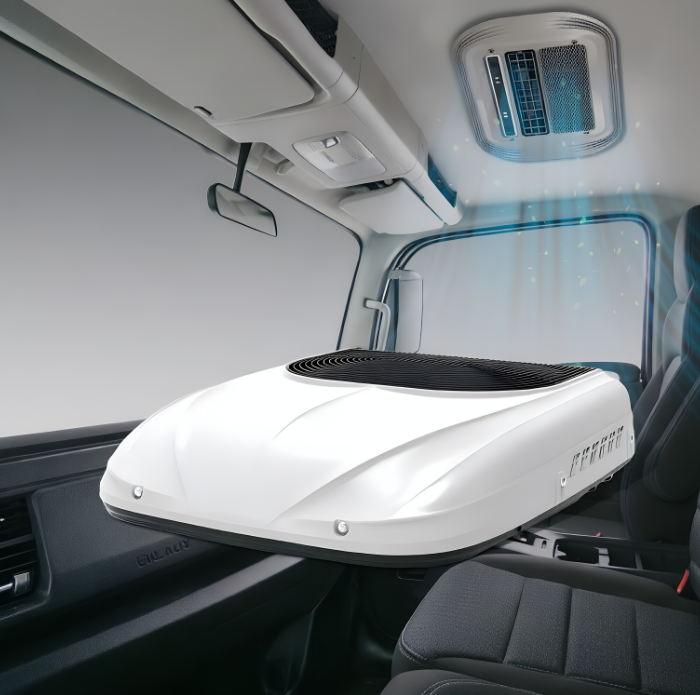
Energy efficiency has become a major focus in modern truck climate control systems. Traditional engine-idling air conditioning consumes fuel continuously, while independent rooftop cooling systems operate using stored electrical energy. The Rooftop Parking Truck Tractor Air Conditioner is engineered to reduce fuel dependency while maintaining consistent cabin comfort during rest stops.
At the core of energy-saving design is the DC inverter compressor. Unlike fixed-speed systems, inverter compressors adjust rotational speed based on thermal load. When cabin temperature approaches the set point, compressor frequency may reduce to lower power consumption, often dropping to 300–500W during maintenance mode. During initial cooling, power draw can rise to 800–1200W to rapidly reduce heat load.
Cooling capacity typically ranges from 2200W (7500 BTU) to around 3000W (10000 BTU) in standard configurations. Higher-end systems can reach 5000W output for larger sleeper cabs or heavily insulated vehicles. This balance between output and electrical consumption is key to long runtime efficiency.
Air circulation design significantly affects energy usage. High-efficiency blowers produce airflow between 420 m³/h and 500 m³/h, reducing compressor workload by accelerating heat exchange inside the cabin. Proper duct positioning helps avoid cold-air concentration and improves uniform temperature distribution.
Power supply systems usually support both 12V and 24V configurations. A 24V system reduces current load compared to 12V, improving wiring efficiency and reducing voltage drop across long cable runs. For example, a 24V system drawing 600W consumes approximately 25A, while a 12V system at the same power requires double the current, increasing cable heating risk.
Battery compatibility is another important design factor. A typical setup includes 100Ah–400Ah battery banks depending on desired runtime. Lithium iron phosphate (LiFePO4) batteries are increasingly used due to stable discharge curves and higher cycle life compared to traditional lead-acid systems. With a 200Ah lithium battery, expected runtime can range from 6 to 10 hours depending on ambient temperature and compressor load.
Thermal insulation of the truck cabin also plays a direct role in energy efficiency. Cabins with improved insulation layers can reduce cooling demand by up to 20–30%. This reduces compressor cycling frequency and extends battery usage time.
Control systems are typically equipped with digital interfaces, allowing precise temperature settings, fan speed adjustment, and sleep mode operation. Some systems include programmable timers to optimize energy usage during overnight rest periods.
From a structural perspective, rooftop units are designed with aerodynamic housings to minimize drag impact. Shell materials often use UV-resistant ABS or composite plastics, ensuring durability under prolonged sun exposure and vibration conditions.
Noise control is another aspect linked to energy optimization. Brushless fan motors reduce friction losses while maintaining airflow stability. Typical operating noise ranges from 45 dB(A) to 55 dB(A), which is suitable for sleeper environments.
In practical applications, rooftop truck cooling systems contribute to reduced operational costs by eliminating fuel consumption during idle cooling. Over long-term use, fleets benefit from lower maintenance costs due to reduced engine idle hours and decreased carbon buildup.
As transport operations continue shifting toward electrification and energy optimization, rooftop-mounted parking air conditioning systems are becoming an essential component of modern truck thermal management strategies.

 English
 Arabic
 Spanish
 Portuguese
 Deutsch
 Turkish
 Dutch
Dutch
 Italiano
 Russian
 Romaian
 Portuguese (Brazil)
 Greek
Greek
