


How Does Folding Outdoor Lounge Chair Fold Mechanism Work?
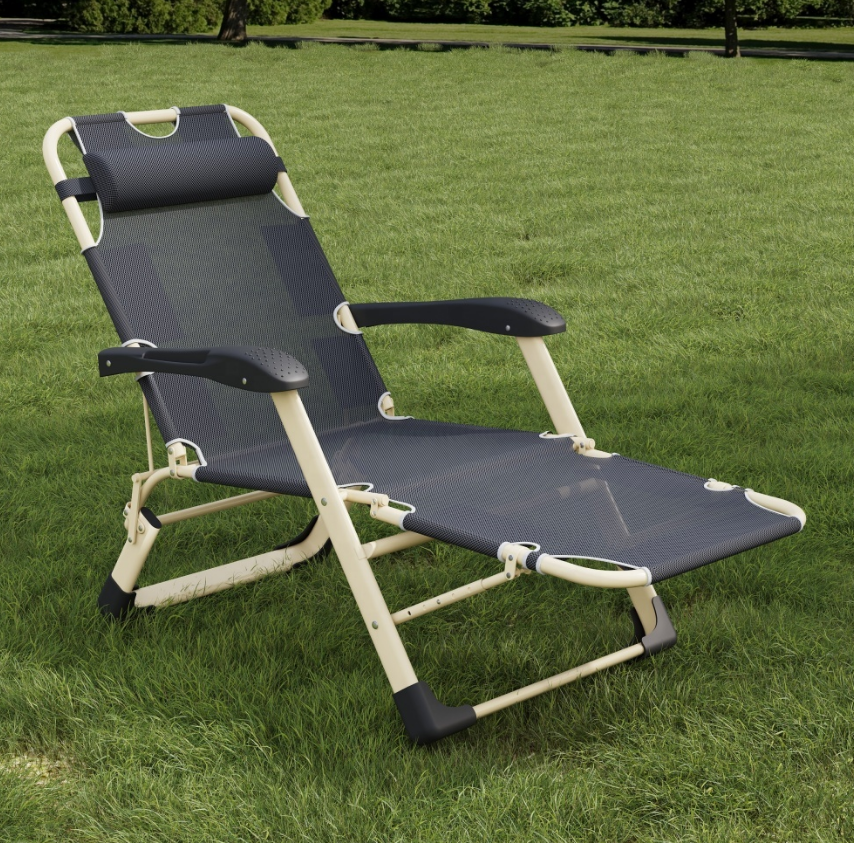
Outdoor seating design has evolved toward compact, multifunctional structures, and the Folding Outdoor Lounge Chair is a clear example of this development. It integrates collapsible mechanics with ergonomic seating geometry, making it suitable for temporary outdoor setups such as camping, beach trips, or backyard relaxation spaces.
The folding mechanism is usually built around dual-hinge or multi-joint pivot systems. These joints are placed at key stress points such as the backrest connection, seat base intersection, and leg support frame. High-strength rivets or locking pins secure each position. When activated, the structure collapses along pre-defined folding axes, reducing volume significantly without requiring disassembly.
Frame materials vary depending on performance requirements. Powder-coated steel is commonly used for enhanced load strength, often featuring wall thickness between 1.0 mm and 1.5 mm. This improves resistance to bending stress while maintaining a relatively manageable weight. Aluminum alloy frames are lighter, often reducing total product weight below 5 kg, making them suitable for travel-oriented applications.
Fabric selection plays a major role in user comfort and durability. Many Folding Outdoor Lounge Chair models use Oxford fabric ranging from 600D to 900D weave density. Higher denier ratings improve abrasion resistance and structural stability under repeated folding tension. Some versions incorporate PVC backing layers to enhance water resistance and prevent moisture absorption during wet conditions.
Reclining systems are integrated into the back support section. These systems often use gear-based adjustment rails or segmented locking slots. Adjustable ranges typically include 90°, 110°, 130°, 150°, and near-flat positions. Each angle is designed to distribute body weight differently, reducing pressure on lumbar and hip regions during extended use.
Ergonomic design considerations include seat depth and back curvature. Seat depth often ranges between 45 cm and 55 cm, offering sufficient support for both upright and reclined postures. Backrest height may vary from 70 cm to 100 cm depending on model design, ensuring coverage for shoulder and upper back support.
Transportability is enhanced through compact folding ratios. Once folded, the chair typically reduces to a flat profile with thickness between 10 cm and 15 cm. This allows storage in small compartments, vehicle trunks, or outdoor gear bags. Some models also feature elastic strap bindings that secure the folded structure during transport.
Surface treatments are applied to improve outdoor resilience. Anti-rust coatings protect metal joints, while UV-resistant fabric coatings help reduce material degradation caused by prolonged sun exposure. Stitching is reinforced using double-thread industrial sewing techniques, particularly at stress points such as seat corners and hinge intersections.
A Folding Outdoor Lounge Chair is designed to integrate mechanical efficiency with user comfort. Its folding architecture, material engineering, and ergonomic adjustments work together to support outdoor usability across different environments and usage durations.

 English
 Arabic
 Spanish
 Portuguese
 Deutsch
 Turkish
 Dutch
Dutch
 Italiano
 Russian
 Romaian
 Portuguese (Brazil)
 Greek
Greek
