


How Does Die Cast Aluminum Cookware Heat?
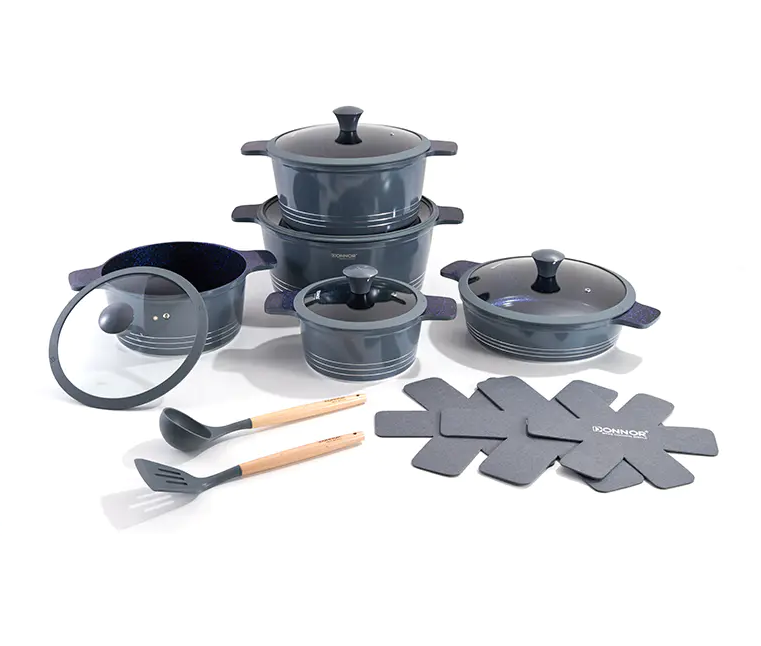
Cooking performance is closely tied to how efficiently heat is transferred and distributed. A die cast aluminum cookware set is engineered specifically to optimize these thermal properties through material composition and structural design.
Aluminum alloys used in die casting typically offer thermal conductivity in the range of 180–220 W/m·K. This allows heat energy from a burner to move rapidly across the cookware body. Compared to stainless steel, which can be below 20 W/m·K, aluminum responds much faster to temperature adjustments. This responsiveness is important for controlling cooking stages such as reducing heat during simmering or increasing it for searing.
The die casting process itself contributes to thermal consistency. Molten aluminum is injected under high pressure into molds, forming a dense microstructure with minimal internal voids. This uniformity reduces thermal resistance variations across the cookware surface. As a result, heat spreads more evenly from center to edge, reducing uneven cooking zones.
Many modern designs include a reinforced base thickness, often around 4–5 mm. This thickness helps stabilize heat retention while still maintaining fast heat response. A thicker base stores thermal energy more effectively, which reduces temperature drops when food is added.
Surface coating technology also influences performance. Ceramic or PTFE-free non-stick layers are commonly applied with thickness levels measured in microns. These coatings reduce friction between food and surface, enabling lower oil usage and smoother heat transfer during cooking. Some coatings are rated for abrasion resistance improvements of over 200–300% compared to standard finishes.
Energy efficiency is another important factor. Because aluminum heats quickly, cooking systems using a die cast aluminum cookware set generally require less time to reach target temperatures. Shorter heating cycles translate into reduced energy consumption in both gas and electric cooking environments.
Heat retention behavior is balanced rather than extreme. Unlike cast iron, which retains heat for long periods but responds slowly, aluminum cools and heats rapidly. This makes it suitable for cooking tasks that require frequent temperature adjustments.
Handle design also plays a thermal safety role. Heat-resistant materials such as phenolic resin or silicone reduce heat transfer from the body to the grip area. Many handles are tested to remain stable under extended exposure to cooking temperatures around 160°C.
Compatibility with induction cooktops is achieved through a bonded ferromagnetic base layer. This layer does not significantly affect heat distribution but enables electromagnetic heating functionality, expanding usability across different kitchen systems.
Overall, the thermal behavior of a die cast aluminum cookware set is defined by fast heat response, balanced retention, and efficient energy transfer. These characteristics make it adaptable for both home cooking and professional environments where timing and temperature control are critical.

 English
 Arabic
 French
 Spanish
 Portuguese
 Deutsch
 Turkish
 Dutch
Dutch
 Italiano
 Romaian
 Portuguese (Brazil)
 Greek
Greek
