


How Are Double Helix Springs Designed?
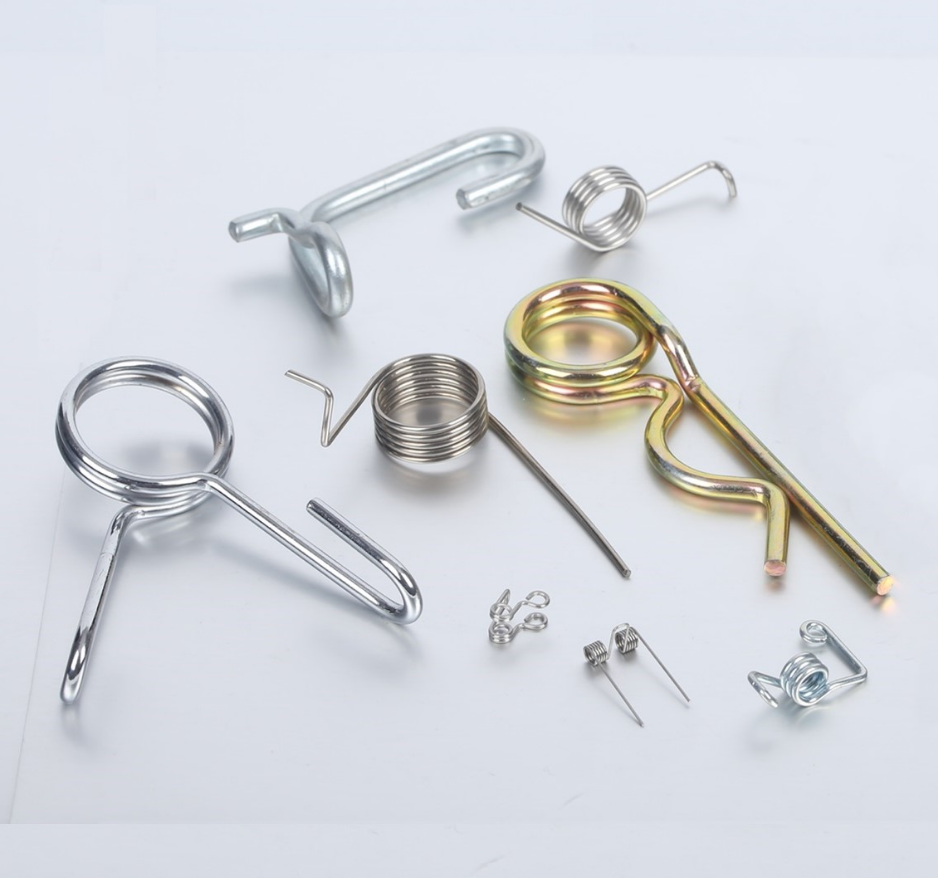
Modern mechanical systems increasingly rely on compact energy storage elements that can deliver repeatable rotational force under constrained space conditions. One advanced configuration used in precision assemblies is the double helix torsional structure, where two helical coils operate in coordinated motion to generate controlled torque output.
The design of Double Helix Torsion Springs is fundamentally governed by geometric parameters, material selection, and stress distribution modeling. Unlike single coil torsion springs, where torque is transmitted through a single wire path, the double helix design introduces a dual-path load system that modifies both stiffness and deformation behavior.
A primary design parameter is wire diameter, typically selected within the range of 0.3 mm to 10 mm depending on load capacity. Increasing wire diameter improves torque resistance but also raises bending stress during angular deflection. To balance this, engineers adjust coil diameter accordingly, often maintaining a mean coil diameter between 5 and 15 times the wire diameter.
Another key parameter is the number of active coils. In double helix configurations, coil count is distributed across two interacting spirals. A typical design may include 3 to 12 active turns per helix, depending on required angular displacement and torque output. Increasing coil count generally reduces stiffness while improving angular flexibility.
Spring rate is a central performance metric. It defines torque per unit angular displacement and is expressed as:
k = T / θ
In double helix systems, overall spring rate is effectively the combined contribution of both helical paths. This allows designers to achieve higher torque output without increasing individual wire stress beyond acceptable limits.
Manufacturing considerations significantly influence final performance. During coiling, maintaining consistent pitch between helices is essential to prevent interference during operation. Pitch deviation is typically controlled within ±0.1 mm for precision components. Additionally, end leg geometry must be aligned carefully to ensure symmetrical load application.
Material selection commonly involves high carbon steel, stainless steel grades, or alloy spring steels depending on environmental exposure. In corrosive environments, stainless steel variants are preferred due to their resistance to oxidation and fatigue degradation. Heat treatment cycles are applied after forming, typically between 260°C and 450°C, to stabilize mechanical properties.
Another important design factor is spring index, defined as the ratio between mean coil diameter and wire diameter. For Double Helix Torsion Springs, an index range of 4 to 10 is generally maintained to ensure manufacturability and reduce stress concentration factors. Lower values increase stiffness but raise internal stress, while higher values improve flexibility but may reduce torque density.
Operating environments also influence design choices. In dynamic assemblies such as robotic joints or actuator systems, cyclic loading frequency can exceed thousands of cycles per hour. Under such conditions, fatigue resistance becomes a primary concern. The dual-helix structure helps distribute repeated stress cycles across two load paths, improving long-term dimensional stability.
Typical angular working ranges vary between 0° and 720°, depending on application requirements. However, most industrial implementations remain within 0° to 360° to maintain predictable torque response and reduce material fatigue risk.
From a system integration perspective, double helix torsion springs are often selected when space constraints require compact torque storage with improved smoothness of motion. Their geometry allows for higher energy distribution efficiency compared to single coil alternatives while maintaining controlled deformation behavior under load.

 English
 Arabic
 French
 Portuguese
 Deutsch
 Turkish
 Dutch
Dutch
 Italiano
 Russian
 Romaian
 Portuguese (Brazil)
 Greek
Greek
