


How Is Wheat Straw Tableware Made?
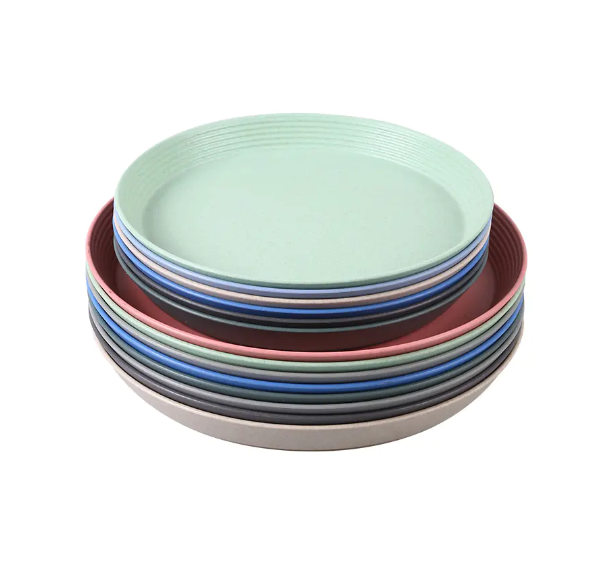
The production of eco-friendly kitchen products has evolved significantly in recent years, and Wheat Straw Material Tableware is one of the most widely adopted examples of this shift. It combines agricultural waste reuse with modern polymer processing technology to create functional dining products used in homes, restaurants, and outdoor environments.
Wheat straw is the dry stalk remaining after wheat grain harvesting. Traditionally treated as waste, it contains a natural fiber composition rich in cellulose (around 35%–45%), hemicellulose (20%–30%), and lignin (15%–20%). These components give the material its structural integrity and make it suitable for composite processing.
Raw material preparation and fiber processing
The manufacturing process begins with collection and cleaning of wheat straw residues. The material is washed to remove dust, soil particles, and residual organic matter. After drying, it is mechanically crushed into short fibers typically ranging from 1 mm to 5 mm in length.
These fibers are then refined through grinding and sieving to ensure uniform particle distribution. Consistency in fiber size is important because it directly affects molding quality and surface smoothness in final products.
At this stage, the material is either used as a high-fiber composite base or blended with polymer binders such as polypropylene or PLA. The fiber-to-binder ratio often ranges between 40:60 and 70:30 depending on durability and heat resistance requirements.
Molding and production technology
Wheat Straw Material Tableware is commonly produced using injection molding or compression molding technology. The blended raw material is fed into high-temperature molds, typically operating between 160°C and 210°C.
Under high pressure, the material flows into predefined mold cavities forming plates, bowls, cups, or utensils. Cooling systems stabilize the structure, ensuring dimensional accuracy and preventing deformation.
Surface finishing may include polishing or texture treatment to enhance tactile feel and improve resistance to scratches. Some products also include natural color pigments, often in muted tones such as beige, light green, or soft gray.
Mechanical properties and performance
Finished wheat straw tableware typically exhibits tensile strength values in the range of 15–35 MPa depending on composition. Flexural strength varies but is sufficient for everyday handling loads such as food weight, stacking pressure, and transport stress.
Heat resistance is generally limited to around 100°C–120°C. Beyond this range, polymer components may soften, which is why direct flame or oven use is not recommended.
Water absorption rates are relatively low due to polymer binding, typically below 2% under standard testing conditions. This allows the material to remain stable during washing cycles and repeated use.
Application scenarios
Wheat straw tableware is widely used in several environments:
Household dining sets for daily meals
Children’s dinnerware due to lightweight and safety features
Outdoor camping and picnic kits
Cafeteria and institutional food service
Travel and portable lunch containers
Its lightweight nature and resistance to breakage make it especially suitable for mobile and high-frequency usage environments.
Hygiene and safety aspects
Food safety requirements are a key part of production standards. High-quality Wheat Straw Material Tableware is manufactured under strict hygiene controls, ensuring no harmful additives exceed regulatory limits. BPA-free formulations are standard in most markets.
Because wheat straw itself is plant-based, it does not inherently contain gluten proteins in its final fiber form. However, production lines must avoid contamination risks during processing to maintain allergen safety compliance.
Environmental impact considerations
One of the main advantages of wheat straw utilization is waste reduction. Millions of tons of wheat straw are produced globally each year, and repurposing this biomass reduces open-field burning practices that contribute to air pollution.
However, environmental performance depends on material composition. Fully biodegradable versions require controlled composting conditions, while composite versions provide durability but degrade more slowly. This trade-off between usability and end-of-life behavior is an important factor in material selection.
Conclusion
Wheat Straw Material Tableware is a result of combining agricultural residue with modern material engineering. Its production process transforms raw plant fibers into functional household products with reliable strength and practical usability. While not completely identical to pure biodegradable materials, it offers a functional balance between sustainability, durability, and everyday convenience.

 English
 Arabic
 French
 Spanish
 Portuguese
 Deutsch
 Turkish
 Dutch
Dutch
 Russian
 Romaian
 Portuguese (Brazil)
 Greek
Greek
