


How Do Magnetic Cubes Improve STEM Learning?
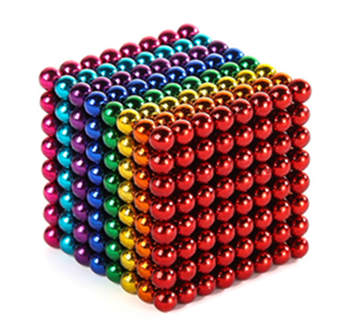
STEM education increasingly relies on hands-on tools that transform abstract concepts into physical experiences. Solid Color Magnetic Block Cubes are one of the most effective tactile learning systems because they combine magnetism, geometry, and structural design into a single modular unit.
Each cube in Solid Color Magnetic Block Cubes sets is engineered with internal magnet positioning that allows predictable attraction patterns. Typically, the magnets are arranged in alternating polarity configurations on each face, meaning opposite sides attract while similar poles repel. This controlled magnetic behavior introduces learners to fundamental physics concepts in an intuitive way.
Standard cube dimensions usually range from 25 mm to 30 mm per side, with internal magnet diameters between 5 mm and 8 mm depending on design. The magnets are often rare-earth neodymium types, selected for their high magnetic strength relative to size. This ensures reliable connectivity even in multi-layered structures.
One of the key educational advantages is spatial reasoning development. When children construct models using Solid Color Magnetic Block Cubes, they naturally engage in:
3D visualization
Structural prediction
Balance correction
Pattern recognition
Unlike flat puzzle systems, cube-based magnetic structures allow full volumetric building. This supports understanding of x, y, and z axes in a physical environment rather than theoretical diagrams.
From a material engineering standpoint, the cubes are typically produced using high-density ABS plastic with a melting point around 105°C–110°C. The surface is smooth but slightly textured to improve grip. Internal reinforcement ribs are often added to maintain structural integrity during repeated drops or compression loads.
Safety design is a major focus. Magnet encapsulation is achieved through ultrasonic welding or heat-sealing methods, which eliminate the risk of magnet leakage. Wall thickness is generally designed at 2.2 mm to 3.5 mm, depending on the expected usage intensity (home vs classroom).
Educational researchers often associate magnetic cube play with improved cognitive flexibility. This is because children frequently modify structures during construction rather than following fixed instructions. This iterative process mirrors real engineering workflows:
Prototype building
Testing stability
Adjusting design
Rebuilding improved versions
Solid Color Magnetic Block Cubes also help introduce early physics concepts such as:
Attraction and repulsion forces
Structural load distribution
Friction and stability
Color design plays a supporting cognitive role. Solid colors reduce visual distraction and help users focus on shape and structure rather than pattern complexity. This is particularly useful in early childhood education environments where attention span training is important.
In group learning settings, these cubes encourage collaborative problem solving. Multiple users can build shared structures, requiring communication about orientation, stability, and design intent. This supports both social development and technical reasoning skills.
Overall, Solid Color Magnetic Block Cubes function as more than a toy system. They operate as a modular learning platform that integrates physics, geometry, and engineering fundamentals into hands-on exploration.

 English
 French
 Spanish
 Portuguese
 Deutsch
 Turkish
 Dutch
Dutch
 Italiano
 Russian
 Romaian
 Portuguese (Brazil)
 Greek
Greek
