


Why Choosing the Right Taxi Service in Rajasthan Makes or Breaks Your Entire Trip
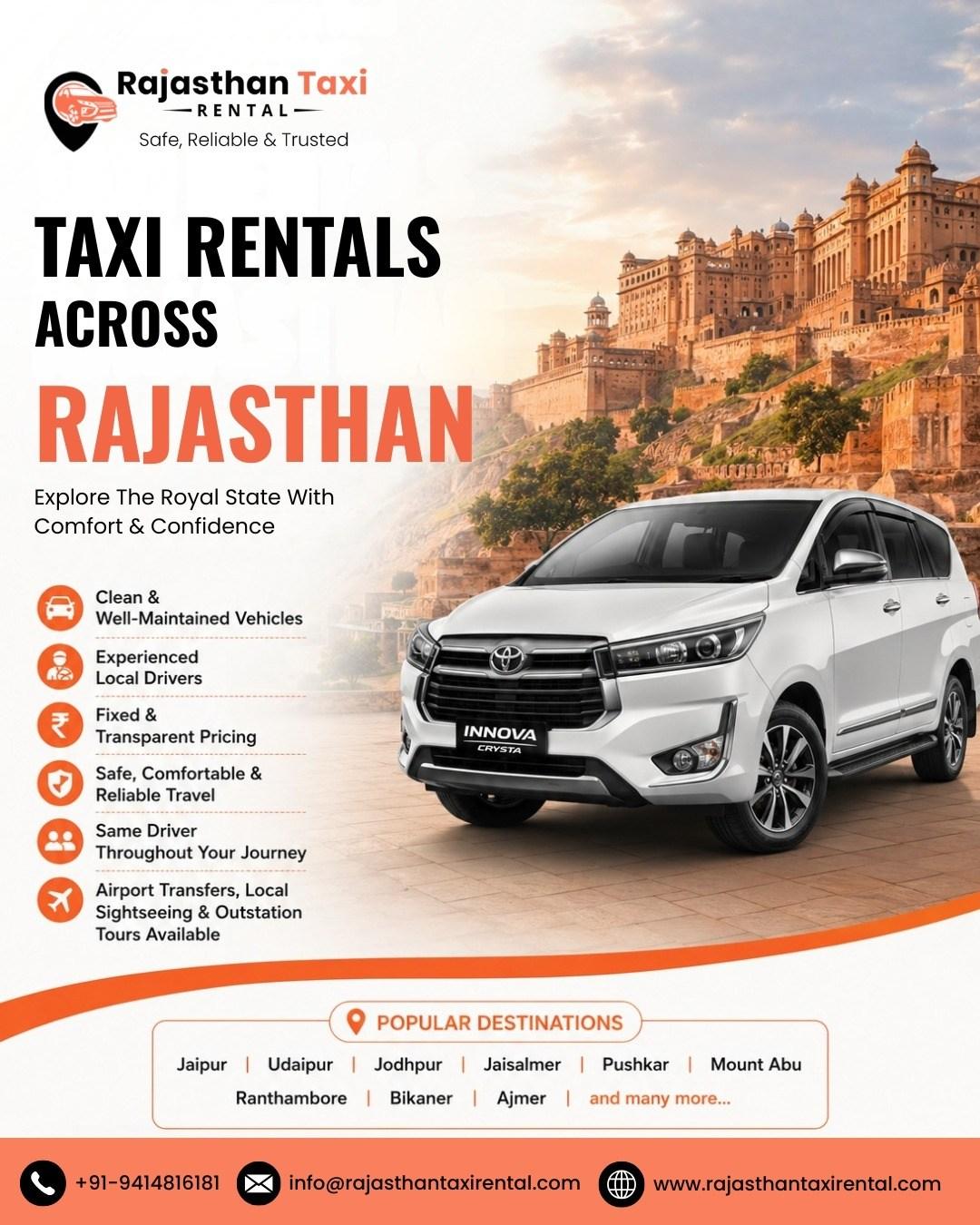
Rajasthan is not a destination you simply pass through. It is a state that demands time, attention, and a pace of travel that lets you absorb everything around you. The sandstone forts that rise from the desert horizon, the painted havelis of merchant towns, the quiet lakes reflecting centuries-old palaces, the bazaars alive with color and sound. All of this unfolds gradually as you move from one city to the next. And the way you move between those cities matters enormously.
Trains are useful. Flights save time between distant points. But for anyone who genuinely wants to experience Rajasthan the way it deserves to be experienced, a reliable taxi service in Rajasthan is the single most important travel decision you will make. It is the thread that connects every destination, every stop, every unexpected moment of beauty along the way.
This guide covers everything you need to know about traveling Rajasthan by taxi, from choosing the right vehicle and understanding fare structures to planning routes and knowing exactly what to expect from a professional driver on a multi-day journey.
Why Rajasthan Is Made for Road Travel
Rajasthan is India's largest state by area, covering over 342,000 square kilometers. Its major tourist cities are spread across this vast landscape with scenic highways connecting them through open desert, rolling hills, and rural villages that give you a window into daily life that no airport or railway platform ever could.
The drive from Jaipur to Jodhpur takes you through the dry heartland of Rajasthan, past small towns and roadside dhabas that have fed travelers for generations. The road from Jodhpur to Jaisalmer is one of the most cinematic drives in India, cutting through the Thar Desert with the horizon stretching flat in every direction until the medieval ramparts of the Golden Fort appear in the distance. Udaipur to Pushkar takes you through the Aravalli Hills, offering a completely different landscape from the desert routes. These drives are experiences in themselves, and you simply cannot have them from the window of a train or the cabin of a plane.
A professional taxi service in Rajasthan transforms these road journeys from logistical necessities into genuine highlights of the trip.
The Major Tourist Cities You Will Cover
Before planning your taxi itinerary, it helps to understand what each city offers and roughly how long it takes to travel between them. This gives you a realistic sense of the distances involved and how to structure your time.
Jaipur: The Pink City
Jaipur is the capital of Rajasthan and the starting point for most tours of the state. The city earns its nickname from the terracotta-pink wash applied to its old city buildings in 1876 in honor of a royal visit. Today it is a layered city where Mughal-era architecture, Rajput heritage, and a thriving modern economy exist side by side. The Amber Fort, Hawa Mahal, City Palace, Jantar Mantar, and Nahargarh Fort are among the most visited sites in all of India. Most travelers need a minimum of two full days to cover Jaipur's major attractions comfortably, and local taxi services within the city make moving between sites smooth and efficient.
Jodhpur: The Blue City
Jodhpur sits roughly 340 kilometers west of Jaipur and the drive typically takes five to six hours depending on the route and stops along the way. The city takes its name from the vivid indigo blue that coats the old city's houses, a sight best appreciated from the ramparts of the mighty Mehrangarh Fort that towers above the entire city. Jodhpur also offers the Umaid Bhawan Palace, Jaswant Thada, and the bustling Clock Tower market. The blue city has a distinctly different energy from Jaipur, quieter in some ways, more concentrated, and deeply atmospheric.
Jaisalmer: The Golden City
From Jodhpur, Jaisalmer lies another 290 kilometers to the northwest. This drive takes around four to five hours and the road conditions are generally good throughout. Jaisalmer is unlike anywhere else in India. The entire old city is constructed from golden yellow sandstone that glows amber in the late afternoon light, giving the city its popular name. The living fort at its center, one of the world's largest continuously inhabited fortifications, houses temples, havelis, restaurants, and homes within its ancient walls. The Thar Desert begins at Jaisalmer's edge, and a desert camp experience under a sky full of stars is an essential part of any visit.
Udaipur: The City of Lakes
Udaipur is the most romantic city in Rajasthan and arguably in all of India. Built around a series of interconnected lakes in a valley of the Aravalli Hills, the city has a dreamlike quality that makes it unlike any other urban destination in the country. The Lake Palace Hotel floating on Pichola Lake, the City Palace rising from the eastern shore, the narrow lanes of the old city, the ghats where locals gather at sunset, all of it comes together in a way that travelers consistently describe as unforgettable. From Jaipur, Udaipur is approximately 395 kilometers by road, a journey of around six to seven hours.
Other Important Destinations
Beyond these four major cities, Rajasthan has many other places worth including in a well-planned itinerary. Pushkar is a sacred lake town with one of India's only Brahma temples and a laid-back traveler culture that makes it a lovely pause between cities. Bikaner in the north has the spectacular Junagarh Fort and the unusual Karni Mata Temple. Bundi is a smaller, less-visited city in southeastern Rajasthan with step wells and a palace that many travelers find more atmospheric than the more famous sites. Mount Abu in the southwest is Rajasthan's only hill station, offering a welcome cool retreat and the extraordinary Dilwara Jain Temples.
Understanding Taxi Fare Structures in Rajasthan
One of the most common sources of confusion and frustration for first-time visitors to Rajasthan is understanding how taxi fares are calculated. The structure is different from the app-based cab model most urban travelers are accustomed to, and knowing what to expect prevents unpleasant surprises.
Per Kilometer Rate with Minimum Daily Distance
For outstation and multi-day taxi bookings, most operators in Rajasthan quote a per-kilometer rate combined with a minimum daily distance guarantee. The per-kilometer rate varies by vehicle type. Economy sedans like the Maruti Suzuki Dzire or Hyundai Xcent typically cost between Rs. 11 and Rs. 14 per kilometer. Mid-size SUVs and MUVs like the Toyota Ertiga run from Rs. 14 to Rs. 16 per kilometer. The Toyota Innova Crysta, which is the most popular choice for families and groups traveling in comfort, generally costs between Rs. 16 and Rs. 20 per kilometer. Luxury vehicles and larger coaches are priced higher and are quoted on a case-by-case basis.
The minimum daily distance guarantee is typically set at 250 kilometers per day. This means that even if you travel less than 250 kilometers in a day, you are billed for the full 250 kilometers. This structure protects the driver and operator from extremely short-distance days that would not cover their costs.
Driver Allowance
A daily driver allowance is charged separately from the per-kilometer fare. This covers the driver's accommodation and meals when traveling outstation. It is a standard charge across Rajasthan's taxi industry and typically ranges from Rs. 250 to Rs. 500 per day depending on the operator and route.
Toll and Parking Charges
Toll fees on national and state highways and parking charges at major tourist sites are generally charged separately and paid by the passenger directly at the toll booth or parking gate. Some operators include toll costs in their quoted package price, so it is worth clarifying this when booking.
Local Sightseeing Rates
For day use within a single city, local taxi rates in Rajasthan are typically quoted as an eight-hour package with a set kilometer limit, most commonly 80 kilometers within the city. Beyond that limit, an additional per-kilometer charge applies. Common local sightseeing rates for a sedan are approximately Rs. 1,800 to Rs. 2,500 for an eight-hour day, while an Innova Crysta typically runs Rs. 3,500 to Rs. 4,500 for the same duration.
Types of Taxi Services Available in Rajasthan
The taxi service in Rajasthan market offers options for every type of traveler, from budget-conscious backpackers to families seeking comfort and luxury travelers who want a premium experience throughout.
Economy Sedans
Vehicles like the Maruti Suzuki Dzire, Hyundai Xcent, and Toyota Etios seat up to four passengers plus the driver comfortably. They are the most affordable option and are well-suited for couples, solo travelers, and small families traveling with limited luggage. Air conditioning is standard across virtually all commercial taxis in Rajasthan, which is essential given the state's climate.
SUVs and MUVs
The Toyota Ertiga, Maruti Ertiga, and similar seven-seat MUVs offer a middle ground between economy and premium that works well for families of five or six with a reasonable amount of luggage. The Toyota Innova Crysta is the gold standard in this category. Spacious, comfortable, and capable on long highway stretches, it is by far the most popular vehicle choice for multi-day Rajasthan tours. International tourists in particular favor it because of its generous legroom, smooth ride quality, and the sense that the vehicle can handle anything the journey requires.
Tempo Travellers
For groups of eight to fourteen people, a Tempo Traveller is the standard option. These are minibus-style vehicles with bench seating, roof luggage racks, and sufficient space for a group traveling together with all their bags. They are widely available across Rajasthan and are regularly used for school groups, family reunions, corporate travel, and group tours. The Force Urbania is a premium variant of this category that offers airline-style push-back seating and a significantly more comfortable ride for groups willing to pay a higher rate.
Luxury Vehicles
For travelers who want a premium experience throughout their Rajasthan journey, luxury sedans and high-end SUVs are available through select operators. The Toyota Fortuner, Mercedes-Benz E-Class, and Toyota Land Cruiser are all available for hire in cities like Jaipur and Udaipur. These are typically used for executive travel, high-end leisure trips, and special occasion transportation.
Popular Taxi Routes and Approximate Travel Times
| Route | Distance | Approximate Time |
|---|---|---|
| Jaipur to Jodhpur | 340 km | 5 to 6 hours |
| Jodhpur to Jaisalmer | 290 km | 4 to 5 hours |
| Jaipur to Udaipur | 395 km | 6 to 7 hours |
| Jaipur to Pushkar | 145 km | 2.5 to 3 hours |
| Udaipur to Mount Abu | 165 km | 3 to 3.5 hours |
| Jaipur to Bikaner | 330 km | 5 to 5.5 hours |
| Jodhpur to Udaipur | 250 km | 4 to 4.5 hours |
| Jaisalmer to Bikaner | 330 km | 5 to 5.5 hours |
| Jaipur to Agra (Golden Triangle) | 240 km | 3.5 to 4 hours |
| Jaipur to Delhi | 280 km | 4.5 to 5 hours |
All times are approximate and assume normal traffic and road conditions. Stops for meals, fuel, and sightseeing add to these estimates.
What a Good Rajasthan Taxi Driver Actually Does
One of the most significant differences between booking a taxi service in Rajasthan and hiring a generic cab is the quality and depth of service a good local driver provides. In Rajasthan, a professional driver is rarely just a driver. They become the most useful person on your entire trip.
Drivers who work specifically with tourists in Rajasthan typically speak conversational to fluent English alongside Hindi and often one or two additional regional languages. They know the fastest and most scenic routes between destinations. They know which highway dhabas serve genuinely good food and which ones to avoid. They know which photography spots are worth pulling over for, which local markets are worth exploring, and where to stop for a cup of chai that will become one of your clearest memories of the trip.
Beyond navigation, a good driver handles the practical friction of travel in a large tourist state. They help with hotel check-ins when communication is complicated. They keep an eye on luggage. They call ahead to confirm arrangements when mobile connectivity becomes patchy in remote areas. They adapt to a group's changing pace without complaint, staying parked at a fort for an extra hour when the light is too beautiful to leave and pushing a little faster on a long stretch when a meal break is running late.
None of this is guaranteed from an app-based cab booking or a walk-up hire at a taxi stand. It is the product of working with a professional operator who selects, trains, and vets their drivers with care.
How to Book a Taxi Service in Rajasthan: Practical Steps
Book in Advance During Peak Season
Rajasthan's peak tourist season runs from October through March. During this period, particularly around popular festivals like the Pushkar Camel Fair in November, the Desert Festival in Jaisalmer in January or February, and the Jaipur Literature Festival typically in late January, demand for quality taxis significantly outpaces supply. Booking your taxi two to four weeks in advance during peak season is strongly recommended. For the specific festival periods mentioned above, booking six to eight weeks ahead is not excessive.
During the shoulder months of April and June and in September, advance booking is still advisable but the lead time can be shorter. The summer months of May and June see dramatically reduced tourist numbers due to extreme heat, which means taxis are more readily available but conditions for outdoor sightseeing are challenging, particularly in the desert regions.
Confirm What Is Included in the Quote
When comparing quotes from different taxi operators, the headline per-kilometer rate can be misleading if you do not confirm what is included. A quote that appears cheaper may not include driver allowance, toll costs, parking fees, or fuel, while a slightly higher quote from a more reputable operator may include all of these in a fully packaged price. Always ask for an itemized breakdown and confirm in writing before the journey begins.
Verify the Vehicle and Driver
For multi-day tours, ask your operator to confirm the specific vehicle model and year, the driver's name, his language skills, and his experience with international tourists before the trip begins. A legitimate operator will provide this information without hesitation and will often include driver reviews or references. Insisting on a GPS-enabled vehicle is reasonable for longer routes.
Keep Contact Details Accessible
Save your driver's mobile number as soon as the booking is confirmed, along with the operator's main contact number. In Rajasthan's desert and rural areas, some stretches of highway have patchy mobile connectivity. Having the driver's number saved means you can reach each other quickly when arriving at an unfamiliar location or if any change in plans is needed.
Best Time to Travel Rajasthan by Taxi
October to February is universally considered the best period for taxi travel across Rajasthan. Temperatures are comfortable, ranging from around 10 to 28 degrees Celsius across the state. Road visibility is clear, the skies are blue and sharp, and every destination is at its most photogenic. This is when Rajasthan truly comes alive with color, events, and activity.
March and April offer a transitional window that experienced travelers often appreciate. The peak season crowds have thinned considerably, hotel rates drop, taxi availability improves, and the landscape still looks beautiful before the summer heat sets in. Mornings and evenings remain pleasant even as daytime temperatures begin to climb.
May and June are genuinely hot across most of Rajasthan, with temperatures in the desert regions regularly exceeding 42 degrees Celsius. Travel is possible and some hardy visitors do make the journey during these months, but sightseeing needs to be concentrated in the early morning and late afternoon hours. Air-conditioned taxis become not just a comfort but a practical necessity during this period.
July, August, and September bring the monsoon to parts of Rajasthan, primarily to the eastern and southern zones around Jaipur, Udaipur, and Mount Abu. Rajasthan in the monsoon is surprisingly beautiful, the landscape turns green, the lakes fill, and the light becomes rich and dramatic. Road conditions can be affected by heavy rain in certain areas but are generally manageable. The extreme northwest and desert regions around Jaisalmer see very little rainfall even during the monsoon.
Tips to Make the Most of Your Rajasthan Taxi Journey
Start early on long driving days. Leaving your hotel by 6:30 or 7:00 in the morning means you cover the bulk of highway distance in cooler morning temperatures, arrive at your destination in time for afternoon sightseeing, and avoid the heat of midday on the road.
Build flexibility into your itinerary. One of the greatest advantages of private taxi travel over trains and buses is that nothing is fixed. If you pass a village market that looks worth stopping at, you can stop. If a particular fort holds you longer than expected, your driver waits. This flexibility is what separates private taxi travel from every other option and it is worth planning an itinerary that has enough breathing room to take advantage of it.
Carry cash in smaller denominations for toll booths, parking fees, and roadside purchases. Many toll plazas in Rajasthan accept FASTag but not all parking facilities at major tourist sites are digitally equipped.
Discuss dietary preferences and meal stop timings with your driver on the first morning. Good drivers know which roadside restaurants serve food that is genuinely clean, freshly prepared, and representative of the regional cuisine of wherever you happen to be on the route. These meal stops, often at places no guidebook mentions, are frequently among the most memorable parts of the entire trip.
Frequently Asked Questions
Q1. What is the best vehicle for a family of four traveling across Rajasthan by taxi?
For a family of four with a normal amount of luggage, the Toyota Innova Crysta is the most commonly recommended vehicle. It offers genuinely comfortable seating for six, generous luggage space in the rear, smooth performance on Rajasthan's mix of national highways and older state roads, and air conditioning that copes well with the desert heat. Economy sedans are adequate for couples or very light-packing families but become cramped on long driving days with full luggage.
Q2. Is it safe to travel Rajasthan by taxi at night?
Night driving on Rajasthan's highways is generally safe on major national highways that are well-lit and regularly patrolled. However, most experienced operators and drivers recommend avoiding late-night highway travel on secondary state roads and rural routes where lighting is poor and stray animals on the road are a genuine hazard. The standard practice on multi-day Rajasthan tours is to complete the day's driving before sunset and resume the following morning.
Q3. Can a taxi service in Rajasthan also include guided tours of the sites?
Taxi drivers provide transportation, route knowledge, and general visitor orientation. For formal guided tours of historical sites, a separate government-approved tourist guide is recommended and available at most major attractions. Some taxi operators can arrange guides in advance at each destination, which saves time and ensures you have an expert explanation at every fort and palace.
Q4. How far in advance should I book a taxi for a Rajasthan tour?
During peak season from October to March, booking two to four weeks in advance is recommended for a standard multi-city tour. During festival periods, six to eight weeks ahead is safer. During the off-season months of April through September, one to two weeks advance booking is generally sufficient, though earlier is always better for ensuring your preferred vehicle and driver combination.
Q5. What documents should I keep handy while traveling by taxi in Rajasthan?
Keep your government-issued photo ID accessible throughout the journey as it may be required at certain heritage site entry points and for hotel check-ins. If you are a foreign national, carry your passport or a clear copy. Your taxi booking confirmation should be saved digitally on your phone. For entry to some national parks and wildlife sanctuaries in Rajasthan, including Ranthambore, your ID is mandatory for entry permit verification.
Final Word
Rajasthan rewards travelers who move slowly enough to notice things. The way the light changes on Jaisalmer's sandstone walls between four in the afternoon and six. The sound of temple bells carried across a lake in Udaipur at dusk. The smell of spices in a Jodhpur market lane so narrow that the buildings on either side almost touch overhead. A good taxi service in Rajasthan does not just get you from one city to the next. It creates the conditions for those moments to happen. Choose your driver and your vehicle with care, plan your route with realistic timing, and let Rajasthan do the rest.

 Arabic
 French
 Spanish
 Portuguese
 Deutsch
 Turkish
 Dutch
Dutch
 Italiano
 Russian
 Romaian
 Portuguese (Brazil)
 Greek
Greek
