


Controlled-Release Fertilizers Market to Reach USD 20.3 Billion by 2034 Driven by Sustainable Agriculture and Precision Farming Adoption
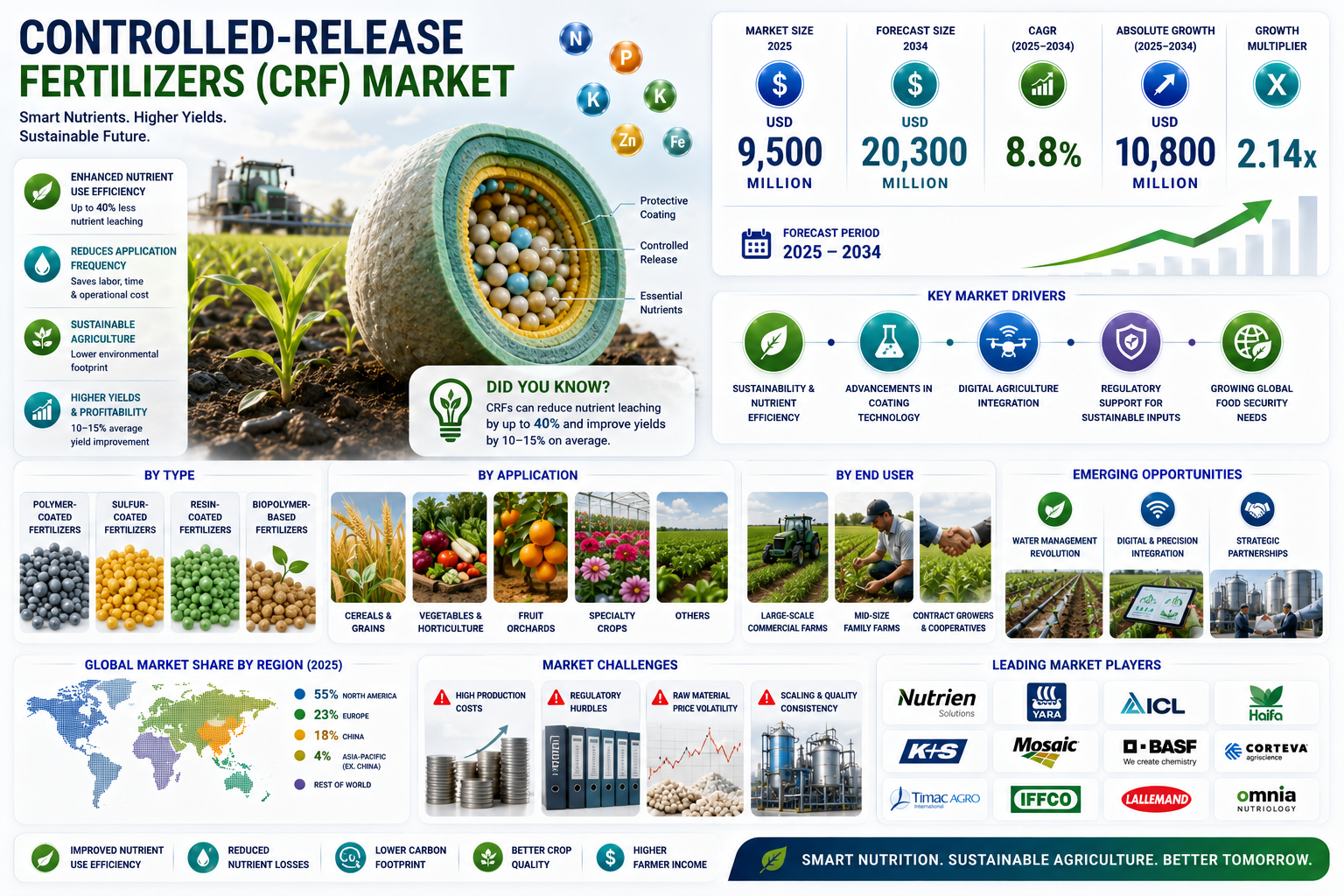
Controlled-Release Fertilizers (CRF) market was valued at USD 9,500 million in 2025 and is projected to reach USD 20,300 million by 2034, exhibiting a remarkable CAGR of 8.8% during the forecast period.
Controlled‑release fertilizers are engineered nutrient delivery systems that release essential macro‑ and micronutrients gradually over time, matching crop uptake patterns. By coating granules with polymeric, sulfur, resin or biopolymer matrices, CRFs improve nutrient use efficiency, dramatically reduce leaching losses, and lower the frequency of field applications-thereby supporting sustainable intensification of agriculture worldwide. Their ability to synchronize nutrient availability with plant growth stages makes them indispensable tools for modern farmers seeking higher yields with lower environmental footprints.
Get Full Report Here: https://www.24chemicalresearch.com/reports/315237/controlledrelease-fertilizers-market
Market Dynamics:
The market's trajectory is shaped by a complex interplay of powerful growth drivers, significant restraints that are being actively addressed, and vast, untapped opportunities.
Powerful Market Drivers Propelling Expansion
- Sustainability and Nutrient Efficiency: Increasing global awareness of ecological stewardship has propelled demand for fertilizers that mitigate nutrient runoff. In regions such as the European Union, stricter nitrate‑pollution regulations have compelled growers to adopt CRFs, which can cut nitrogen leaching by up to 40% compared with conventional urea. According to the International Fertilizer Association, over 30% of major cereal‑producing nations have already incorporated CRF technologies into national best‑practice guidelines, reinforcing a steady demand pipeline.
- Advancements in Coating Technology: Recent breakthroughs in polymer chemistry and bio‑based coating materials have enhanced release‑rate precision while reducing material costs. For instance, a patented biodegradable polymer introduced by a leading agritech firm in 2023 enables a 20‑day to 120‑day release window, catering to both short‑cycle cereals and long‑cycle horticultural crops. As a result, adoption in corn, wheat and rice-accounting for roughly 55% of global arable land-has accelerated, with growers reporting a 10‑15% yield uplift on average.
- Digital Agriculture Integration: The rise of precision‑farming platforms that incorporate soil‑moisture sensors, satellite‑derived NDVI indices, and AI‑driven nutrient‑management algorithms has created a fertile environment for CRFs. By feeding real‑time agronomic data into CRF dosing schedules, farmers can further trim fertilizer waste, achieving up to a 25% reduction in total nutrient input while preserving or enhancing yields. This synergy between hardware, software and CRF formulations is a key catalyst for market expansion across North America, Europe and emerging economies.
Download FREE Sample Report: https://www.24chemicalresearch.com/download-sample/315237/controlledrelease-fertilizers-market
Significant Market Restraints Challenging Adoption
Despite its promise, the market faces hurdles that must be overcome to achieve universal adoption.
- High Production Costs and Complex Manufacturing: The sophisticated coating equipment required for uniform polymer or resin layers, coupled with the need for quality‑controlled raw material inputs, keeps production expenditures above those of conventional granular fertilizers. According to a 2022 industry survey, manufacturers report a 15‑25% cost premium for CRFs relative to bulk urea, a barrier for price‑sensitive smallholder markets.
- Regulatory Hurdles: Stringent registration processes for new coating chemistries can extend product launch timelines by 12‑24 months in major jurisdictions such as the United States, the European Union and China. Variable standards across countries create a fragmented compliance landscape, compelling manufacturers to invest heavily in region‑specific testing and documentation.
Critical Market Challenges Requiring Innovation
Scaling production to meet projected demand while preserving coating uniformity remains a technical challenge. Current continuous‑flow coating lines achieve throughput rates of 500‑800 kg per hour, yet manufacturers aiming to serve large‑scale commercial farms require capacities exceeding 2 tonnes per hour. Moreover, ensuring consistent release‑rate performance across diverse soil textures demands rigorous quality‑control protocols, often consuming 12‑18% of operating budgets. Supply‑chain fragmentation compounds these issues; fluctuations in polymer resin prices-a 20‑30% annual volatility reported by major commodity indices-directly affect CRF profitability.
Additionally, the market contends with an immature distribution network for specialty inputs. While conventional fertilizers enjoy ubiquitous dealer coverage, CRFs rely on a limited set of agronomic service providers who can advise on application timing and dosage, restraining market penetration in remote regions.
Vast Market Opportunities on the Horizon
- Water Management Revolution: CRFs can be paired with advanced irrigation scheduling to further diminish nutrient leaching. Integrated systems that synchronize drip‑irrigation pulses with CRF release kinetics have demonstrated water‑use efficiency improvements of 15‑20% in field trials across the Mediterranean basin, presenting an attractive value proposition for water‑scarce regions.
- Specialty Crop Formulations: High‑value horticultural and fruit crops increasingly demand tailored nutrient blends. CRFs enriched with micronutrients such as zinc, boron, and iron, or with biostimulants like seaweed extracts, are gaining traction in greenhouse production where precise nutrient balance directly translates into premium fruit quality and market price premiums.
- Strategic Partnerships as a Catalyst: Collaborations between fertilizer manufacturers, seed companies and digital‑platform providers are accelerating the co‑development of crop‑specific CRF solutions. Over 40 strategic alliances have been announced since 2021, reducing time‑to‑market for new formulations by 30‑40% and fostering integrated service packages that combine seed, input and data analytics.
In-Depth Segment Analysis: Where is the Growth Concentrated?
By Type:
The market is segmented into Polymer‑coated fertilizers, Sulfur‑coated fertilizers, Resin‑coated fertilizers and Biopolymer‑based fertilizers. Polymer‑coated fertilizers currently lead the type classification because their engineered coating matrix enables precise modulation of nutrient solubility, aligning release profiles with crop growth stages. This capability fosters enhanced nutrient use efficiency, reduced leaching risk, and improved agronomic outcomes across a broad spectrum of soils. Consequently, manufacturers prioritize R&D investments in polymer chemistry to sustain competitive advantage and respond to growers’ demand for environmentally responsible solutions.
By Application:
Application segments include Cereals and grains, Vegetables and horticulture, Fruit orchards, Specialty crops and Others. Cereals and grains represent the dominant application arena for controlled‑release fertilizers. The extensive acreage and intensive fertilization regimes drive the need for sustained nutrient availability, which aligns with the release characteristics of these products. In this segment, growers value the ability to minimize multiple top‑dressing operations, thereby reducing labor and equipment costs while maintaining consistent crop vigor. The reliability of controlled‑release technology also supports yield stability in variable climatic conditions, reinforcing its strategic importance for staple crop production.
By End User:
The end‑user landscape includes Large‑scale commercial farms, Mid‑size family farms and Contract growers & cooperatives. Large‑scale commercial farms emerge as the primary end‑user segment for controlled‑release fertilizers. Their operational scale amplifies the economic benefits of reduced application frequency, lower labor inputs, and optimized input budgeting. Moreover, corporate sustainability commitments drive the adoption of technologies that mitigate nutrient runoff and align with environmental stewardship goals. These enterprises often engage in long‑term supplier partnerships to secure consistent product quality, fostering a market dynamic where innovation and reliability are paramount.
Download FREE Sample Report: https://www.24chemicalresearch.com/download-sample/315237/controlledrelease-fertilizers-market
Competitive Landscape:
The controlled‑release fertilizers market is moderately consolidated, with a handful of global agribusinesses leveraging extensive nitrogen‑based product portfolios, worldwide distribution networks and deep R&D capabilities. Nutrien Ltd. (Canada) leads the market through its expansive coating technologies and strategic acquisitions of regional CRF producers, enabling it to capture a sizable share of high‑value crop‑specific solutions. Yara International ASA (Norway) follows closely, differentiating its offerings with patented polymer‑coated granules and a strong presence in Europe and Latin America. ICL Fertilizers (Israel) and Haifa Group (Israel) specialize in proprietary release‑rate technologies that command premium pricing, while K+S AG (Germany) and The Mosaic Company (USA) capitalize on scale to supply bulk CRF products to large‑farm operations. BASF SE (Germany) and Corteva Agriscience (USA) complement the competitive landscape by integrating CRF lines within broader crop‑protection portfolios, driving cross‑selling opportunities and reinforcing market consolidation.
Beyond the established giants, a cadre of niche and emerging manufacturers is reshaping the CRF frontier through innovative formulations and localized market focus. Timac Agro (France) concentrates on specialty CRF blends for horticulture and organic farming, leveraging its expertise in micronutrient‑enhanced releases. IFFCO (India) has introduced cost‑effective coated urea variants tailored to smallholder needs, expanding its reach across South Asia. Regional players such as Lallemand Inc. (Canada) and Omnia Fertilizers (Brazil) are investing in bio‑based coating systems that address sustainability mandates, while start‑ups in China and Australia are exploring slow‑release technologies driven by digital agriculture platforms. These entrants increase competitive pressure, stimulate product differentiation, and encourage incumbents to accelerate innovation cycles.
List of Key Controlled‑Release Fertilizers Companies Profiled
● Nutrien Ltd. (Canada)
● Yara International ASA (Norway)
● ICL Fertilizers (Israel)
● Haifa Group (Israel)
● K+S AG (Germany)
● The Mosaic Company (USA)
● BASF SE (Germany)
● Corteva Agriscience (USA)
● Timac Agro (France)
● IFFCO (India)
● Lallemand Inc. (Canada)
● Omnia Fertilizers (Brazil)
Regional Analysis: A Global Footprint with Distinct Leaders
● North America: Is the leading region, holding a 55% share of the global market. This dominance is fueled by massive R&D investments, a robust agritech ecosystem, and strong demand from its world‑leading corn, soybean and wheat sectors. The United States acts as the primary engine of growth, driven by both large‑scale commercial farms and a thriving precision‑agriculture industry.
● Europe & China: Together they form a powerful secondary bloc, accounting for 41% of the market. Europe’s strength derives from stringent environmental regulations, substantial subsidies for sustainable inputs and a mature fertilizer distribution network. China, supported by significant government backing and a massive manufacturing base, is a dominant producer and a rapidly growing consumer, especially for rice, maize and vegetable production.
● Asia‑Pacific (ex‑China), South America and MEA: These regions represent the emerging frontier of the CRF market. While currently smaller in scale, they offer significant long‑term growth opportunities driven by increasing agricultural industrialization, investments in renewable energy‑linked irrigation, and a growing technological focus on digital farming.
Get Full Report Here: https://www.24chemicalresearch.com/reports/315237/controlledrelease-fertilizers-market
Download FREE Sample Report: https://www.24chemicalresearch.com/download-sample/315237/controlledrelease-fertilizers-market
About 24chemicalresearch
Founded in 2015, 24chemicalresearch has rapidly established itself as a leader in chemical market intelligence, serving clients including over 30 Fortune 500 companies. We provide data-driven insights through rigorous research methodologies, addressing key industry factors such as government policy, emerging technologies, and competitive landscapes.
● Plant-level capacity tracking
● Real-time price monitoring
● Techno-economic feasibility studies
International: +1(332) 2424 294 | Asia: +91 9169162030
Website: https://www.24chemicalresearch.com/

 English
 Arabic
 French
 Spanish
 Portuguese
 Deutsch
 Turkish
 Dutch
Dutch
 Italiano
 Russian
 Romaian
 Greek
Greek
