


Field Service Management (FSM) Software, 2026–2030 – Industry Analysis & Growth Outlook
As organizations strive to deliver faster, more reliable, and customer-centric services, managing field operations has become a strategic priority. Industries such as utilities, telecommunications, manufacturing, energy, healthcare, and facility management depend on mobile workforces to install, inspect, repair, and maintain critical assets. Traditional field service processes, often reliant on manual scheduling and paper-based workflows, are no longer sufficient to meet growing customer expectations and increasingly complex operational demands. As businesses accelerate digital transformation initiatives, the Field Service Management (FSM) Software Market has emerged as a key enabler of operational efficiency, workforce optimization, and superior customer experiences.
Quadrant Knowledge Solutions reveals that the Field Service Management (FSM) software market is projected to register an above-average CAGR through 2028. The growing adoption of connected technologies, mobile applications, cloud computing, and artificial intelligence (AI) is transforming field service operations across industries. Organizations are increasingly investing in advanced FSM platforms to streamline scheduling, optimize technician dispatch, improve asset visibility, and enhance service delivery. As digital transformation continues to reshape enterprise operations, the demand for intelligent field service management solutions is expected to remain strong through 2030.
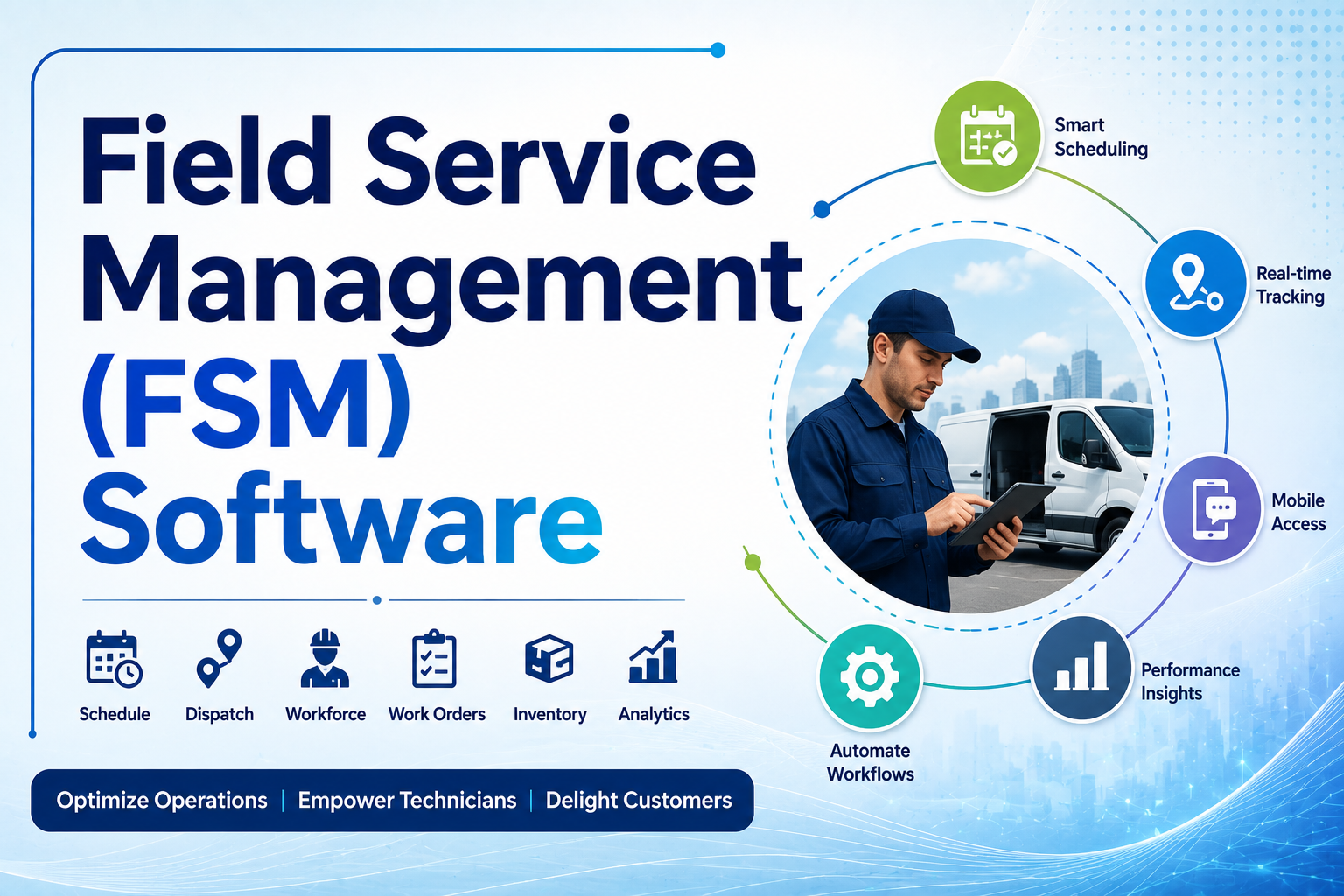
Field Service Management software is designed to manage and optimize end-to-end field operations, including work order management, scheduling, dispatching, route optimization, inventory tracking, mobile workforce management, customer communication, and service analytics. Modern FSM platforms integrate with enterprise applications such as Enterprise Resource Planning (ERP), Customer Relationship Management (CRM), asset management, and IoT platforms, providing organizations with real-time visibility into field operations and enabling data-driven decision-making.
One of the primary drivers fueling the Field Service Management (FSM) Software Market is the increasing reliance on mobile workforces across multiple industries. Organizations managing geographically dispersed technicians require intelligent scheduling and dispatch capabilities to ensure the right personnel, equipment, and resources are assigned to each service request. Advanced FSM software uses AI-powered scheduling algorithms to optimize technician assignments based on skills, availability, location, and service priorities. This improves first-time fix rates, reduces travel time, and enhances overall workforce productivity.
The rapid expansion of the Internet of Things (IoT) is significantly influencing the evolution of field service management. Connected sensors embedded in industrial equipment, utility infrastructure, medical devices, and transportation assets continuously generate operational data that can be analyzed to identify maintenance requirements before failures occur. By integrating IoT data with FSM platforms, organizations can transition from reactive maintenance to predictive and condition-based service models. Automated service alerts, remote diagnostics, and predictive maintenance scheduling minimize equipment downtime while improving asset reliability and customer satisfaction.
Artificial intelligence and machine learning are further transforming field service operations. AI-powered analytics help organizations forecast service demand, predict equipment failures, optimize inventory levels, and recommend the most efficient service routes. Intelligent virtual assistants support technicians by providing real-time access to technical documentation, troubleshooting guides, and historical service records while they are on-site. These capabilities improve operational efficiency, reduce service resolution times, and enhance the overall quality of customer support.
Cloud computing has become a foundational technology for modern FSM platforms. Cloud-native deployments enable organizations to centrally manage field operations across multiple regions while providing secure access to service information from any location. Mobile applications connected to cloud-based platforms allow technicians to receive work orders, update service status, capture customer signatures, manage inventory, and communicate with dispatch teams in real time. This seamless connectivity improves collaboration while ensuring operational consistency across distributed service organizations.
Customer experience has become another significant factor driving investments in field service management solutions. Today's customers expect rapid response times, accurate appointment scheduling, proactive communication, and timely issue resolution. FSM platforms provide automated notifications, appointment tracking, technician location updates, and self-service scheduling capabilities that improve transparency throughout the service lifecycle. Enhanced customer engagement not only increases satisfaction but also strengthens brand loyalty and long-term business relationships.
Another emerging trend shaping the market is the growing adoption of augmented reality (AR) and remote assistance technologies. Field technicians can leverage AR-enabled smart glasses or mobile devices to receive real-time guidance from remote experts, reducing the need for repeat visits and accelerating problem resolution. These technologies also support technician training, knowledge sharing, and complex equipment maintenance, particularly in industries with highly specialized service requirements.
Sustainability objectives are also encouraging organizations to modernize field operations. Intelligent route optimization reduces unnecessary travel, lowering fuel consumption and carbon emissions. Predictive maintenance extends equipment lifecycles, minimizes waste, and improves resource utilization. Digital documentation eliminates paper-based workflows while supporting regulatory compliance and environmental initiatives. Organizations increasingly view FSM platforms as strategic tools that contribute to both operational excellence and sustainability goals.
Despite strong market momentum, organizations continue to face challenges related to integrating FSM software with legacy enterprise systems, managing diverse field assets, and ensuring data security across connected environments. Technology vendors are addressing these issues by developing open integration frameworks, AI-powered automation capabilities, standardized APIs, and advanced cybersecurity features that simplify deployment while supporting enterprise scalability and compliance.
Looking ahead, the Field Service Management (FSM) Software Market is expected to experience sustained growth through 2030 as organizations continue investing in digital transformation, connected operations, intelligent automation, and customer-centric service models. Emerging technologies such as generative AI, digital twins, 5G connectivity, edge computing, and autonomous service management will further enhance FSM capabilities, enabling organizations to deliver faster, smarter, and more proactive field services.
Quadrant Knowledge Solutions provides comprehensive research into the Field Service Management software market, offering valuable insights into technology innovation, competitive positioning, market dynamics, vendor capabilities, and future growth opportunities. The research supports enterprise decision-makers, technology vendors, investors, and service organizations in evaluating evolving market trends and identifying strategic opportunities within the rapidly growing field service ecosystem.
As enterprises continue modernizing their service operations, the Field Service Management (FSM) Software Market will remain a critical technology supporting operational efficiency, workforce productivity, and customer satisfaction. By combining AI, IoT, cloud computing, and mobile technologies, modern FSM platforms empower organizations to optimize field operations, improve asset performance, reduce operational costs, and build lasting competitive advantages in an increasingly service-driven economy.

 English
 Arabic
 French
 Spanish
 Portuguese
 Deutsch
 Turkish
 Dutch
Dutch
 Italiano
 Russian
 Romaian
 Greek
Greek
