What Is LLM?
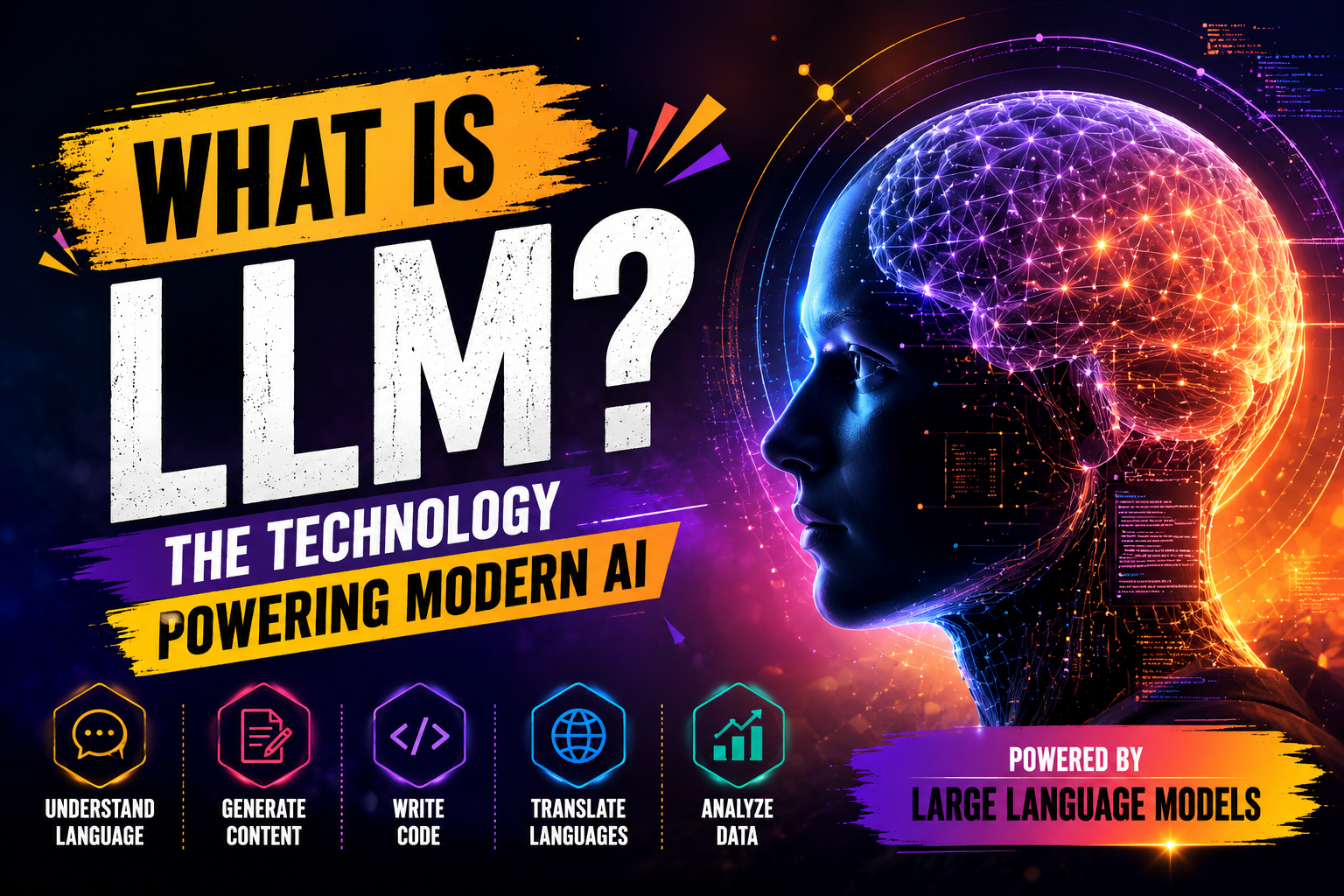
Artificial intelligence has evolved rapidly over the past few years, and one of the biggest breakthroughs is the Large Language Model (LLM). Unlike traditional AI systems that follow fixed rules or perform specific tasks, LLMs can understand, generate, and respond to human language in a natural way.
Popular AI tools like ChatGPT, Gemini, Claude, and Llama are all powered by LLMs, making them capable of writing content, answering questions, generating code, and much more.
What Is a Large Language Model (LLM)?
A Large Language Model (LLM) is an advanced AI model trained on massive datasets containing books, articles, websites, and other text. Instead of relying on predefined rules, it learns patterns in language to understand context and generate meaningful responses.
The more data an LLM is trained on, the better it becomes at understanding complex questions and producing accurate answers.
What Is Traditional AI?
Traditional AI is designed to perform specific tasks using predefined rules, algorithms, or structured data. These systems work well within a limited scope but struggle when faced with unexpected questions or changing situations.
Examples of traditional AI include:
- Spam email filters
- Face recognition systems
- Recommendation engines
- Fraud detection software
LLM vs Traditional AI
| Feature |
LLM |
Traditional AI |
| Learning Method |
Trained on massive text datasets |
Rule-based or task-specific algorithms |
| Flexibility |
Handles multiple language tasks |
Designed for one specific task |
| Understanding |
Understands context and conversation |
Limited contextual understanding |
| Output |
Generates human-like responses |
Produces predefined results |
| Applications |
Chatbots, writing, coding, translation |
Image recognition, fraud detection, automation |
Why Are Businesses Choosing LLMs?
Organizations are adopting LLMs because they improve productivity and automate language-based tasks. They can assist customer support teams, generate marketing content, summarize documents, write software code, and provide intelligent insights from business data.
Traditional AI remains valuable for specialized tasks, but LLMs offer greater flexibility when human language and communication are involved.
Real-World Applications of LLMs
Today, large language models are used across many industries, including
- AI-powered customer support
- Content creation and copywriting
- Software development
- Healthcare documentation
- Financial analysis
- Legal document review
- Education and personalized learning
These applications continue to grow as LLM technology becomes more accurate and accessible.
Final Thoughts
LLMs represent the next generation of artificial intelligence by enabling machines to understand and generate human language with remarkable accuracy. While traditional AI remains essential for specialized applications, large language models provide the flexibility needed for modern business, communication, and automation. As AI continues to evolve, understanding the difference between LLMs and traditional AI experts has become increasingly important for businesses and technology professionals.
FAQs
What is LLM in AI?
LLM stands for Large Language Model, an AI system trained on massive amounts of text to understand and generate human-like language.
Is ChatGPT an LLM?
Yes. ChatGPT is powered by OpenAI's Large Language Models, which enable it to understand questions and generate natural responses.
What is the difference between LLM and traditional AI?
LLMs learn from vast text datasets and can perform many language-related tasks, while traditional AI is typically designed for specific tasks using predefined rules or algorithms.
Which is better, LLM or traditional AI?
Neither is universally better. Traditional AI excels at specialized tasks, while LLMs are ideal for language understanding, content generation, customer support, and conversational AI.




 Arabic
 French
 Spanish
 Portuguese
 Deutsch
 Turkish
 Dutch
Dutch
 Italiano
 Russian
 Romaian
 Portuguese (Brazil)
 Greek
Greek
