


How Cognitive EW Supports Modern Defense
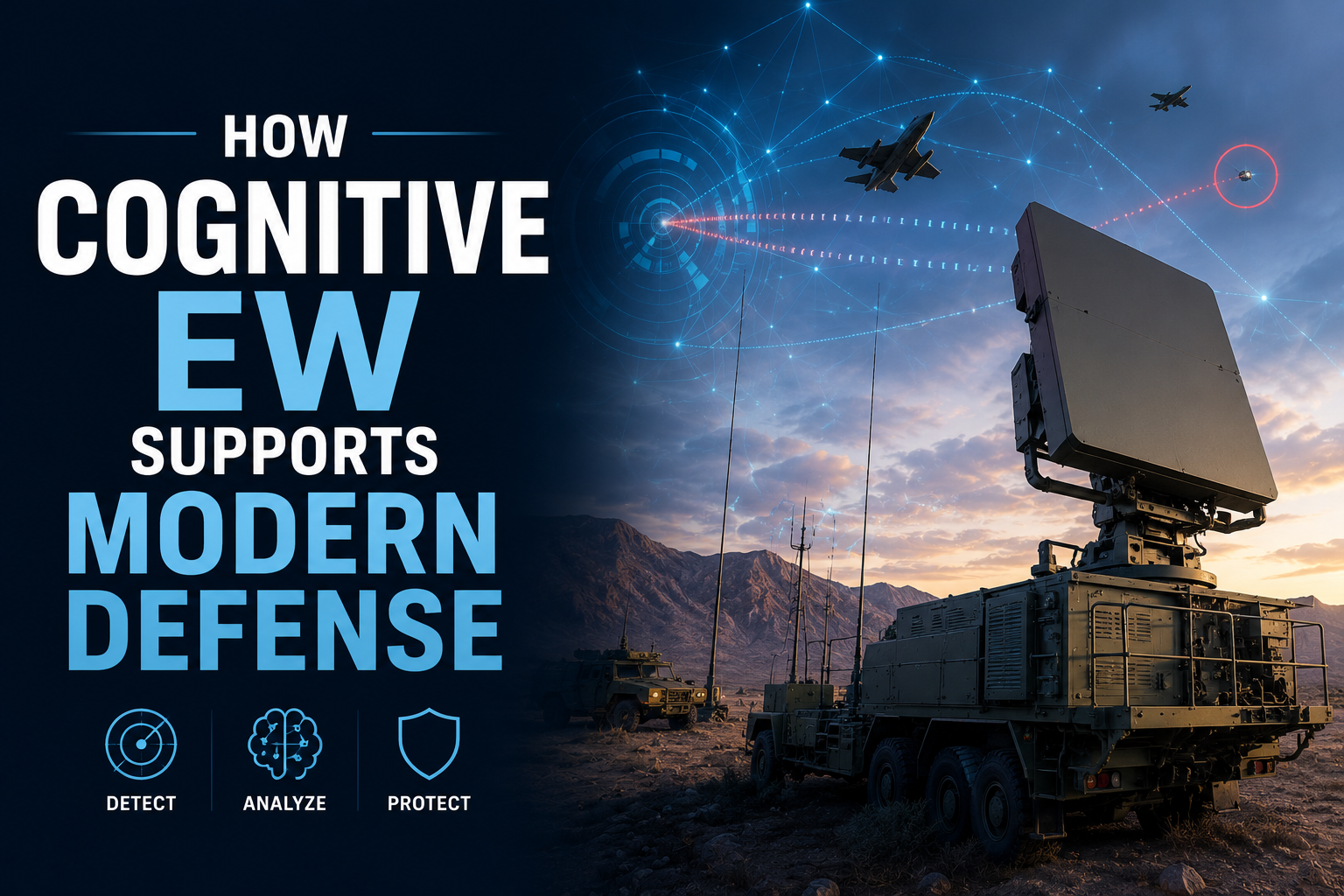
Cognitive electronic warfare is becoming important as defense forces face faster, more complex, and more crowded electromagnetic environments. Traditional electronic warfare systems often depend on known threat libraries and pre-planned responses. Cognitive EW adds artificial intelligence, machine learning, adaptive signal processing, and real-time decision support to help systems detect, understand, and respond to changing radar, communication, and sensor threats more effectively.
A published study by MarkNtel Advisors reports that the global cognitive electronic warfare sector was valued at around USD 10.20 billion in 2025. It is projected to grow from USD 11.43 billion in 2026 to USD 22.6 billion by 2032, registering a CAGR of around 12.03% during 2026–32. This growth reflects rising demand for adaptive defense systems, spectrum dominance, AI-enabled threat response, and advanced military modernization.
Spectrum Control Drives Demand
Modern defense operations depend heavily on the electromagnetic spectrum. Radar, satellite links, navigation signals, drones, communication networks, missiles, and surveillance systems all use spectrum-based capabilities. When this environment becomes contested, forces need systems that can detect threats, protect friendly operations, and disrupt hostile activity.
NATO explains that electromagnetic warfare uses the electromagnetic spectrum to create effects that support military objectives. This makes cognitive EW important because future battlefields require faster understanding of signals and more adaptive responses.
AI Improves Threat Response
Artificial intelligence helps cognitive EW systems process large volumes of signal data and identify patterns faster than manual methods. These systems can learn from changing signal behavior, recognize unfamiliar emissions, and recommend or generate countermeasures. This supports quicker action in environments where threats may change during a mission.
Cognitive EW is especially useful when adversaries use agile radars, frequency hopping, low-probability-of-intercept signals, or adaptive communication systems. AI-based tools can help reduce response time and improve decision quality when traditional rule-based systems are not enough.
Adaptive Countermeasures Gain Importance
Adaptive countermeasures are a central feature of cognitive electronic warfare. Instead of relying only on stored responses, cognitive systems can evaluate new signals and adjust actions in real time. This helps platforms survive against unknown or rapidly changing threats.
DARPA’s Adaptive Radar Countermeasures program focuses on enabling airborne EW systems to automatically generate effective countermeasures against new and adaptive radars. This type of research shows why adaptive capability is becoming a major direction for future EW development.
Airborne Platforms Need Protection
Aircraft, drones, helicopters, and unmanned systems operate in environments where radar-guided threats, communication jamming, and electronic attacks can affect survivability. Cognitive EW can support threat detection, jamming decisions, decoy coordination, and mission adaptation. This makes it relevant for both manned and unmanned platforms.
As defense forces expand unmanned systems and connected aircraft operations, EW systems must handle more signals at faster speeds. Cognitive tools can help platforms analyze the surrounding spectrum and respond without waiting for long manual interpretation.
Land and Naval Systems Expand Use
Cognitive EW is not limited to aircraft. Ground forces use electronic warfare for communication protection, drone defense, signal intelligence, and battlefield awareness. Naval platforms also require spectrum awareness because ships rely on radar, communication links, navigation systems, and electronic support measures.
Land and naval operations often take place in congested environments where friendly, civilian, and hostile signals may overlap. Cognitive systems can help classify signals, prioritize threats, reduce interference, and support commanders with clearer electronic situational awareness.
Testing Environments Become Critical
Cognitive EW systems need strong testing because real-world electromagnetic environments are complex and unpredictable. Developers must validate how systems detect signals, learn patterns, avoid false responses, and perform under operational pressure. Simulation, digital test ranges, and RF emulation help reduce risk before deployment.
DARPA’s Digital RF Battlespace Emulator program aims to create a large-scale virtual RF environment for developing, training, and testing advanced radar and electronic warfare systems. Such testing tools support safer and more reliable EW innovation.
Data Quality Shapes Performance
Cognitive EW depends on data. Signal libraries, mission data files, spectrum recordings, threat behavior, training datasets, and feedback loops all influence system performance. Poor data quality can create wrong classifications, missed threats, or ineffective responses. Therefore, data management is as important as hardware capability.
Defense organizations need secure data pipelines, updated threat libraries, validated algorithms, and strong human oversight. Systems must be trained and tested carefully so they support mission decisions without creating unnecessary operational risk.
Human Oversight Remains Necessary
Although cognitive EW uses automation, human oversight remains important. Commanders and operators must understand system recommendations, mission rules, escalation risks, and potential effects on friendly or civilian systems. Automated responses must be controlled to avoid unintended interference or operational mistakes.
The goal is not to remove people from decision-making but to support them with faster analysis and better options. Cognitive EW works best when automation, operator training, doctrine, and mission planning are aligned.
Outlook for Cognitive EW
The global cognitive electronic warfare sector is expected to grow strongly through 2032, supported by contested spectrum operations, AI-enabled defense modernization, adaptive radar threats, unmanned platforms, and advanced testing environments. Defense forces need systems that can respond faster to unknown and changing electronic threats.
Future growth will depend on algorithm reliability, secure data management, realistic testing, platform integration, human oversight, and interoperability. Companies that combine advanced sensors, AI software, adaptive countermeasures, and dependable mission support will remain important in the cognitive EW sector.

 English
 Arabic
 French
 Spanish
 Portuguese
 Deutsch
 Dutch
Dutch
 Italiano
 Russian
 Romaian
 Portuguese (Brazil)
 Greek
Greek
