


How Does a Rubber Extrusion Production Line Work in Manufacturing?
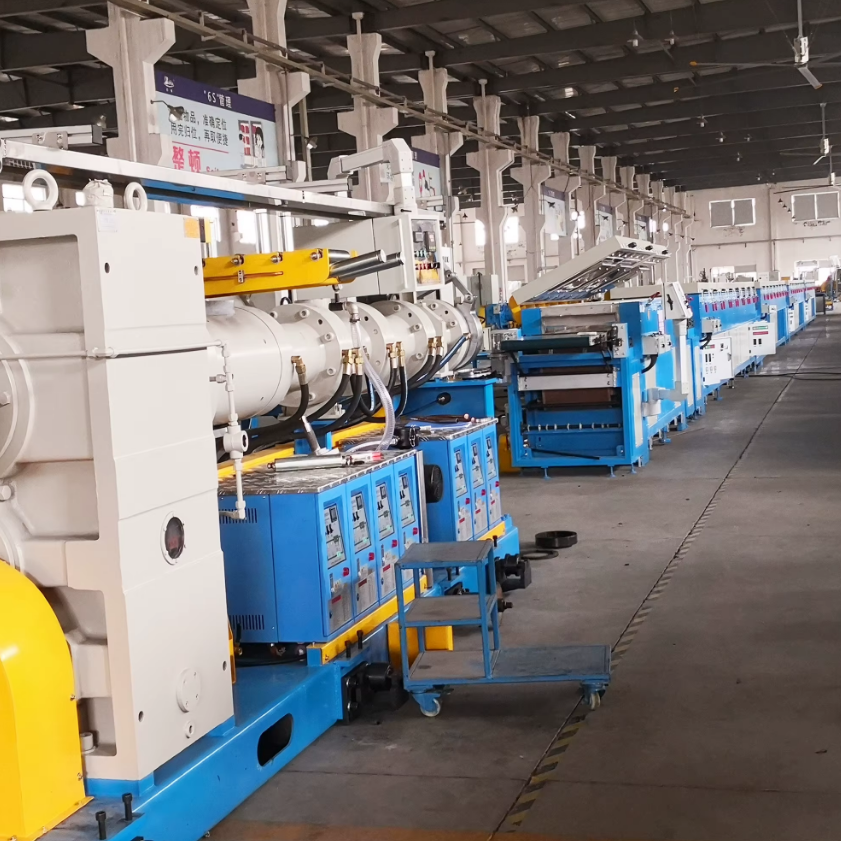
A rubber extrusion production line is a manufacturing system designed to shape rubber materials into continuous profiles with specific dimensions and properties. It plays a central role in many industrial sectors, providing a stable and efficient method for producing items such as sealing strips, hoses, cables, and various structural components.
The primary function of a rubber extrusion production line is to convert raw rubber compounds into formed products through a controlled extrusion process. This begins with the preparation of rubber material, usually in the form of pellets or sheets. The material is fed into an extruder, where it is heated, softened, and pushed forward by a rotating screw. Within the extruder barrel, the rubber blends uniformly and gradually becomes plasticized, making it suitable for shaping. This transformation ensures that the material reaches the correct viscosity for consistent extrusion.
Another key function of the production line is shaping the rubber into continuous profiles. At the end of the extruder, the material passes through a die—a precision tool that determines the shape and size of the final product. Dies come in many designs depending on the application, such as simple round openings for hoses or more complex shapes for automotive sealing strips. By using dies, manufacturers can produce long, uniform products that meet specific geometric requirements. This shaping function is valuable for industries that rely on consistent product dimensions and performance.
Temperature control is an important element of the production line's operation. Rubber requires carefully managed heating and cooling to achieve the right physical properties. During extrusion, heating zones along the barrel maintain even temperatures to ensure smooth flow and prevent material degradation. After the rubber leaves the die, cooling equipment—such as water troughs, air coolers, or infrared systems—helps stabilize the shape and improve dimensional accuracy. This controlled cooling function is essential for preventing deformation and maintaining product quality.
A rubber extrusion production line also performs the function of continuous production. Because the process involves feeding material at one end and receiving shaped profiles at the other, manufacturers can operate the system for extended periods. This supports efficient output and reduces downtime associated with batch processing. Continuous production is especially useful for large-volume applications where long lengths of material are required, such as building insulation strips, window seals, or industrial tubing.
Quality control is another function integrated into many production lines. Modern extrusion systems often include monitors and sensors that track parameters such as temperature, pressure, speed, and product dimensions. These tools help operators adjust settings in real time to maintain stable conditions. In some cases, automated inspection systems check the surface finish or measure cross-sectional dimensions to ensure that the product conforms to specifications. By integrating quality control into the process, manufacturers can reduce waste and improve overall reliability.
In addition to forming and cooling, the production line often includes downstream equipment for finishing. Depending on the product type, these processes may involve cutting, trimming, surface treatment, or coiling. For example, hose production may require wrapping, braiding, or adding reinforcement layers. Sealing strips may need vulcanization to enhance their elasticity and durability. The finishing function ensures that the extruded profiles are ready for final use or assembly.
Energy efficiency is another area where the production line provides value. Modern extrusion machines are designed to optimize heat distribution and screw speed, helping reduce energy consumption. Efficient temperature management systems support stable operation while thermal loss. Although efficiency levels vary by machine type and production setup, these features support cost-effective operation for manufacturers.
Flexibility is also part of the production line's function. By changing dies, adjusting process parameters, or modifying the rubber formulation, the same equipment can produce a wide variety of products. This adaptability allows manufacturers to respond to different market needs without major equipment changes. It also supports experimentation with new material blends or product designs.

 English
 French
 Spanish
 Portuguese
 Deutsch
 Turkish
 Dutch
Dutch
 Italiano
 Russian
 Romaian
 Portuguese (Brazil)
 Greek
Greek
