


Aircraft Engine Nacelle Market Competitive Analysis & Industry Outlook 2026–2035
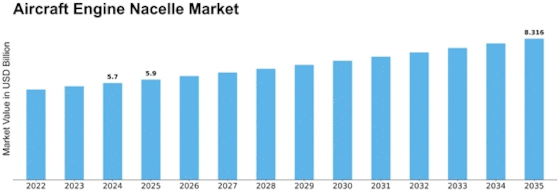
The Aircraft Engine Nacelle Market is a key segment within the global aerospace industry, driven by a sustained increase in aircraft deliveries and the growing focus on fuel efficiency and environmental sustainability. As per Market Research Future (MRFR), The Aircraft Engine Nacelle industry is projected to grow from 5.901 USD Billion in 2025 to 8.316 USD Billion by 2035, exhibiting a compound annual growth rate (CAGR) of 3.49% during the forecast period 2025 - 2035, emerging as a steady growth domain within aerospace components.
Modern aircraft nacelles perform multiple functions: they streamline airflow, protect engine systems from environmental hazards, support thrust performance, and reduce noise levels generated during jet operation. This multifunctionality represents one of the most important Aircraft Engine Nacelle Market trends shaping investment and product development strategies among OEMs and Tier-1 suppliers in the aerospace value chain.
Sustainability is a focal point within the industry. With global regulatory bodies pushing for reduced greenhouse gas emissions and quieter aircraft operations, aircraft engine nacelle manufacturers are investing in next-generation materials and designs. Composite nacelles, for example, offer significant weight advantages over conventional aluminum and titanium alloys, directly contributing to improved fuel economy and lower carbon footprints for airlines.
One major driver for market growth is the ongoing renewal and expansion of airline fleets around the world. As passenger air travel continues its post-pandemic recovery, airlines are placing orders for both new-generation narrowbody and widebody aircraft. Each new aircraft requires advanced nacelle systems — a factor that propels the aircraft engine nacelle market forecast. Additionally, the retrofit of aging aircraft with more efficient nacelles is becoming an essential investment for carriers seeking operational savings and compliance with modern emissions standards.
The commercial aviation segment holds the largest share of the market due to the sheer volume of passenger aircraft incorporating advanced nacelle technologies. However, the military aviation segment is gaining momentum as defense agencies modernize aircraft fleets with enhanced performance systems that include weight-optimized and stealth-compatible nacelles, contributing to long-term demand growth.
From a materials perspective, composite materials are expected to register the fastest growth due to their increasing adoption in new aircraft programs. Composite nacelles provide significant advantages in terms of weight reduction, strength, and corrosion resistance. Aluminum and titanium alloys remain important due to their established use and specific engineering applications where thermal or impact resilience is required.
Technological innovation is another trend redefining the aircraft engine nacelle landscape. Manufacturers are integrating smart health monitoring systems and sensors into nacelle designs, enabling predictive maintenance and real-time performance tracking — capabilities that significantly reduce unplanned downtimes and maintenance costs for airlines. These advancements feed directly into broader fleet management strategies focused on maximizing aircraft availability and lifecycle performance.
Another important driver is the rise of regional aircraft programs in Asia-Pacific, where expanding air travel demand has stimulated domestic aerospace manufacturing and supply chain development. Countries like China and India are enhancing their aerospace capabilities, creating new opportunities for nacelle manufacturers to support localized production as part of broader industrial growth objectives.
Despite growth opportunities, the market is not without challenges. Persistent global supply chain disruptions, escalated material costs, and extended lead times for critical components can impact production schedules and delivery cycles. These factors require strategic planning and collaboration across the industry to ensure nacelle manufacturers can meet evolving airline and defense needs.
Overall, the aircraft engine nacelle market is set to navigate a dynamic period of innovation and expansion through 2035, fueled by sustainability imperatives, advanced materials, and evolving fleet requirements.
Discover More Research Reports on Aerospace & Defense By Market Research Future:

 English
 Arabic
 French
 Spanish
 Portuguese
 Deutsch
 Turkish
 Italiano
 Russian
 Romaian
 Portuguese (Brazil)
 Greek
