


Application Lifecycle Management for Regulated Industries: Trends, Benefits & Future Outlook
Organizations operating in highly regulated industries face increasing pressure to deliver innovative software while complying with evolving regulatory standards. Industries such as healthcare, medical devices, pharmaceuticals, aerospace, defense, automotive, banking, and energy must balance speed, quality, security, and compliance throughout the software development lifecycle.
This is where Application Lifecycle Management for Regulated Industries becomes a strategic enabler. Modern ALM platforms go beyond traditional software development tools by providing end-to-end visibility, traceability, governance, and collaboration across every phase of the application lifecycle. As organizations embrace AI, cloud-native development, DevSecOps, and digital engineering, ALM solutions are becoming the foundation for compliant software innovation.
Why ALM Matters in Regulated Industries
Unlike conventional software projects, regulated industries require every requirement, design decision, code change, test result, and deployment activity to be fully documented and auditable. Regulatory bodies expect organizations to demonstrate complete traceability throughout the development lifecycle.
An advanced Application Lifecycle Management for Regulated Industries platform centralizes requirements management, risk assessment, test management, quality assurance, release management, and documentation into a single ecosystem. This integrated approach minimizes compliance risks while improving collaboration across engineering, quality, regulatory, and operations teams.
Organizations also benefit from automated workflows that reduce manual effort, improve consistency, and accelerate product delivery without compromising quality.
Key Market Drivers
Several technology and business trends are accelerating ALM adoption across regulated industries.
1. Growing Regulatory Complexity
Global regulations continue to evolve, requiring organizations to maintain accurate documentation, change history, and validation records. Digital traceability has become essential for maintaining compliance and simplifying audits.
2. Software-Defined Products
Modern products increasingly depend on embedded software and connected technologies. Automotive systems, medical devices, aerospace equipment, and industrial machinery now require sophisticated software lifecycle management.
3. Digital Transformation
Enterprises are modernizing legacy development environments through cloud platforms, agile methodologies, and DevSecOps. ALM solutions provide the governance needed to support these transformations while maintaining compliance.
4. Cybersecurity Requirements
Security is now integrated into every phase of software development. Secure coding, vulnerability tracking, automated testing, and continuous monitoring help organizations reduce operational and regulatory risks.
5. Emerging Technology Trends
The ALM market continues to evolve with advanced technologies that improve productivity and decision-making.
6. Artificial Intelligence
AI is transforming requirements analysis, defect prediction, automated documentation, intelligent testing, and risk identification. AI-powered recommendations help development teams prioritize tasks, improve software quality, and reduce development cycles.
End-to-End Digital Traceability
Organizations increasingly demand complete traceability from business requirements to deployment. Digital traceability simplifies compliance audits while improving visibility across development activities.
DevSecOps Integration
Security is shifting left within the software development lifecycle. Modern ALM platforms integrate seamlessly with CI/CD pipelines, enabling automated compliance validation, security testing, and release governance.
Cloud-Native ALM
Cloud deployment enables global collaboration, scalability, lower infrastructure costs, and faster software updates. Organizations can support distributed engineering teams while maintaining centralized governance.
Benefits of Modern ALM Solutions
Implementing a modern ALM platform delivers measurable business benefits beyond regulatory compliance.
- Faster software development cycles
- Improved collaboration across cross-functional teams
- Enhanced regulatory compliance and audit readiness
- Complete lifecycle traceability
- Reduced product recalls and compliance risks
- Higher software quality through automated testing
- Better visibility into project progress
- Increased productivity through workflow automation
- Lower development and maintenance costs
- Faster time-to-market
These benefits enable organizations to innovate confidently while meeting strict regulatory requirements.
Industry Use Cases
Medical Devices
Manufacturers rely on ALM platforms to manage software requirements, risk management, validation testing, and regulatory documentation required for product approvals.
Automotive
As connected and autonomous vehicles become increasingly software-driven, ALM supports functional safety, cybersecurity, software version control, and requirements traceability throughout development.
Aerospace and Defense
Engineering teams use ALM to manage complex development programs requiring extensive documentation, configuration management, verification, and certification.
Pharmaceuticals
ALM solutions support laboratory systems, manufacturing software, quality management applications, and validation processes while maintaining regulatory compliance.
Financial Services
Banks and financial institutions leverage ALM to improve software governance, maintain security standards, manage regulatory reporting, and accelerate digital banking innovation.
Vendor Evaluation Becomes Critical
Selecting the right ALM platform requires more than comparing features. Organizations should assess vendors based on technology innovation, scalability, compliance capabilities, integration ecosystem, AI readiness, customer experience, deployment flexibility, and long-term product strategy.
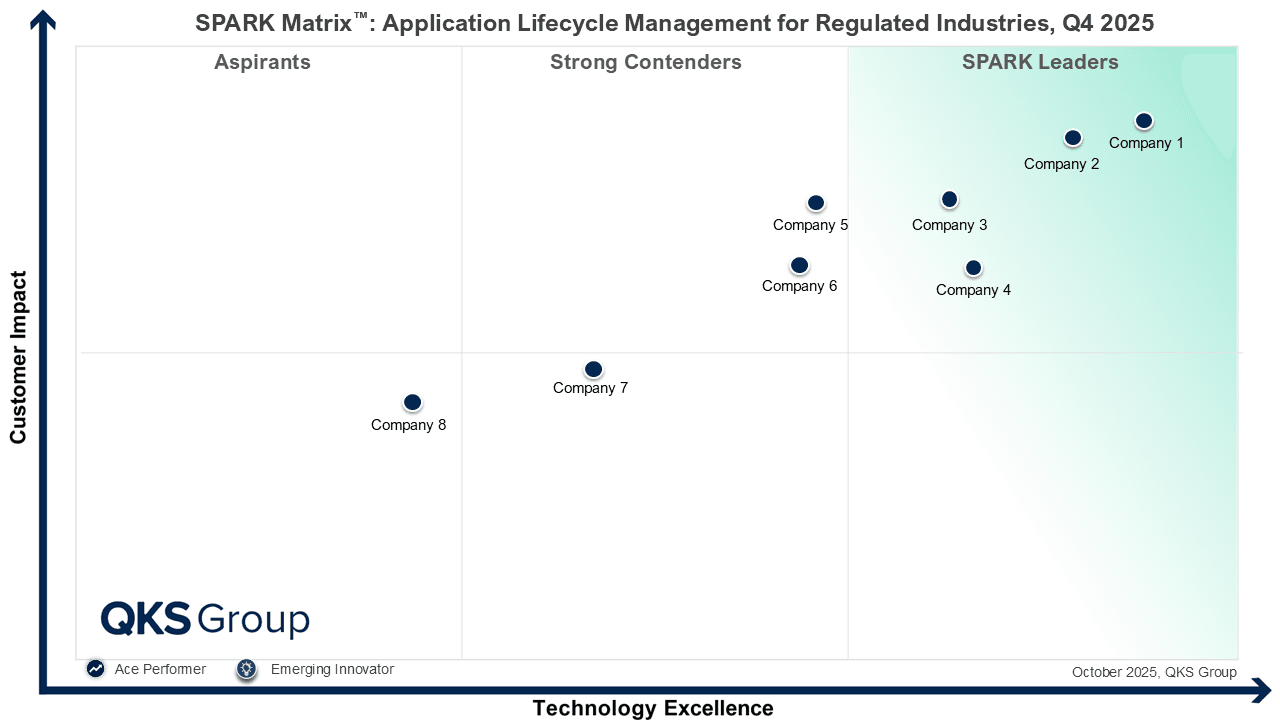
Analyst evaluations such as QKS Group's SPARK Matrix are designed to help enterprises compare vendors using structured criteria including technology excellence and customer impact, enabling more informed software investment decisions.
The Future of ALM in Regulated Industries
The future of ALM will be defined by intelligent automation, AI-assisted engineering, digital twins, predictive quality management, and tighter integration with Product Lifecycle Management (PLM), Systems Engineering, and enterprise DevSecOps ecosystems.
Organizations will increasingly seek platforms that connect requirements, design, development, testing, security, compliance, and operations into a unified digital thread. This approach improves visibility, supports continuous compliance, and accelerates innovation while reducing operational risk.
Conclusion
As software becomes central to business success across regulated industries, Application Lifecycle Management for Regulated Industries is no longer just a development tool—it is a strategic platform for governance, quality, and digital transformation.
Organizations investing in modern ALM solutions can improve collaboration, automate compliance, strengthen security, and accelerate product innovation while meeting evolving regulatory expectations. Enterprises that adopt intelligent, integrated, and scalable ALM platforms today will be better positioned to deliver high-quality software, maintain customer trust, and achieve sustainable growth in an increasingly complex regulatory landscape.

 English
 Arabic
 Spanish
 Portuguese
 Deutsch
 Turkish
 Dutch
Dutch
 Italiano
 Russian
 Romaian
 Portuguese (Brazil)
 Greek
Greek
