


Shift-Right Testing Explained: Using Production Monitoring to Improve Software Quality
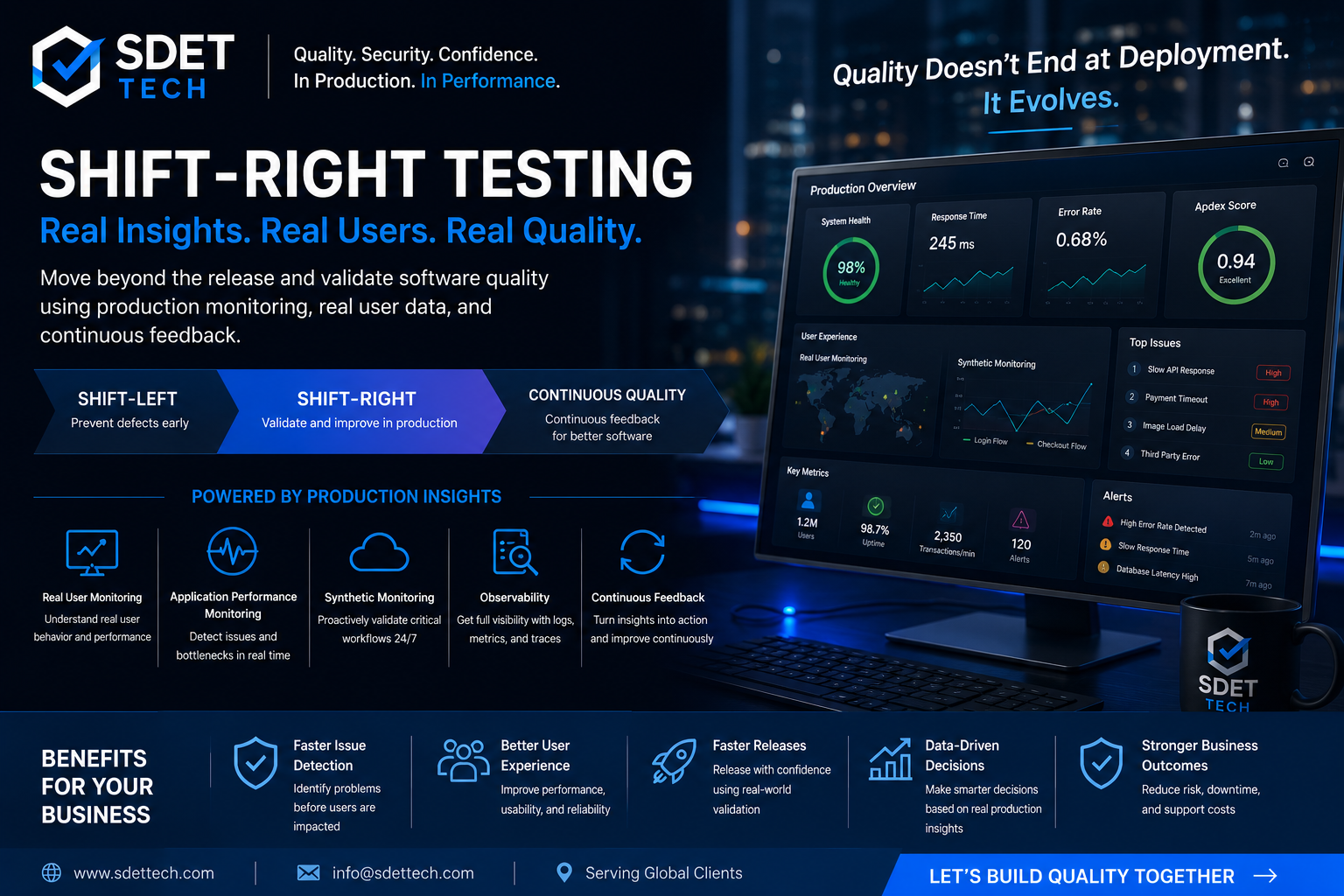
Software testing has traditionally focused on identifying defects before an application reaches production. While this approach remains essential, modern software development demands more than pre-release validation. With continuous deployment, cloud-native applications, microservices, and AI-powered software becoming the norm, businesses need visibility into how applications behave after deployment. This is where Shift-Right Testing is transforming the future of quality engineering.
Shift-Right Testing extends the software testing lifecycle into production by combining real user monitoring, application performance monitoring, observability, synthetic monitoring, and production analytics. Instead of assuming software is reliable after release, organizations continuously validate performance, stability, and user experience using real production data. For businesses pursuing faster releases without compromising quality, Shift-Right Testing has become an essential part of modern software testing services.
What Is Shift-Right Testing?
Shift-Right Testing is a quality engineering practice that focuses on testing and validating applications after they have been deployed into production or production-like environments. Rather than ending QA at deployment, Shift-Right Testing enables organizations to monitor real-world application behavior, detect issues early, and continuously improve software quality.
Unlike traditional testing methods, Shift-Right Testing uses live application telemetry, production monitoring, synthetic transactions, user behaviour analysis, and observability tools to uncover issues that cannot always be replicated in testing environments.
The goal is not to replace traditional QA but to complement Shift-Left Testing by creating a continuous feedback loop that improves software reliability throughout the application lifecycle.
Why Traditional Testing Alone Is No Longer Enough
Today's applications are significantly more complex than they were just a few years ago. Businesses operate across cloud platforms, distributed microservices, APIs, third-party integrations, mobile applications, and multiple geographic regions.
Even the most comprehensive pre-production testing cannot perfectly simulate every production scenario.
Unexpected traffic spikes, regional latency, infrastructure failures, browser differences, user behaviour variations, and third-party service interruptions often appear only after deployment.
This is why organizations are investing in production monitoring, continuous testing, and application observability as core components of their quality engineering strategy.
How Shift-Right Testing Works
Shift-Right Testing relies on continuous monitoring and intelligent analysis rather than one-time validation.
Once an application is deployed, quality engineers monitor system health using production metrics, logs, traces, infrastructure monitoring, synthetic transactions, user analytics, and application performance monitoring.
When anomalies occur, engineering teams receive immediate alerts, allowing them to investigate issues before they affect large numbers of users.
Production insights are then fed back into development and testing teams, improving future releases and strengthening overall software quality.
This continuous improvement cycle is one of the defining characteristics of modern Quality Engineering Services.
Key Components of Shift-Right Testing
Application Performance Monitoring (APM)
Application Performance Monitoring enables organizations to track response times, transaction performance, database behaviour, server health, and infrastructure utilization.
Monitoring these metrics continuously helps teams detect bottlenecks before users experience service degradation.
Performance monitoring also provides valuable insights for capacity planning and infrastructure optimization.
Real User Monitoring (RUM)
Real User Monitoring collects data directly from users interacting with production applications.
Unlike simulated testing, RUM provides insights into actual page load times, browser performance, device compatibility, network conditions, and user journeys.
These insights help organizations optimize customer experience based on real-world usage patterns.
Synthetic Monitoring
Synthetic monitoring continuously executes automated user journeys from multiple geographic locations.
These scripted transactions validate critical workflows such as user login, payment processing, checkout, and account creation.
Even when no real users are active, synthetic monitoring helps identify issues proactively.
Observability
Modern observability combines logs, metrics, and distributed traces to provide complete visibility into complex application ecosystems.
Observability enables engineering teams to quickly identify root causes rather than simply detecting failures.
For cloud-native and microservices architectures, observability has become an essential quality engineering capability.
Feature Flag Validation
Many organizations now release new features gradually using feature flags.
Shift-Right Testing validates these releases by monitoring production behaviour before expanding availability to all users.
This significantly reduces deployment risks while supporting continuous delivery.
Benefits of Shift-Right Testing
Improved Software Reliability
Continuous production validation identifies issues that traditional testing cannot reproduce.
This results in more stable applications and higher customer satisfaction.
Faster Incident Detection
Real-time monitoring enables organizations to identify failures immediately rather than relying on customer complaints.
Early detection reduces downtime and minimizes business impact.
Better Customer Experience
Production insights help businesses understand how customers actually interact with their applications.
Teams can prioritize improvements based on real user behaviour instead of assumptions.
Faster Software Releases
Because production monitoring provides continuous validation, organizations can deploy updates more confidently and more frequently.
Shift-Right Testing supports agile development and DevOps without sacrificing quality.
Smarter Quality Engineering Decisions
Production analytics provide valuable feedback for future testing strategies.
Teams learn which components require deeper validation and which risks deserve greater attention.
Shift-Left vs Shift-Right Testing
Many organizations mistakenly believe Shift-Right Testing replaces Shift-Left Testing.
In reality, they complement one another.
Shift-Left Testing focuses on preventing defects during development through early testing, automation, and continuous integration.
Shift-Right Testing validates software under real operating conditions after deployment.
Together, these approaches create a comprehensive Continuous Quality Engineering strategy that improves both software quality and release velocity.
Industries Benefiting from Shift-Right Testing
Several industries are rapidly adopting Shift-Right Testing because of increasing digital complexity.
Financial institutions monitor payment systems for transaction reliability and fraud detection.
Healthcare organizations validate application availability while protecting sensitive patient information.
E-commerce platforms monitor checkout performance during seasonal traffic spikes.
SaaS companies use production monitoring to ensure continuous service availability for global users.
Telecommunications providers rely on observability to maintain high network and application performance.
Best Practices for Successful Shift-Right Testing
Organizations adopting Shift-Right Testing should establish measurable service-level objectives and monitor key performance indicators continuously.
Critical business workflows should be validated using synthetic monitoring alongside real user monitoring.
Observability platforms should integrate logs, metrics, and traces into a unified monitoring strategy.
Security monitoring, performance testing, and production validation should work together rather than operating independently.
Most importantly, production insights should continuously improve test automation, regression testing, and future development cycles.
The Future of Shift-Right Testing
As AI transforms software engineering, Shift-Right Testing is becoming increasingly intelligent.
AI-powered monitoring platforms can detect anomalies automatically, predict failures before they occur, prioritize incidents based on business impact, and recommend corrective actions.
Combined with autonomous testing and predictive analytics, the future of Quality Engineering will rely heavily on continuous production intelligence rather than isolated testing activities.
Organizations that embrace Shift-Right Testing today will be better positioned to deliver reliable, secure, and resilient digital experiences tomorrow.
How SDET Tech Helps Businesses Implement Shift-Right Testing
Modern software demands continuous quality beyond deployment, and SDET Tech helps organizations achieve exactly that. Our Quality Engineering Services combine automation testing, performance testing, API testing, cybersecurity testing, accessibility testing, and production-grade monitoring strategies to deliver reliable software throughout its lifecycle.
We help businesses integrate Shift-Right Testing into DevOps and CI/CD pipelines by implementing application performance monitoring, real user monitoring, observability, synthetic monitoring, and continuous quality validation. By combining AI-driven testing with real-world production insights, SDET Tech enables organizations to release software faster, reduce operational risks, improve application performance, and deliver exceptional digital experiences across web, mobile, cloud, and enterprise platforms.
Whether you are modernizing legacy systems or building cloud-native applications, SDET Tech provides the expertise needed to transform traditional QA into intelligent, continuous quality engineering that keeps pace with today's rapidly evolving software landscape.

 English
 Arabic
 French
 Spanish
 Portuguese
 Turkish
 Dutch
Dutch
 Italiano
 Russian
 Romaian
 Portuguese (Brazil)
 Greek
Greek
