


types of antenna in wireless communication
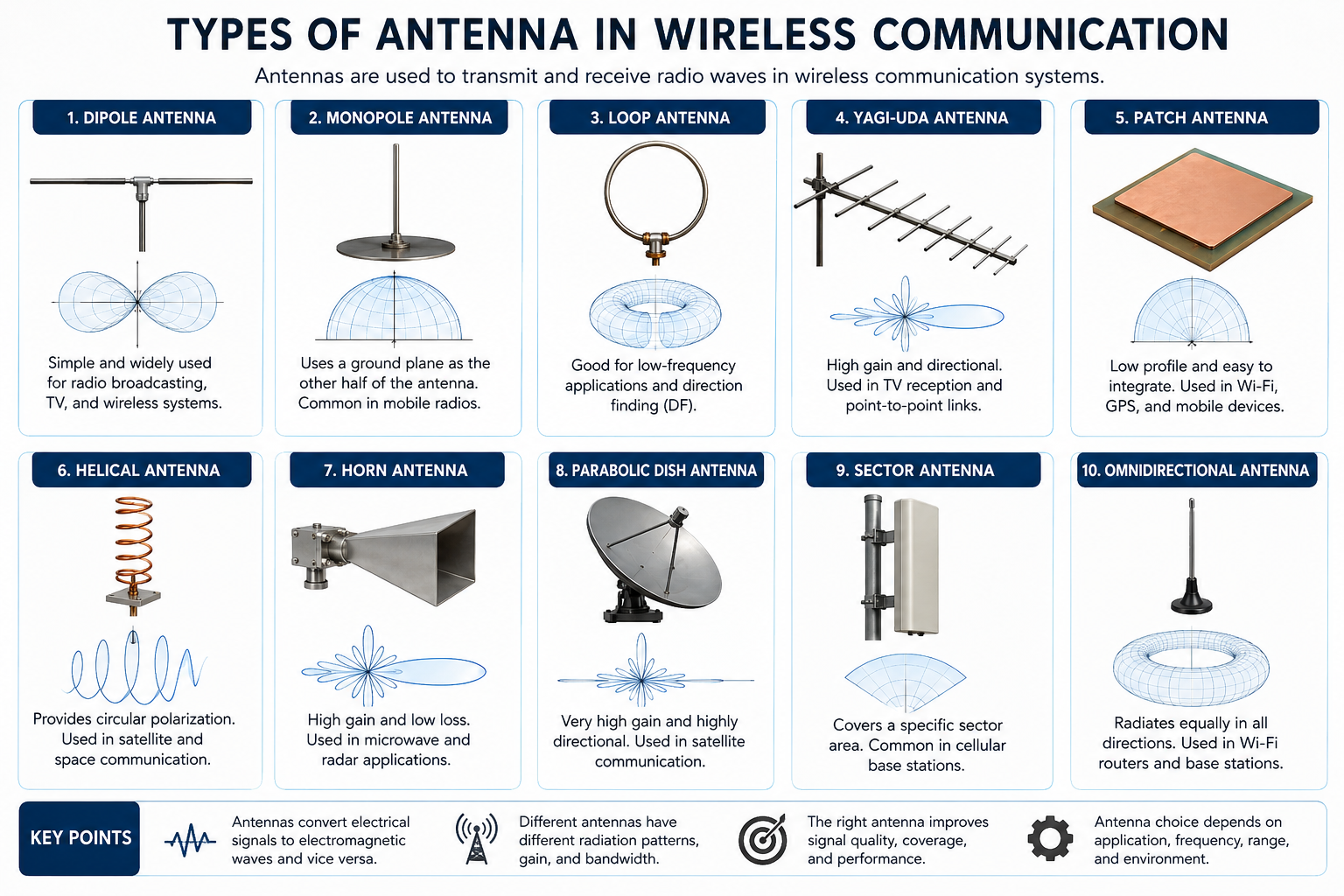
Imagine you are standing by a still pond. You drop a pebble into the water. What happens? The pebble creates waves that travel out in all directions, in perfect circles. Now imagine you want to send a message across that pond. You could use the waves to carry a small floating object to the other side.
An antenna works on a very similar idea, but instead of water waves, it uses invisible waves of energy called radio waves. These radio waves are a type of electromagnetic energy, just like light, but our eyes cannot see them. An antenna is a special piece of metal designed to launch these radio waves into the air when sending a signal, and to catch them when receiving a signal. It is the bridge between the electrical signals in a wire and the radio waves that fly freely through space.
Without antennas, your mobile phone would be a useless brick, your Wi-Fi would not exist, and you could not listen to the radio. They are the unsung heroes that make our wireless world spin. But not all antennas are the same. Just as a spoon and a shovel are both tools for digging but designed for very different jobs, antennas come in many shapes and sizes, each with a special way of sending and catching radio waves. The shape and size of an antenna control the shape and direction of the waves it creates, much like the shape of a flashlight’s reflector controls the beam of light.
Let’s explore the most common types of these magic sticks and dishes, and understand how they talk to each other without wires.
The Three Big Ideas About How an Antenna Works
Before we meet the different types, it helps to know three simple ideas that describe how any antenna sends out energy.
-
Omni-directional Antennas: Think of a bare lightbulb hanging from the ceiling. When you switch it on, it sends light equally in almost all directions. You can see it from anywhere in the room. An omni-directional antenna works just like that. It sends out radio waves in a nearly perfect sphere or a flat doughnut shape. It does not focus the energy in one direction. This is perfect when you want to send a signal to many receivers scattered all around.
-
Directional Antennas: Now think of a flashlight. It does not light up the whole room. Instead, it takes the same amount of light and focuses it into a powerful, narrow beam that can travel a long distance in one direction. A directional antenna does the same with radio waves. It focuses the energy into a specific direction, making the signal much stronger there but very weak or non-existent in other directions.
-
Gain: Gain is a measure of how much an antenna can focus energy. An omni-directional antenna has a low gain because it spreads its energy everywhere. A directional antenna has a high gain because it concentrates its energy. It is important to know that an antenna does not magically create extra power. It simply shapes the power it gets, like putting your thumb over the end of a garden hose to make the water shoot further. The water pressure is the same, but the stream is more focused.
Now, let’s look at the different types of antennas that use these ideas.
The Simplest and Most Common: The Dipole Antenna
The dipole is the grandfather of many antennas. It is one of the simplest you can build. Picture a straight metal rod that is cut exactly in the middle. A wire from your radio connects to the two inner ends of the rod. The total length of this rod is usually one-half of the length of the radio wave it is designed to send or receive. This is called a half-wave dipole.
Think of it like a tuning fork. A tuning fork is made to vibrate perfectly at one musical note. A dipole antenna is made to resonate perfectly with one specific radio wave. When it sends a signal, the electrical energy swings back and forth along the rod in time with the radio wave.
A dipole’s radiation pattern is simple and beautiful. It does not send waves out from the tips of the rod. Instead, it sends them out from the sides, creating a pattern that looks like a giant, flattened doughnut with the rod passing through the hole. From the side, the signal is strong. If you were standing looking directly at the tip of the rod, you would get almost no signal. This shape gives a dipole a small gain of about 2.15 dBi over the most basic imaginary antenna. The famous “rabbit ears” on old television sets were simple dipole antennas whose length you could adjust.
The Next Step Up: The Monopole or Whip Antenna
A monopole antenna is simply one half of a dipole. It is a single, straight rod, usually a quarter of the radio wave’s length, placed over a large flat metal surface. The metal surface acts as a mirror, creating an electrical reflection of the missing half of the dipole. This is the “whip” antenna you see on a car for the radio, or the one that used to stick out of the top of a walkie-talkie.
Because it is only half the size of a dipole, it is much more compact and perfect for mobile use. The metal roof of the car acts as the ground plane, the electrical mirror. Its radiation pattern is similar to a dipole cut in half. It sends energy out sideways, low along the horizon, which is exactly what you want for a car driving around a city.
The Everyday Workhorse: The Patch or Panel Antenna
Look at the back of your Wi-Fi router. You will often see a flat, rectangular plastic shape. Inside is a patch antenna. This is a tiny, square or rectangular flat piece of metal mounted on a small circuit board. They are cheap to make, light, and incredibly flat.
A patch antenna is a directional antenna. It sends most of its energy out from the flat face of the patch. The radiation pattern looks like a half-sphere or a broad lobe projecting from the front. This makes it perfect for a Wi-Fi router on a wall. The router can send a strong signal forward into your living room, while it sends very little energy backward into the wall. It has a moderate gain, perhaps 4 to 8 dBi, which helps focus the signal where you need it. Your phone’s flat back hides multiple tiny patch antennas for Wi-Fi, Bluetooth, and GPS.
The High-Gain Champion: The Yagi-Uda Antenna
This is the classic TV antenna you see on rooftops in towns and rural areas. It looks like a short metal backbone with several parallel metal bars attached to it. It was invented in Japan by Mr. Hidetsugu Yagi and his student Mr. Shintaro Uda. It is a highly directional antenna with high gain.
A Yagi antenna has three main parts, all attached to a long central boom. The one at the back is called the reflector. It is the longest bar. Its job is to block radio waves from the back and bounce them forward. The next one is the driven element, which is a folded dipole. This is the only part actually connected to the wire. It sends or receives the signal. The bars in front are called directors, and they get progressively shorter. They act like a funnel, channeling the radio waves forward into a narrow, powerful beam.
If you point a Yagi antenna at a distant cell tower, you can pull in a signal from miles away. The long boom with many directors creates a very high gain, often 10 to 15 dBi. However, because the beam is so narrow, the antenna must be pointed very carefully. A slight turn in the wrong direction can lose the signal completely.
The King of Distance: The Parabolic Dish Antenna
When you need to send a signal over truly vast distances, like from the Earth to a satellite in space, you need the parabolic dish antenna. This is the large circular dish you see in pictures of space observatories and satellite TV installations. It is the ultimate directional antenna with the highest possible gain.
The dish is not the actual antenna element. The real antenna is a small feed horn or dipole placed right at the focal point of the dish. The dish’s job is to act as a giant mirror. Its perfectly curved parabolic shape captures radio waves arriving from a distant source, all traveling parallel to each other. The curve of the dish reflects these parallel waves and focuses them onto a single point, the feed horn in the middle. This is exactly like using a magnifying glass to focus sunlight into a hot, intense spot of light.
When sending a signal, the process is reversed. The small feed antenna shoots radio waves at the dish, and the dish’s curved shape reflects them out into a perfectly straight, parallel beam, like a laser. The size of the dish matters a lot. A bigger dish collects more energy and focuses it more tightly, giving a much higher gain. These antennas must be aimed with extreme precision. A tiny alignment error of a fraction of a degree could mean missing a satellite over 35,000 kilometers away.
The Smart Antenna: Multiple Input, Multiple Output (MIMO)
This is not a single antenna type you can see, but a clever new way of using several antennas together. Look at a modern Wi-Fi router. It does not have one antenna, but two, three, or even four. Your smartphone also has multiple antennas hidden inside. This is MIMO technology, and it solves a big problem.
In a city, radio waves do not just travel in a straight line. They bounce off walls, cars, and buildings, creating echoes. In the past, these echoes caused confusion and a poor signal. MIMO uses these echoes as an advantage. It uses multiple antennas to send different pieces of data in the same signal, all at the same time. Think of it like a team of workers carrying boxes from a truck to a house. One person carrying boxes one at a time through the front door is slow. A team of four people, each using a different door or window, can move the whole load much faster. The receiving device uses its multiple antennas and powerful digital brain to sort out the different echo paths and put the data back together. This dramatically increases speed and reliability without needing more power, making it the foundation of Wi-Fi 5, 5G, and all modern high-speed wireless systems.
Choosing the Right Tool for the Job
So, how do engineers pick the right antenna? They think about a simple balance.
If you need to connect to anyone, anywhere, like a mobile phone to a tower, you want a nearly omni-directional pattern. The tiny antennas inside your phone are designed to send and receive signals in almost all directions, so you can hold it any way and still get a signal.
If you are connecting two fixed buildings with a Wi-Fi bridge, you do not want to waste energy sending a signal up into the sky or down into the ground. You would use a directional antenna, like a Yagi or a small dish, and point the two antennas at each other. This focuses the energy, giving you a fast, reliable link over several kilometers using the same power as your indoor router.
For a satellite, there is no choice but a dish. The distance is so great that the tiny bit of energy that reaches Earth must be gathered over a large area and focused to a point just to be heard.
Antennas, from a simple straight wire to a giant dish that scans the stars, are all governed by the same beautiful physics. They are passive translators that turn guided electrical waves into unguided, free-flying radio waves. Understanding their different types is understanding how our modern conversation works. The next time you make a phone call or use a GPS map, remember the invisible, carefully shaped doughnuts and beams of radio energy flying all around you, all thanks to these magic sticks and dishes.

 English
 Arabic
 French
 Spanish
 Portuguese
 Deutsch
 Dutch
Dutch
 Italiano
 Russian
 Romaian
 Portuguese (Brazil)
 Greek
Greek
