


Immersive Technology in Military & Defense Market Platform Innovations Reshape Synthetic Training Environments
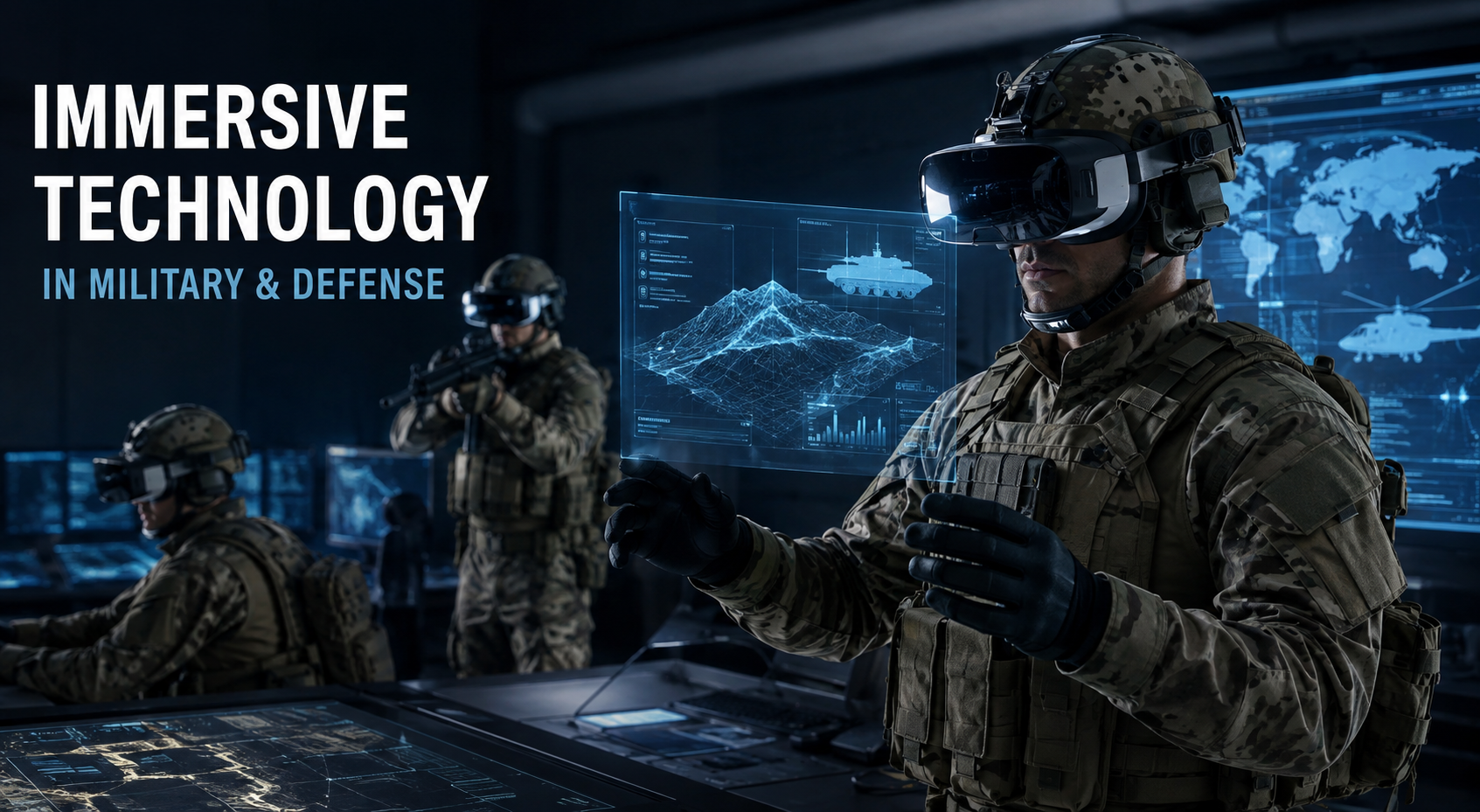
The Immersive Technology in Military & Defense Market Platform landscape is undergoing a profound architectural transformation, evolving from fragmented, purpose-built simulators to unified, intelligent ecosystems that serve as the foundation for a "military metaverse" . The core innovation driving this change is the emergence of the Synthetic Training Environment (STE), a "system of systems" that integrates live, virtual, and constructive (LVC) training domains into a single, coherent platform . This platform is built upon a multi-layered architecture, starting with the hardware interface—a range of head-mounted displays (HMDs) from high-fidelity VR headsets for fully immersive training to ruggedized AR devices like Microsoft's HoloLens-based Integrated Visual Augmentation System (IVAS) for field operations . The hardware layer is increasingly complemented by haptic feedback devices that simulate touch, adding another dimension of realism.
The second and most crucial layer of this platform is the software engine, predominantly built on commercial gaming engines like Unreal Engine and Unity, representing a seismic shift from proprietary military software . This approach leverages a massive ecosystem of tools, a global community of developers, and rapid innovation cycles driven by the multi-billion dollar video game industry. On top of this core engine, specialized plugins and software layers are added for military-specific requirements, including advanced physics models, AI behavior algorithms, and robust networking code for large-scale, multi-user exercises . The software/platform segment is the fastest-growing component of the market , driven by demand for enhanced capabilities and the shift towards subscription-based, service-oriented models . This is a major trend where defense spending is moving towards software and content pipelines rather than just one-off hardware purchases.
The third and most ambitious layer is the integration and networking fabric that connects everything together, enabling the vision of a "persistent synthetic world" . This involves open standards like the High-Level Architecture (HLA) that allow disparate simulations to interoperate. The goal is to create a "One World Terrain"—a common geospatial database that ensures a pilot in a VR flight simulator experiences the exact same terrain as an infantry soldier using an AR device on the ground . This integration fabric connects live entities (soldiers with tracked positions), virtual entities (trainees in simulators), and constructive entities (AI-controlled forces), enabling incredibly complex, large-scale exercises impossible to conduct purely in the real world . This capability is a key driver for platforms like Anduril's Lattice AI, which integrates sensor data to build a unified view of the entire battlespace .
Looking to the future, these platforms are evolving towards creating autonomous, self-optimizing training ecosystems. The integration of AI will enable predictive scenario generation, where the system creates new training challenges based on trainee performance patterns . The focus will shift from simple simulation to "intelligent immersion," where the platform acts as a cognitive partner, providing real-time decision support and after-action reviews that highlight tactical and cognitive errors . As the commercial XR market matures, defense platforms will increasingly leverage off-the-shelf components, reducing costs and accelerating innovation cycles. The success of these platforms will depend on their ability to be open, interoperable, and rapidly adaptable to new threats, making them the central nervous system for military preparedness and strategic advantage .
Explore More Like This in Our Regional Reports

 English
 French
 Spanish
 Portuguese
 Deutsch
 Turkish
 Dutch
Dutch
 Italiano
 Russian
 Romaian
 Portuguese (Brazil)
 Greek
Greek
