


Certificate Management Software: A Smarter Approach to Compliance Control
Certificate Management Software: A Smarter Approach to Compliance Control
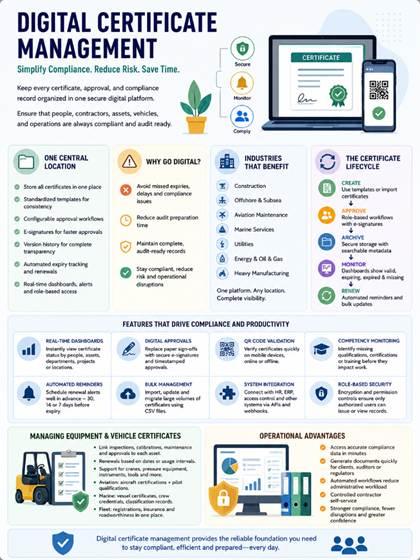
Maintaining compliance can become increasingly difficult when essential certificates and related documentation are spread across different systems and storage locations. Licences, inspection records, employee qualifications, contractor certifications, approvals, and other compliance documents may sit across inboxes, shared drives, spreadsheets, and physical filing systems. As a result, finding a specific record can take considerable time, particularly when an audit, inspection, or operational review requires immediate access.
Certificate management software addresses this challenge by consolidating certification records for employees, contractors, equipment, vehicles, and other organisational assets within a secure digital environment. By establishing one central source of information, HR, safety, and operations teams can quickly check credentials, verify compliance status, and confirm that work can continue only when all necessary certificates are valid.
A Centralised Approach to Certificate Management
When certificates are maintained across disconnected systems, administrative effort increases and important records can become difficult to control. Digital certificate management creates a structured environment where the entire certification lifecycle can be managed from one place.
Standardised templates help organisations maintain consistency when creating certificates, while configurable workflows make approvals easier to control and track. Electronic signatures further simplify the approval process by allowing authorised personnel to review and sign documents digitally while maintaining accountability.
Once a certificate has been approved, it can be stored securely alongside its complete version history, making earlier records available whenever required. Expiry dates can be monitored continuously, with renewal processes initiated automatically before certificates become invalid. Real time dashboards, automated notifications, secure document storage, and role based permissions turn certificate administration into an organised and proactive process rather than a task handled only when deadlines approach.
Why Organisations Are Adopting Digital Certificate Management
Spreadsheets and physical filing systems remain common ways of tracking certificates. Although these approaches can be manageable when operations are small, maintaining them becomes progressively harder as the organisation expands. A missed expiry date may postpone projects, disrupt planned maintenance, stop high risk work, create compliance concerns, or complicate insurance related reviews.
A digital certificate management system helps minimise these issues by continuously checking certificate validity, sending renewal notifications ahead of deadlines, and maintaining complete records that are ready for audit. Instead of searching through separate folders, emails, and databases during an inspection, organisations can quickly show that required certifications are valid, accurate, and properly documented.
Industries That Can Benefit
Organisations working in regulated and documentation intensive environments need dependable methods for controlling certificates and compliance information. Construction, offshore operations, subsea engineering, aviation maintenance, marine services, utilities, energy production, and heavy manufacturing all rely on accurate certification records to support compliant and safe operations.
Centralised certificate management gives managers and compliance personnel greater visibility into employee qualifications, contractor credentials, supplier documentation, and asset records. Information can be monitored across projects, departments, facilities, and locations from a single environment. Whether an organisation manages one operation or a geographically distributed workforce, the platform can scale while maintaining visibility and control.
The Certificate Management Lifecycle
Create → Approve → Archive → Monitor → Renew
Certificate management begins with creating or importing templates that reflect organisational standards and applicable requirements. Each certificate can then move through defined approval stages based on user roles, with electronic signatures helping establish clear ownership and accountability throughout the process.
Following approval, certificates are securely archived and assigned searchable information so authorised users can locate them quickly. Dashboards provide a current view of valid certificates, approaching expiry dates, expired documentation, and missing records. When certificates need to be renewed or updated, bulk management capabilities make large scale changes easier to handle.
Integrations with HR platforms, ERP systems, workforce applications, and other business systems can also keep information synchronised through REST APIs and webhooks. Each approval, modification, and workflow activity is captured within the system, creating a detailed history that can support audits and record keeping.
Features That Support Compliance and Productivity
- Real time dashboards: View certificate status across employees, contractors, assets, teams, departments, projects, and locations.
- Digital approvals: Move away from manual sign offs through secure electronic signatures and recorded approval timestamps.
- QR code validation: Check certificate information from mobile devices in connected as well as offline environments.
- Competency monitoring: Highlight missing qualifications, certifications, or training before they create operational problems.
- Automated renewal alerts: Send reminders ahead of certificate expiry using configurable intervals such as 30, 14, or 7 days.
- Bulk certificate management: Import, modify, or migrate substantial volumes of certificate records efficiently through CSV files.
- System integration: Exchange information with HR, ERP, access control, and other enterprise applications through APIs and webhooks.
- Role based security: Safeguard certificate information through encryption and permission controlled access so only authorised users can issue or view records.
Certificate Management for Equipment and Vehicles
Certificate control is not limited to employee and contractor documentation. Equipment, machinery, vehicles, and specialised operational assets can also require certificates and supporting records to remain compliant. Inspection documentation, calibration records, maintenance certificates, and regulatory approvals can be associated directly with the relevant asset.
Renewal requirements can be organised around fixed calendar dates or usage based intervals, helping organisations manage certification requirements for cranes, pressure equipment, laboratory instruments, testing equipment, and other assets. Aviation organisations can maintain aircraft certification records alongside pilot qualifications, while marine operators can manage vessel certificates, crew credentials, and classification documentation within the same environment. Fleet teams can similarly bring vehicle registrations, insurance records, and roadworthiness certificates together in one secure location.
Operational Benefits of Digital Certificate Management
Moving away from spreadsheets and physical records toward a live digital platform gives teams faster access to current compliance information. Documents requested by customers, auditors, regulators, or internal departments can be located and produced in minutes rather than requiring hours or days of manual searching. Automated workflows, structured approval processes, and controlled contractor self service can also reduce administrative demands while supporting more efficient operations.
The overall outcome is improved compliance control, fewer disruptions, faster access to critical documentation, and greater assurance that employees, contractors, equipment, vehicles, and vessels are supported by valid and accessible certificates. When reliable documentation is essential for maintaining safe and uninterrupted operations, digital certificate management provides the structured foundation organisations need to stay compliant, efficient, and ready for audits or operational requirements.
Book a free demo @ https://toolkitx.com/campaign/certificate-management/
Browse More
https://toolkitx.com/blogsdetails.aspx?title=What-is-a-Confined-Space-Entry-Permit-A-Simple-Guide

 English
 Arabic
 French
 Spanish
 Portuguese
 Deutsch
 Turkish
 Dutch
Dutch
 Russian
 Romaian
 Portuguese (Brazil)
 Greek
Greek
