


Why Businesses Are Replacing Manual Checklists with Digital Solutions
Why Businesses Are Replacing Manual Checklists with Digital Solutions
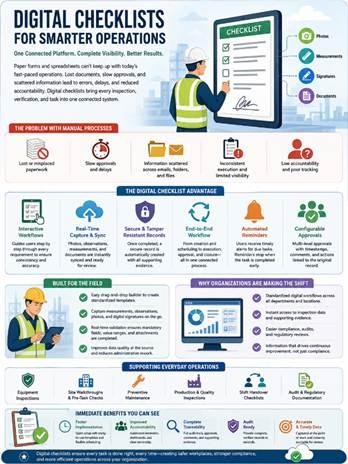
Paper checklists and disconnected spreadsheets were built for simpler working environments, not the speed and complexity of modern operations. As organizations expand, compliance requirements become more demanding, and employees need immediate access to reliable information, manual processes can quickly turn into operational bottlenecks. Missing documents, lengthy approval processes, and exhausting audit preparation are just some of the problems teams encounter. Critical information may also be buried across emails, shared folders, spreadsheets, and separate files. This fragmentation makes it harder to maintain visibility, execute tasks consistently, and establish clear accountability.
A centralized digital checklist platform brings these scattered activities together within a single connected environment. Rather than maintaining separate records for individual inspections or routine tasks, organizations can manage their information through one organized system that keeps data accessible and actionable. ToolKitX's Checklist module helps operations, HSE, and quality teams coordinate daily activities more effectively while strengthening consistency, transparency, and operational oversight from one platform.
More Than a Checklist for Capturing Information
A checklist should not simply serve as a form that employees fill out once a task has already been completed. Its purpose is to guide people through the work itself, making sure every required step is addressed correctly and consistently. ToolKitX transforms static forms into interactive workflows that take users through each stage of an activity, helping teams follow the same process across inspections, verifications, and routine operations.
While a checklist is being completed, the system checks responses as information is entered, helping identify errors and preventing incomplete submissions. Once all required information has been provided, the platform creates a secure, tamper resistant record automatically. Since the system is cloud based, photographs, measurements, observations, digital signatures, and supporting documents captured in the field are synchronized immediately and remain accessible for review. This means the evidence associated with an activity is already attached to its checklist when the work ends, removing the need to track down missing records afterward.
One Connected Process from Creation to Completion
Checklist management follows a defined workflow that can begin with creating and scheduling an activity and continue through execution, review, approval, and closure. Managers can monitor checklist activity through a centralized dashboard, with records organized according to factors such as status, assigned employee, location, or deadline.
Filters and visual status indicators help teams quickly recognize overdue checklists and activities that may be falling behind schedule. This allows managers to intervene earlier and address potential delays before they create wider operational problems.
Recurring inspections and regularly scheduled tasks can also be managed within the same workflow. After a recurring schedule has been established, assigned employees receive automatic reminders when a checklist is due. When the checklist is completed ahead of its deadline, the system automatically stops further reminders for that task. This keeps notifications relevant while reducing unnecessary alerts for employees.
Once a checklist has been submitted, it can move through configurable approval stages involving supervisors, HSE personnel, managers, or other required stakeholders. Approvals, comments, changes, and actions remain connected to the original checklist and are recorded with precise timestamps. Where corrective action is required, those actions can remain linked to the relevant checklist as well. Instead of separating related information across emails, files, and documents, the entire activity remains connected in one record.
Designed Around Real Field Work
The real advantage of digital checklists becomes apparent at the point where inspections and operational activities actually take place. ToolKitX is designed to support field teams with a straightforward drag and drop template builder, allowing organizations to develop standardized checklists without requiring specialized technical skills.
Templates can be adjusted to suit different sites, departments, equipment, facilities, and operational procedures while still maintaining consistent requirements across the organization.
Field data can be captured directly within the checklist without relying on separate paperwork. Employees can enter measurements, document observations, attach photographs, and collect digital signatures as part of the same activity. The result is a detailed record that reflects what was observed and completed at the actual point of work.
Data quality can also be strengthened through real time validation. Mandatory fields, acceptable value ranges, and required attachments can be configured to ensure necessary information is provided before a checklist is submitted. By identifying incomplete or unsuitable entries before they become part of the final record, organizations can reduce administrative rework and improve confidence in the information being collected.
Why Businesses Are Adopting Digital Checklists
For organizations operating across multiple locations, relying on paper forms and spreadsheets becomes increasingly challenging as operations grow and compliance expectations change. Manual approaches can produce inconsistent processes, make information harder to locate, and complicate documentation tracking when audits or compliance reviews take place.
ToolKitX replaces these fragmented approaches with standardized digital workflows that can be applied across departments, facilities, and locations. Inspection information becomes available without waiting for paperwork to be collected, approval processes become easier to manage, and operational data can contribute to continuous improvement rather than being used only as evidence of compliance.
Supporting Everyday Operational Activities
The Checklist module can be configured for a broad range of business activities. In HSE and Permit to Work environments, teams can use it for equipment checks, site inspections, pre task verification, and other activities where structured assessment, documentation, and approval are required.
Operations and quality teams can apply the same capabilities to shift handovers, preventive maintenance checks, routine production inspections, and recurring operational procedures where consistent execution matters.
When documentation is requested by customers, auditors, or regulatory authorities, organizations can retrieve complete checklist records without manually gathering evidence from different systems. Photographs, approval records, digital signatures, comments, and other supporting documentation remain connected to the relevant activity, making it easier to demonstrate what was completed and how it was reviewed.
Delivering Practical Operational Improvements
Organizations can get started with the Checklist module using ready to use templates and flexible scheduling capabilities designed to simplify implementation. Automated reminders help keep assigned activities on track, while centralized dashboards provide managers with greater visibility into ongoing and completed work. Structured approval workflows further strengthen accountability by ensuring submissions move through the appropriate review process.
Preparing for audits also becomes more straightforward when records include complete traceability, supporting evidence, and detailed audit histories. Most importantly, information is captured directly where the work occurs rather than being reconstructed later from paper notes or separate files. This helps ensure that each checklist contains complete and accurate information and is available for review as soon as the activity is submitted.
Book a free demo @ https://toolkitx.com/campaign/checklist/
Browse More
https://toolkitx.com/blogsdetails.aspx?title=RIDDOR-Reporting:-What-Must-Be-Reported-and-How

 English
 Arabic
 French
 Spanish
 Portuguese
 Deutsch
 Turkish
 Dutch
Dutch
 Italiano
 Russian
 Romaian
 Greek
Greek
