


How Workforce Scheduling Software Simplifies Employee Shift Management
How Workforce Scheduling Software Simplifies Employee Shift Management
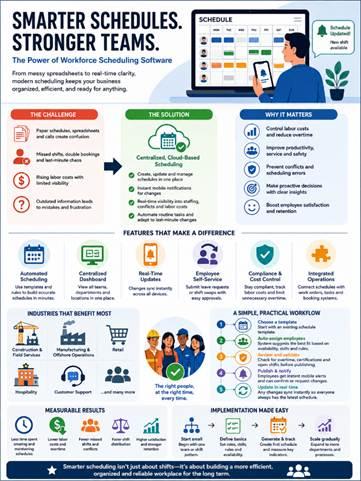
Coordinating employee shifts through paper schedules, spreadsheets, endless text messages, and back and forth phone calls often leads to unnecessary complexity. It becomes easy for shifts to be overlooked, employees to be double booked, and labor costs to rise without clear visibility. A centralized cloud based workforce scheduling system replaces these disconnected methods with a single platform where schedules are created, updated, and managed in one place. Employees receive instant notifications on their mobile devices whenever changes occur, while managers gain real time insight into staffing coverage, scheduling conflicts, and workforce expenses. By automating routine scheduling and accommodating last minute adjustments, organizations can keep operations running efficiently with minimal disruption.
How Workforce Scheduling Has Changed
Workforce scheduling has evolved well beyond simply assigning employees to weekly shifts. Modern scheduling solutions function as intelligent workforce planning systems that translate operational requirements into efficient staffing plans. They consider employee availability, qualifications, organizational policies, and scheduling preferences to create balanced schedules that support business objectives.
After schedules are finalized, they are instantly shared across desktop and mobile platforms as the single, up to date version. This eliminates confusion caused by outdated spreadsheets, multiple document versions, or conflicting email communications. Instead of relying on scattered information, every employee accesses the same schedule from one centralized platform, ensuring everyone remains informed.
Why Better Scheduling Improves Business Operations
Scheduling issues rarely create immediate disruption, but over time they can significantly affect operational efficiency and financial performance. Overstaffing increases payroll expenses, while understaffing places pressure on productivity, customer service, workplace safety, and project timelines. Limited visibility into staffing also makes it more difficult to control overtime, absenteeism, and scheduling conflicts.
A dedicated scheduling platform addresses these challenges by organizing employee information, scheduling policies, and approval workflows within one system. Routine scheduling tasks become automated, potential conflicts are identified before schedules are released, and managers can resolve issues proactively instead of reacting after problems arise. The result is a more reliable scheduling process, fewer operational interruptions, and stronger workforce stability.
Features That Improve Workforce Scheduling
Effective workforce scheduling software combines ease of use with practical business benefits. Automated scheduling, supported by reusable templates, allows managers to build employee rosters based on staffing requirements, workload, and employee qualifications without recreating schedules from the beginning every time. Processes that once required hours can often be completed in just a few minutes.
A centralized dashboard gives managers complete visibility across multiple teams, departments, or locations from a single interface. Whenever schedules are updated, every connected device reflects the changes immediately, reducing dependence on phone calls, emails, or messaging apps.
Employees can submit leave requests or request shift swaps directly through the platform, while managers review and approve requests through a transparent workflow with a complete activity history. Built in compliance checks and labor cost monitoring help reduce unnecessary overtime while ensuring appropriately qualified employees are scheduled for the right roles. When connected with work orders, operational tasks, or booking systems, scheduling becomes part of a unified operational environment instead of existing as a separate process.
Industries That Gain the Greatest Value
Organizations with changing staffing demands often benefit the most from structured workforce scheduling solutions. Construction companies and field service providers can coordinate crews more effectively while responding quickly to project changes or weather related disruptions. Manufacturing facilities and offshore operations maintain smoother production by aligning staffing with operational requirements, accommodation capacity, and workforce availability.
Retail businesses, hospitality providers, and customer support teams also improve workforce planning by adapting more efficiently to changing customer demand. Better scheduling helps reduce last minute staffing shortages, maintain consistent service quality, and create a more organized workplace.
A Practical Scheduling Workflow
Modern workforce scheduling software follows a straightforward process designed for day to day operations. Managers begin by selecting an existing scheduling template, after which the system automatically recommends employee assignments based on availability, qualifications, and predefined scheduling rules.
Before schedules are published, the platform checks for potential issues such as overtime thresholds, expired certifications, or vacant shifts. Once approved, employees immediately receive their schedules through mobile notifications, allowing them to confirm assignments or submit scheduling requests. Any future modifications are synchronized instantly, ensuring everyone always has access to the latest schedule.
Tracking the Benefits of Smarter Scheduling
The value of workforce scheduling software becomes evident through measurable operational improvements. Automated scheduling reduces the time managers spend creating and maintaining employee rosters. Improved workforce visibility helps align staffing levels with operational demand while controlling payroll costs and limiting unnecessary overtime.
Real time communication minimizes missed shifts and attendance issues, while transparent scheduling practices encourage fair shift distribution across teams. Together, these improvements contribute to higher employee satisfaction, stronger workplace confidence, and improved staff retention.
Implementing Workforce Scheduling Successfully
Adopting workforce scheduling software does not require organizations to transform every process at once. Many businesses begin with a single department or a recurring shift pattern before expanding across the organization. After defining employee roles, skills, scheduling rules, and availability, managers can generate their first automated schedule and measure performance using indicators such as scheduling time, overtime hours, and shift adjustments.
As employees and managers become familiar with the platform, additional departments and operational processes can be incorporated gradually. Over time, workforce scheduling moves beyond a repetitive administrative responsibility and becomes a dependable system that improves efficiency, consistency, and long term operational performance.
Book a free demo at https://toolkitx.com/campaign/employee-scheduling/
Browse More
https://toolkitx.com/blogsdetails.aspx?title=job-hazard-analysis-vs-task-risk-assessment
https://toolkitx.com/blogsdetails.aspx?title=hse-incident-reporting
https://toolkitx.com/blogsdetails.aspx?title=health-and-safety-in-manufacturing
https://toolkitx.com/blogsdetails.aspx?title=what-is-process-safety-management

 English
 Arabic
 Spanish
 Portuguese
 Deutsch
 Turkish
 Dutch
Dutch
 Italiano
 Russian
 Romaian
 Portuguese (Brazil)
 Greek
Greek
