


The Complete Guide to Digital Logbooks for Modern Operations
The Complete Guide to Digital Logbooks for Modern Operations
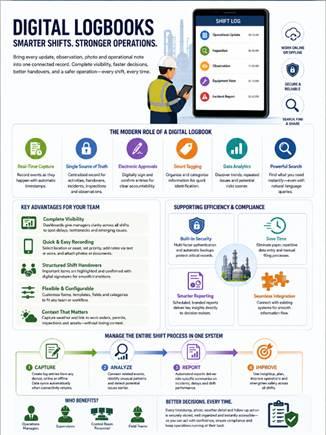
When shift information lives across notebooks, spreadsheets, whiteboards, emails, and individual files, critical details can easily disappear from view. Teams may waste valuable time reconstructing what happened because no single record contains the full sequence of events. Missing context creates uncertainty, slows decisions, and makes communication between shifts less consistent.
A digital logbook brings updates, photographs, observations, and operational notes together within one structured timeline. Rather than working from fragmented records, teams can search, review, and share a complete operational history from the control room, a field tablet, or a mobile device, including situations where connectivity is temporarily unavailable. With ToolKitX Log Books, each shift contributes to one continuous operational record that stays connected to the work wherever it takes place.
The Modern Role of a Digital Logbook
Today's digital logbook is not simply a paper log transferred to a screen. It functions as a central record of operational activity, shift handovers, incidents, inspections, and observations. Entries can be captured as events happen, automatically timestamped, and securely retained for later review.
ToolKitX extends this approach with capabilities including electronic approvals, intelligent tagging, and data analytics. Rather than allowing collected information to sit unused, teams can sign records electronically, find specific details through powerful search, and spot recurring operational patterns. This helps users recognize repeated problems, strengthen shift handovers, and identify possible risks without digging through email chains or guessing who originally recorded an update.
Why Fast Access to Information Matters
Oil and gas, utilities, offshore operations, power generation, and major construction projects can generate large amounts of shift information every day. As those records accumulate, finding one relevant detail becomes harder unless the underlying system can organize and retrieve information efficiently.
ToolKitX makes that process simpler by enabling users to organize, filter, and search operational records quickly, regardless of how much information has accumulated. Instead of scanning hundreds of entries manually, users can enter natural language searches such as "pump vibration issues this week" and quickly find the information they need.
Built in pattern recognition can also draw attention to unusual activity before it grows into a broader operational concern. Automated notifications keep relevant personnel informed through the application or connected systems, giving supervisors the ability to review, approve, or escalate matters promptly while preserving a clear and traceable audit history.
Key Advantages Teams Experience
Digital dashboards give managers a consolidated view of activity across shifts, helping them spot recurring delays, workflow bottlenecks, and developing concerns before they become more significant problems.
Creating an entry is designed to be simple and fast. Users choose the relevant location or asset, set the priority, add notes through text or voice, and attach photographs or documents. Smart defaults minimize repetitive steps, helping logging fit naturally into routine operational work.
Shift handovers become clearer and more dependable as well. Critical details, including open tasks, unresolved hazards, and pending permits, are surfaced through a guided handover process. Digital signatures from outgoing and incoming personnel provide clear confirmation that responsibility has been transferred, helping reduce confusion and strengthen accountability.
The platform can also be adapted to different operational needs. Organizations can configure forms, categories, templates, and fields without depending on complicated development work. Operations, maintenance, HSE, and project teams can use the same system while following their own workflows. Weather details can be recorded alongside operational entries, preserving environmental conditions associated with important decisions. Records can also link with work orders, permits, inspections, and asset information, enabling users to move between related processes while keeping the surrounding context intact.
Supporting Efficiency While Maintaining Compliance
Moving away from paper records, repeated data entry, and manual filing can free up time across the organization. Built in security features, including multi factor authentication and automated backups, help protect operational information from unauthorized access and accidental loss.
Reporting is simplified as well through scheduled, branded reports that provide useful operational summaries directly to decision makers. Because ToolKitX connects with existing enterprise systems, information can move across operational, safety, financial, and reporting functions rather than staying trapped within separate departments.
Managing the Entire Shift Process in One System
The process starts with capturing information. Personnel can create log entries from nearly any device, whether connected or offline, while synchronization takes place automatically after connectivity returns.
The collected information can then be evaluated by connecting related events, recognizing unusual patterns, and detecting potential operational concerns earlier. Automated reporting can deliver role specific summaries covering incidents, delays, and overall shift performance without forcing teams to prepare spreadsheets manually.
Those insights can ultimately support planning, operational improvements, and safety initiatives. Instead of responding only after an issue appears, organizations can use historical patterns to make better informed decisions and guide future actions.
Organizations That Benefit the Most
Operations managers, supervisors, control room personnel, and field teams across energy, offshore operations, utilities, and construction can gain stronger operational visibility and more coordinated shift management. Digital logbooks make team communication easier, preserve continuity between shifts, and keep operational records accessible when they are needed.
Whether teams are reviewing incidents, checking compliance, or preparing for audits, timestamps, photographs, weather details, and follow up actions remain securely stored, organized, and available without forcing users to reconstruct the story from scattered records for faster, more confident operational decisions.
Book a free demo @ https://toolkitx.com/campaign/log-books/
Browse More
https://toolkitx.com/campaign/permit-to-work/
https://toolkitx.com/campaign/tank-management/
https://toolkitx.com/campaign/gps-tracking/
https://toolkitx.com/campaign/loto/

 English
 Arabic
 French
 Spanish
 Portuguese
 Deutsch
 Turkish
 Dutch
Dutch
 Italiano
 Russian
 Romaian
 Greek
Greek
