


Why Offshore Operations Are Moving Beyond Spreadsheet Based Planning
Why Offshore Operations Are Moving Beyond Spreadsheet Based Planning
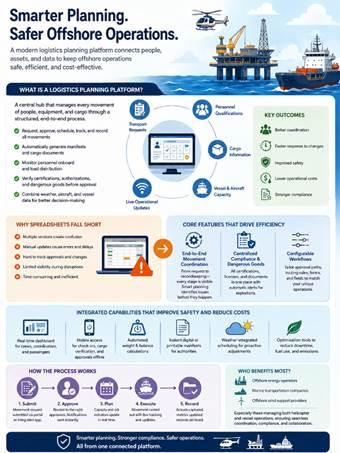
Offshore operations are seldom interrupted by one major problem in isolation. More often, disruption develops when several smaller issues arrive at the same time. A helicopter diverted by poor weather, a supply vessel running late, or a crew member facing an unexpected certification issue may be manageable individually.
A modern logistics planning platform brings these moving parts together through one connected planning environment. Rather than relying on separate spreadsheets, lengthy email chains, and disconnected applications, teams can manage transport requests, personnel qualifications, cargo details, aircraft and vessel capacity, and current operational updates in one place. With everyone working from the same real time information, coordinators can organize movements more effectively, respond quickly to changing conditions, strengthen safety, and control costs across a single offshore installation or a wider fleet of assets.
What Is a Logistics Planning Platform?
A logistics planning platform serves as a central control point for coordinating personnel, equipment, and cargo movements. In offshore and marine operations, it creates a consistent process for submitting, reviewing, approving, scheduling, tracking, and documenting movements involving employees and external contractors.
It can also take over many repetitive administrative tasks. Passenger manifests and cargo documents can be produced automatically, while personnel onboard and load distribution can be monitored throughout each journey.
Compliance becomes part of planning rather than a separate administrative exercise. Before a movement is approved, the system can check certifications, required permissions, and dangerous goods requirements. This helps teams address potential compliance gaps before execution. Weather conditions, aircraft availability, and vessel positions can also be brought into one operational view, giving planners earlier visibility of possible disruptions and more time to adjust schedules.
Why Spreadsheets No Longer Meet Operational Demands
Spreadsheets can work for simple planning when conditions remain stable. Offshore environments, however, can change quickly. Severe weather, emergency evacuations, changing priorities, late arrivals, and port restrictions may require schedules to be revised immediately. When several spreadsheet files move between coordinators, conflicting versions can appear, leaving teams uncertain about which information should be trusted.
Dedicated logistics planning software addresses this problem by creating a single operational source of truth. It reduces repetitive data entry, connects approvals directly with movement requests, and makes updates available across the organization. Teams no longer need to compare separate files or reconcile conflicting information. Instead, everyone can work from one synchronized view of current operations.
Features That Enhance Operational Efficiency
End to End Movement Coordination
Every movement can follow a defined workflow beginning with the request and continuing through approval, scheduling, execution, and record retention. Because each stage remains visible, planners can track progress without relying on separate communications. Intelligent planning functions can also flag duplicate requests, limited capacity, inefficient routes, and overweight cargo before they become execution problems.
Centralized Compliance and Dangerous Goods Control
Certifications, licenses, crew qualifications, vessel classifications, and regulatory records can be maintained within one centralized environment. Dangerous goods details can remain connected to the relevant cargo information, while automated reminders can alert teams when critical documents approach expiration. This makes compliance easier to manage without disrupting operations.
Configurable Workflows for Different Operations
No two offshore organizations operate in exactly the same way. Modern logistics platforms can be configured around different approval routes, routing requirements, planning fields, and operational forms without demanding extensive development work. Contractor specific procedures, helicopter seating requirements, and different vessel configurations can all be accommodated, allowing the technology to support established processes rather than forcing teams to redesign them.
Integrated Capabilities That Improve Safety and Reduce Costs
A centralized dashboard gives offshore crews, onshore coordinators, and passengers a shared view of movement status in real time. Mobile capabilities can allow teams to verify cargo, check in passengers, and approve manifests even when connectivity is limited.
Automated weight and balance calculations reduce dependence on manual calculations and help limit human error. Passenger and cargo manifests can be created quickly in digital or printable formats for dispatch teams, customs personnel, and port authorities. When weather information is considered alongside operational schedules, planners can make adjustments before disruptions escalate. Visual scheduling and optimization recommendations can further reduce equipment downtime, improve fuel use, and decrease transportation related emissions.
How the Planning Process Works
The process starts when someone submits a movement request through a user portal or connected business application. Standardized forms capture the information required for planning, helping ensure requests are complete before they reach approval. Once submitted, the request is routed to the appropriate decision makers, and approval notifications can be sent automatically to the relevant participants.
During planning, capacity information and operational risk indicators can change continuously. This gives planners an opportunity to identify potential problems before a movement begins. Once the journey is complete, actual operational information is captured, performance measures are updated, and finalized records are securely stored for reporting, audits, and future reviews.
Why Dedicated Logistics Planning Platforms Deliver Greater Value
Specialized logistics planning platforms offer capabilities that conventional spreadsheets cannot easily provide together. Real time operational visibility, automated compliance checks, dangerous goods validation, offline mobile support, and secure audit tracking can all operate within one system. Approvals, planning decisions, and operational changes are recorded automatically, replacing scattered communication with a traceable history. This improves accountability while supporting regulatory requirements and giving teams a dependable record of how each movement was planned and managed.
Organizations That Benefit the Most
Organizations involved in offshore energy, marine transportation, and offshore wind support can benefit from dedicated logistics planning software. Companies coordinating both helicopter and vessel movements can gain particular value from more structured planning, stronger compliance oversight, and closer coordination between operational teams.
By cutting repetitive administrative work, improving visibility across movements, and helping teams respond faster to weather changes, delayed cargo, and shifting priorities, logistics planning platforms support more efficient operations. More importantly, they create a coordinated planning environment that helps offshore organizations manage complex movements with greater consistency, control, and operational reliability.
Book a free demo @ https://toolkitx.com/campaign/logistic-planning/
Browse More
https://toolkitx.com/campaign/logistic-planning/
https://toolkitx.com/campaign/checklist/
https://toolkitx.com/campaign/certificate-management/
https://toolkitx.com/campaign/log-books/

 English
 Arabic
 French
 Spanish
 Portuguese
 Deutsch
 Turkish
 Dutch
Dutch
 Italiano
 Russian
 Romaian
 Portuguese (Brazil)
