


Why Tank Terminals Are Moving Beyond Spreadsheets and Manual Systems
Why Tank Terminals Are Moving Beyond Spreadsheets and Manual Systems
Tank terminals operate around the clock in an environment where conditions can change quickly. Inventory levels fluctuate, product ownership can change during the day, inspections need to be completed, transportation schedules must remain coordinated, and maintenance work requires careful scheduling. When these activities depend on disconnected applications, spreadsheets, or manual records, teams can end up working with inconsistent information, creating delays and operational difficulties.
A cloud based tank farm management platform brings these critical activities together within a centralized environment. Operations, HSSE, maintenance, and finance teams can work from consistent information, improving collaboration, limiting errors, and making everyday decisions more efficiently.
What Does a Modern Tank Farm Management Platform Do?
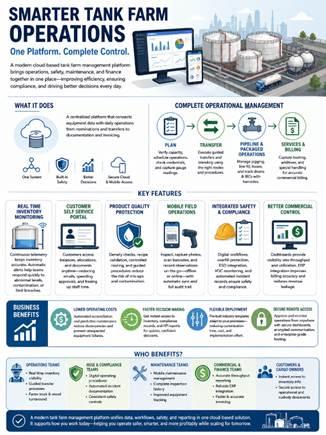
A modern tank farm management platform functions as a central operational hub for liquid and gas storage facilities. It can gather information from connected equipment, including tank level, temperature, and pressure sensors, and connect those readings with the operational processes taking place across the facility.
From nominations and product transfers to documentation and billing, the platform supports a broad range of terminal activities while helping employees follow established procedures and safety requirements. Rather than switching between separate applications, spreadsheets, and paper records, organizations can manage individual terminals or larger networks through one cloud based system with secure mobile access.
Key Features to Consider
Real Time Inventory Monitoring
Continuous telemetry keeps inventory information current and gives operators a clearer understanding of storage conditions. When unusual level changes, potential contamination, or measurements outside permitted limits occur, automated alerts can notify the appropriate teams so potential issues can be addressed without unnecessary delay.
Customer Self Service Portal
Customers and cargo owners can access inventory balances, allocation information, and custody documentation through a secure online portal. Providing direct access reduces dependence on email exchanges, accelerates approvals, and allows terminal employees to spend more time on operational responsibilities rather than repetitive administrative work.
Product Quality Protection
Validation capabilities help protect product quality throughout transfer activities. Density verification, recipe checks, controlled routing, and guided procedures can help minimize the possibility of incorrect transfers, product mixing, or seawater contamination during operations.
Mobile Field Operations
Personnel working in the field can use mobile devices to perform inspections, take photographs, scan barcodes, and document observations. Information can also be captured when connectivity is unavailable and synchronized when the connection is restored. This helps maintain reliable records while creating a more complete audit trail.
Integrated Safety and Compliance
Digital workflows can replace paper driven processes by taking employees through required operational steps in a consistent manner. Capabilities such as overfill protection, emergency shutdown integration, VOC monitoring, and automated incident documentation help teams apply safety controls consistently while maintaining appropriate records.
Better Commercial Control
Operational dashboards give management greater visibility into throughput, asset utilization, and performance across customers, products, terminals, and loading locations. Connecting the platform with ERP systems can improve billing accuracy, streamline invoicing, and reduce potential revenue leakage associated with manual processes.
Complete Operational Management
A centralized platform can support the full product movement cycle, regardless of whether cargo enters or exits through vessels, barges, pipelines, trucks, or ISO containers.
Prior to a transfer, the system can verify available tank capacity, coordinate operating schedules, collect readings from gauges and radar equipment, and confirm driver or crew credentials. Internal movements and blending operations can then follow guided workflows designed to help ensure the appropriate transfer paths are selected. Pipeline activities can account for pigging, line fill quantities, and interface losses, while packaged materials such as drums and IBCs can be tracked through barcode technology to support complete reconciliation. Services including product heating, additive injection, and specialized handling can also be captured automatically for more accurate commercial billing.
Business Benefits
Lower Operating Costs
Automated inventory reconciliation helps minimize discrepancies, while scheduled and predictive maintenance can reduce the likelihood of unexpected equipment breakdowns. Combined, these capabilities can improve efficiency while helping control operating expenses.
Faster Decision Making
Managers can access inventory details, compliance information, and KPI reporting without having to gather data from several separate systems. Having dependable information readily available enables faster and more informed operational decisions.
Flexible Deployment
Industry focused templates can be configured around established operating procedures, reducing the need for significant software customization. Whether the facility involves a refinery, LNG operation, or inland storage terminal, organizations can deploy the platform more efficiently while reducing implementation effort and cost.
Secure Remote Access
Supervisors can review and approve activities remotely, while senior management can monitor terminal performance through secure dashboards. Enterprise grade hosting, encrypted communications, and centralized administration provide security while allowing teams to maintain operational flexibility.
Who Benefits?
Operations Teams
- Real time visibility into inventory
- Guided product transfer workflows
- Faster truck and vessel turnaround
HSSE and Compliance Teams
- Digital operating procedures
- Automated incident records
- Consistent safety control processes
Maintenance Teams
- Mobile maintenance capabilities
- Complete inspection records
- Better equipment visibility and tracking
Commercial and Finance Teams
- Accurate throughput information
- Reliable ERP connectivity
- Faster, more precise invoicing
Customers and Cargo Owners
- Immediate access to inventory information
- Secure access to custody and operational documentation
Conclusion
A modern tank farm management platform connects operational information, workflows, safety processes, and commercial reporting within one cloud based environment. Rather than requiring organizations to completely redesign established procedures, it can support existing ways of working while improving efficiency, compliance, and operational visibility.
For organizations managing one terminal or expanding across multiple facilities, centralizing these activities provides a scalable alternative to spreadsheets, paper records, and disconnected legacy applications. With information and workflows brought together in one system, tank terminal operators can create a stronger foundation for efficient operations and continued long term growth.
Book a free demo @ https://toolkitx.com/campaign/tank-management/
Browse More

 English
 Arabic
 French
 Spanish
 Portuguese
 Deutsch
 Turkish
 Dutch
Dutch
 Russian
 Romaian
 Portuguese (Brazil)
 Greek
Greek
