


What Are the Most Common Challenges in CRM Projects?
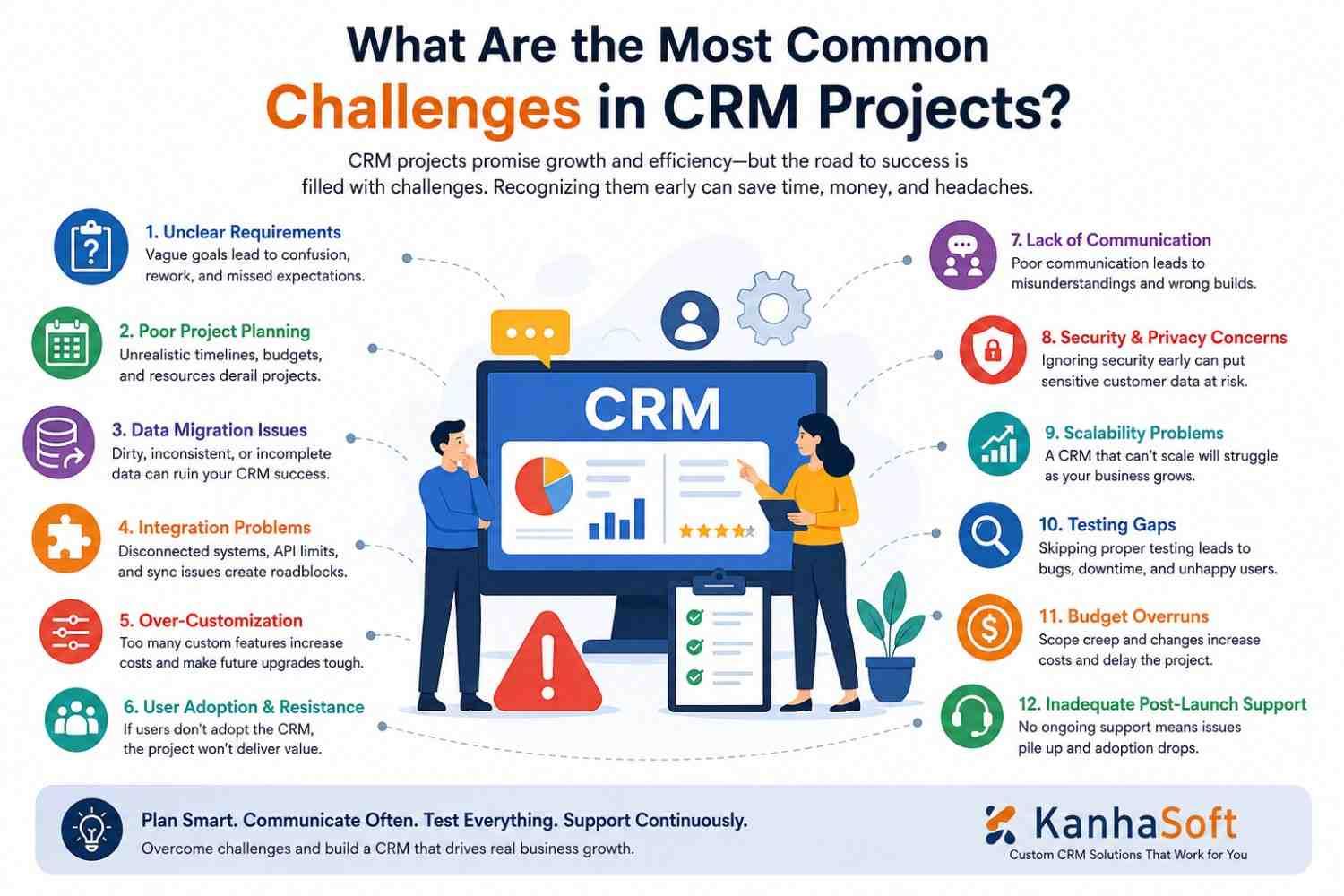
A CRM project usually starts with an optimistic sentence: “This should make everything easier.” Then come the spreadsheets, integrations, legacy databases, changing requirements, and the occasional meeting where nobody remembers who approved what. We have seen how quickly a promising CRM initiative can become complicated when business goals and technology decisions move in different directions.
A successful CRM implementation requires more than installing software. It involves planning, data preparation, workflow design, integrations, testing, training, security, and continuous improvement. Industry implementation guidance also emphasizes these areas as critical parts of a successful CRM rollout.
So, what are the most common challenges in CRM projects? Let’s break them down—and, more importantly, understand how businesses can avoid them.
1. Unclear CRM Requirements
One of the earliest problems in a CRM project can also be one of the most expensive: unclear requirements.
Businesses often know that they need a better CRM but have not clearly defined what “better” actually means. Sales may want pipeline automation, marketing may need campaign data, customer service may require ticket management, while management wants dashboards that magically answer every business question.
Without clearly documented requirements, development teams may build features that sound useful but do not solve the actual business problem.
Before development begins, teams should identify workflows, users, business objectives, required features, integrations, reporting needs, and measurable outcomes. A process-focused approach can reduce unnecessary rework and help keep the project aligned with business goals.
2. Poor CRM Project Planning
A CRM project without a realistic implementation plan is a little like starting a road trip without checking where the road actually goes.
Poor planning can lead to unrealistic deadlines, unclear responsibilities, insufficient resources, and unexpected costs. It can also make it difficult to determine whether the project is actually progressing.
A proper CRM implementation plan should define the project scope, milestones, resources, dependencies, testing strategy, data migration approach, and success metrics. Planning should also consider what happens after launch—not just how quickly the software can go live.
In other words, “launch day” should not be treated as the finish line. It is simply the point where the CRM starts meeting real users, real data, and real-world problems.
3. Data Migration Challenges
Data migration is one of those CRM tasks that looks simple until someone opens the old spreadsheet.
Customer records may exist across spreadsheets, legacy systems, databases, email platforms, and disconnected applications. Some records may be duplicated, incomplete, outdated, or stored in inconsistent formats.
Migration therefore requires more than copying information from one system to another. Teams need to identify which data should be moved, clean it, map fields between systems, validate relationships, and test the migrated information.
Microsoft's CRM migration guidance highlights schema mismatches, data volume, relationship complexity, data quality, performance, and security as important migration considerations.
Clean data matters because a CRM can only produce useful insights when the information inside it can be trusted.
4. CRM Integration Problems
Modern businesses rarely operate with one system. A CRM may need to communicate with ERP software, accounting platforms, marketing automation tools, e-commerce applications, customer support systems, communication platforms, and external APIs.
That sounds wonderfully connected—until two systems disagree about how customer information should be stored.
Integration challenges can involve authentication, API limitations, inconsistent data structures, synchronization rules, duplicate records, and legacy technology. These issues are easier to manage when integration requirements are identified during the planning stage instead of being treated as an afterthought.
A capable CRM software development Company can help businesses evaluate integration requirements, design appropriate APIs, establish data flows, and test system-to-system communication before deployment.
5. Over-Customization
Customization is useful. Too much customization is where things can become interesting—in the least enjoyable sense of the word.
Businesses sometimes attempt to reproduce every existing process inside the new CRM. Instead of improving workflows, the organization ends up rebuilding old complexity inside newer software.
The goal should not be to customize everything. It should be to customize what genuinely supports competitive or operational requirements while using standard functionality where it makes sense.
Excessive customization can increase development costs, maintenance requirements, testing effort, and future upgrade complexity. A better approach is to prioritize essential requirements and evaluate whether each customization solves a real business problem.
6. User Adoption and Resistance to Change
A CRM can be technically excellent and still fail if employees refuse to use it.
This is one of the most common challenges because implementing CRM software changes how people perform everyday tasks. Employees may be comfortable with existing spreadsheets or systems and may not immediately understand why a new process is better.
Successful adoption requires user involvement, communication, training, simple workflows, and ongoing support. Salesforce also distinguishes implementation from adoption, noting that adoption means integrating the CRM into everyday workflows rather than simply installing and learning the system.
The lesson is fairly straightforward: do not build the CRM around users and then introduce it to them at the end. Bring those users into the project much earlier.
7. Lack of Stakeholder Communication
CRM projects usually involve several teams, and each team has its own priorities.
Sales wants faster lead management. Marketing wants better segmentation. Customer support wants complete customer histories. Management wants reliable reporting. Developers, meanwhile, would probably appreciate requirements that stop changing every Tuesday.
Regular communication helps prevent these competing expectations from becoming project problems.
Stakeholders should participate in requirement discussions, workflow reviews, testing, demonstrations, and acceptance decisions. Clear ownership should also be established so everyone knows who can approve changes and who is responsible for specific business processes.
When communication is consistent, misunderstandings can be identified early—when they are still relatively inexpensive to fix.
8. Security and Data Privacy Concerns
CRM systems contain valuable customer information, making security a core project requirement rather than a decorative feature added near the end.
Businesses should consider role-based access, authentication, authorization, encryption, audit trails, backups, data retention, and appropriate security controls based on their requirements.
Security should also be considered during data migration and integration. Moving information between systems creates additional points where data could potentially be exposed or mishandled.
For organizations operating in regulated environments, privacy and compliance requirements should be considered during architecture and implementation planning.
The basic principle is simple: customer data deserves protection before, during, and after CRM deployment.
9. Scalability Problems
A CRM that works perfectly for 20 users may not behave the same way when the organization has 500 users, millions of records, and several additional integrations.
Scalability should therefore be considered from the beginning.
Businesses should think about future user growth, customer data volume, automation requirements, integrations, reporting, API usage, and performance expectations.
Microsoft's implementation guidance recommends considering scalability, data architecture, integrations, analytics, security, and operational requirements as part of implementation planning.
Building for future growth does not mean creating an unnecessarily complicated system today. It means selecting an architecture that can evolve without requiring the entire CRM to be rebuilt whenever the business grows.
10. Testing and Quality Assurance Gaps
Testing is often where CRM projects discover whether the requirements actually work in the real world.
Testing should cover more than whether a button opens the correct screen. Businesses should evaluate workflows, integrations, permissions, automation, performance, security, reporting, data migration, and user acceptance.
User acceptance testing is particularly valuable because business users can identify problems that technical testing may not reveal. Microsoft guidance recommends testing with migrated data and validating both normal and edge-case scenarios before going live.
Skipping testing to save time usually creates the opposite result. Problems that could have been fixed before launch become production issues—where they tend to cost more and attract considerably more attention.
11. Budget Overruns and Scope Creep
CRM projects can begin with a defined scope and gradually collect additional requirements.
One new dashboard becomes three. One integration becomes five. A small customization turns into a complete workflow redesign. Suddenly, the original timeline is looking rather optimistic.
Scope creep is not always bad. Businesses naturally discover new requirements during implementation. The problem occurs when those changes are introduced without evaluating their impact on cost, timeline, resources, and project priorities.
A formal change-management process can help. Each significant change should be evaluated, documented, prioritized, and approved before development begins.
The objective is not to say “no” to every new idea. It is to understand what that idea will actually cost.
12. Legacy System Compatibility
Many organizations cannot simply switch off their old systems and start fresh.
Legacy applications may contain valuable customer information, business rules, or processes that the new CRM must continue supporting. Older systems may also lack modern APIs or use outdated data structures.
This creates another layer of complexity.
Businesses may need middleware, custom APIs, scheduled synchronization, data transformation, or gradual modernization. The right solution depends on the existing technology environment and the importance of each legacy dependency.
Understanding the current technology landscape before development begins can prevent unpleasant surprises later.
13. Poor Reporting and Analytics
A CRM can collect enormous amounts of information without automatically producing useful business intelligence.
Businesses sometimes focus heavily on data collection and only later ask what they actually want to measure.
Instead, reporting requirements should be defined early. Teams should identify important KPIs such as sales pipeline performance, lead conversion, customer retention, response times, revenue trends, and team productivity.
Good CRM reporting depends on good data structures. If information is inconsistent or incomplete, dashboards may look impressive while telling an inaccurate story.
That is a particularly dangerous combination—beautiful charts and questionable decisions.
14. Inadequate Post-Launch Support
Going live is not the end of a CRM project.
Once employees start using the system, they will discover new questions, workflow gaps, performance issues, and improvement opportunities. Some requirements that seemed perfect during testing may need adjustment after real-world usage begins.
Post-launch support should include monitoring, troubleshooting, user assistance, performance reviews, bug fixes, and planned improvements.
Businesses should also measure adoption and collect user feedback. Microsoft guidance recommends monitoring adoption, usage, feedback, and alignment with business KPIs after implementation.
A CRM should evolve with the business. Otherwise, today's solution can become tomorrow's limitation.
15. When Should Businesses Consider CRM Project Rescue?
Sometimes a CRM project has already gone off track.
The implementation may be significantly delayed. Costs may have increased. Users may not be adopting the system. Integrations may be unstable. Requirements may have changed so much that the original architecture no longer makes sense.
This is where CRM Project Rescue can become necessary.
The objective is not simply to add more developers and hope for the best. A proper rescue effort should begin with a structured assessment of the current system, requirements, architecture, data, integrations, project scope, and outstanding issues.
From there, the team can prioritize critical problems, establish a realistic recovery roadmap, and determine what should be fixed, redesigned, postponed, or removed.
Sometimes the smartest project decision is not starting over—it is understanding what went wrong and fixing it strategically.
16. How Can Businesses Avoid Common CRM Project Challenges?
Businesses can significantly reduce CRM project risks by taking a structured approach:
- Define measurable business objectives before development.
- Document workflows and requirements clearly.
- Involve end users early.
- Establish realistic timelines and budgets.
- Clean and validate data before migration.
- Identify integrations during planning.
- Avoid unnecessary customization.
- Build security into the architecture.
- Test workflows with real-world scenarios.
- Prepare employees through role-specific training.
- Establish post-launch support.
- Monitor adoption and business outcomes.
- Review and improve the CRM continuously.
A strong implementation strategy should cover business processes, data migration, integrations, testing, security, analytics, cutover, and change management rather than treating them as separate last-minute activities.
What Makes a CRM Project Successful?
A successful CRM project is not simply one that launches on schedule.
It is one that helps employees work more efficiently, gives managers reliable information, improves customer interactions, and supports measurable business objectives.
That requires alignment between people, processes, and technology.
The best CRM projects are designed around actual business workflows rather than an endless list of features. They use clean data, sensible integrations, intuitive interfaces, appropriate automation, thorough testing, and continuous user feedback.
Most importantly, the project should have a clear definition of success.
If nobody knows what the CRM is supposed to improve, it becomes remarkably difficult to determine whether it actually improved anything.
Conclusion
CRM projects rarely become challenging because the idea of managing customer relationships is complicated. They become challenging when business processes, people, data, and technology are expected to change at the same time.
That is why preparation matters.
From unclear requirements and data migration to integration, customization, user adoption, testing, security, and scalability, each challenge can affect the final value of the CRM. The good news is that most of these problems can be identified—and addressed—before they become expensive disasters.
At KanhaSoft, we believe technology should simplify business operations rather than create another system employees have to wrestle with every morning.
A successful CRM is not the one with the longest feature list. It is the one that people actually use, data teams can trust, and the business can continue to grow with. And, occasionally, that means knowing when to stop adding features and start fixing the fundamentals.
Frequently Asked Questions
What is the biggest challenge in a CRM project?
Poor planning and unclear requirements are among the biggest CRM project challenges. They can lead to scope creep, rework, budget increases, implementation delays, and solutions that do not properly match business needs.
Why do CRM projects fail?
CRM projects can fail because of unclear requirements, poor data quality, integration problems, excessive customization, inadequate testing, weak user adoption, insufficient training, security issues, and poor post-launch support.
How can businesses improve CRM user adoption?
Businesses can improve adoption by involving employees early, keeping workflows simple, providing role-specific training, explaining the benefits clearly, collecting feedback, and offering ongoing support after implementation.
Why is data migration difficult in CRM projects?
Data migration can involve duplicate records, incomplete information, inconsistent formats, schema differences, complex relationships, and large data volumes. Proper cleansing, mapping, transformation, validation, and testing help reduce migration risks.
How long does a CRM project take?
The timeline depends on project scope, business complexity, number of users, integrations, customization, data migration, testing, and organizational readiness. Small implementations may take weeks, while complex enterprise projects can take several months.
When should a business consider CRM Project Rescue?
A business may consider CRM Project Rescue when an implementation is seriously delayed, over budget, technically unstable, poorly adopted, or no longer aligned with business requirements. The first step should be identifying the root causes before deciding on corrective action.
How can CRM integration challenges be reduced?
Integration challenges can be reduced by identifying required systems early, documenting data flows, evaluating API capabilities, defining synchronization rules, and performing thorough integration testing before launch.
What should businesses consider before starting a CRM project?
Businesses should define objectives, document requirements, assess existing systems and data, identify stakeholders, establish a realistic budget and timeline, plan integrations, define security requirements, and establish measurable success criteria.

 English
 Arabic
 French
 Spanish
 Portuguese
 Deutsch
 Turkish
 Dutch
Dutch
 Italiano
 Russian
 Romaian
 Portuguese (Brazil)
