


Scleral Lens Market Outlook 2032: Technological Advancements, Rising Eye Disorders and Growing Adoption of Specialty Contact Lenses
Scleral Lens Market: Key Segmentation, Growth Drivers, Trends and Recent Developments
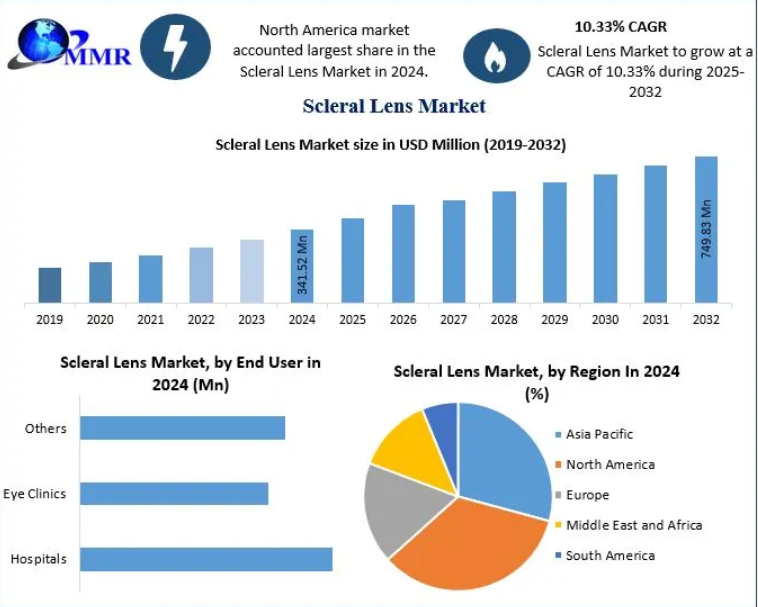
The global Scleral Lens Market is expanding as eye-care professionals increasingly adopt specialty contact lenses for patients with irregular corneas, keratoconus, severe dry eye disease, and other ocular-surface disorders. Scleral lenses are large-diameter gas-permeable lenses that vault over the cornea and rest on the sclera, creating a fluid reservoir between the lens and the ocular surface. This design can improve visual correction for irregular corneas while also providing a protective and hydrating environment for the cornea. According to Maximize Market Research, the global Scleral Lens Market was valued at USD 341.52 million in 2024 and is projected to reach approximately USD 749.83 million by 2032, expanding at a CAGR of 10.33% from 2025 to 2032. The market is being supported by increasing demand for specialty vision correction, rising prevalence of dry eye disease and keratoconus, advances in lens design and manufacturing, and growing awareness among patients and eye-care professionals.
𝐃𝐨𝐰𝐧𝐥𝐨𝐚𝐝 𝐅𝐫𝐞𝐞 𝐏𝐃𝐅 𝐁𝐫𝐨𝐜𝐡𝐮𝐫𝐞 @https://www.maximizemarketresearch.com/request-sample/261194/
Scleral Lens Market Overview
Scleral lenses have become an increasingly important option for patients who cannot achieve satisfactory vision or comfort with conventional soft or corneal rigid gas-permeable lenses. Their larger diameter enables the lens to bridge the irregular corneal surface while resting on the less sensitive scleral tissue. The fluid reservoir beneath the lens can help maintain a moist ocular surface, making scleral lenses particularly relevant for patients with severe ocular-surface disease. Current clinical literature continues to identify scleral lenses as an important option for keratoconus and irregular astigmatism, while also emphasizing the importance of appropriate fitting and monitoring during long-term wear.
The market is also benefiting from improvements in customization. Eye-care professionals can increasingly tailor lens diameter, landing zones, vault, optical power, and other parameters to individual ocular anatomy. Digital imaging, corneal topography, tomography, and computer-aided lens design are helping practitioners improve fitting accuracy and patient outcomes. These developments are gradually moving scleral lenses from a highly specialized niche toward a more established category within specialty contact lens care.
Key Market Segmentation
The Scleral Lens Market is segmented by type, application, end user, and region. Based on type, the market is divided into mini-scleral, semi-scleral, and full-scleral lenses. Among these, mini-scleral lenses represented the leading segment in 2024, according to Maximize Market Research. Their popularity is associated with their ability to provide stable corneal vaulting while creating a fluid reservoir that can support patients with irregular corneal conditions and dry eye symptoms.
Mini-scleral lenses are generally designed with diameters of approximately 15–18 mm and can be customized for patients with keratoconus, corneal scarring, post-transplant irregularities, and other corneal abnormalities. Their combination of visual rehabilitation and ocular-surface protection is a significant factor supporting demand. However, fitting remains specialized and can require multiple appointments, which may limit adoption in areas where trained practitioners are scarce.
Semi-scleral lenses represent an intermediate category and are designed to extend beyond the corneal limbus while having a smaller overall diameter than full-scleral designs. They can be useful for certain patients who require greater stability than conventional rigid lenses but do not need the larger dimensions of full-scleral lenses.
Full-scleral lenses offer extensive corneal vaulting and a larger fluid reservoir and are commonly used for complex corneal irregularities and severe ocular-surface disease. Their greater customization requirements make them particularly relevant to specialty eye-care practices.
By application, the market includes applications associated with keratoconus, dry eye disease, corneal irregularities, post-surgical vision correction, ocular-surface disorders, and other indications. Keratoconus is one of the most important applications because scleral lenses can neutralize irregular corneal optics and provide stable vision without directly bearing on the corneal apex. Dry eye disease is another rapidly developing application because the fluid reservoir can provide continuous hydration and protection of the ocular surface.
Based on end user, the market includes hospitals, eye clinics, specialty eye-care centers, optometry practices, and other healthcare facilities. Eye clinics and specialty practices are particularly important because scleral lenses require specialized examination, fitting, dispensing, and follow-up. The increasing number of practitioners receiving advanced specialty-lens training is expected to expand the addressable patient population.
Rising Prevalence of Dry Eye Disease Drives Market Growth
The growing prevalence of dry eye disease is one of the most important factors supporting the Scleral Lens Market. Dry eye can cause burning, irritation, fluctuating vision, foreign-body sensation, and reduced quality of life. While conventional treatments such as artificial tears and other therapies can provide relief for many patients, individuals with severe or chronic ocular-surface disease may require more specialized approaches.
Scleral lenses provide a fluid reservoir between the lens and cornea, helping maintain hydration during wear. Maximize Market Research identifies increasing demand for scleral lenses in dry eye treatment as a significant market driver and estimates that dry eye affects approximately 344 million people globally.
Recent clinical literature also highlights the increasing use of scleral lenses among patients with dry eye and ocular-surface disease and notes that advances in lens technology are allowing practitioners to customize treatment according to individual ocular-surface requirements.
Growing Burden of Keratoconus and Corneal Irregularities
Keratoconus is another major growth driver. The condition causes progressive thinning and deformation of the cornea, resulting in irregular astigmatism and distorted vision. Conventional glasses and standard contact lenses may not provide adequate correction for some patients with advanced disease. Scleral lenses can bridge the irregular corneal surface and create a smooth optical interface, potentially improving visual quality.
The growing awareness of keratoconus diagnosis and treatment is encouraging more patients to seek specialty eye-care services. Increased use of corneal topography and tomography is also improving disease detection and enabling practitioners to develop more precise lens designs.
Scleral lenses are additionally used following corneal transplantation, refractive surgery, radial keratotomy, trauma, and other conditions that create irregular corneal surfaces. As the number of patients requiring complex vision rehabilitation increases, demand for customized specialty lenses is expected to grow.
Technological Advancements in Lens Design
Technology is transforming the scleral lens fitting process. Modern manufacturers are increasingly using computer-aided design, advanced lathing technologies, digital corneal measurements, and customized landing-zone profiles to produce lenses that better match individual ocular anatomy.
Higher oxygen-permeable materials are also important because oxygen transmission is a critical consideration for scleral lens wear. Research and clinical discussions continue to examine factors such as corneal edema, hypoxia, and endothelial response during long-term use, encouraging manufacturers and practitioners to optimize lens materials, thickness, reservoir depth, and fit. A 2026 meta-analysis specifically examined corneal thickness, swelling, and intraocular-pressure responses associated with scleral lens wear, demonstrating continued scientific interest in optimizing safety and performance.
Digital fitting technologies can also reduce trial-and-error during lens selection. By using detailed corneal measurements and customized simulations, practitioners can potentially improve first-fit success and reduce the number of adjustments required.
Increasing Adoption of Specialty Contact Lenses
Consumer and professional awareness of specialty contact lenses is increasing. Patients who previously had limited options for complex corneal conditions are now more likely to be referred to specialty optometrists and ophthalmologists. Professional education is also expanding, allowing more practitioners to develop expertise in scleral lens fitting.
Recent fitting data reinforce this trend. A 2026 report on the SCOPE survey indicated that the dataset represented 462,272 scleral lens fits in 2025, a 53% increase from 248,828 fits in 2020. The same report indicated that fitting activity is becoming increasingly concentrated among higher-volume and more experienced practitioners.
This growth in fitting volume provides an important foundation for market expansion, although the concentration of expertise also demonstrates the need for broader practitioner training.
High Cost and Specialized Fitting Remain Challenges
Despite strong growth prospects, the Scleral Lens Market faces several challenges. The high cost of customized lenses is a significant barrier, particularly for patients without adequate insurance coverage. Maximize Market Research notes that scleral lenses can cost approximately USD 1,000–3,000, depending on customization and advanced features.
The fitting process also requires specialized equipment, practitioner training, diagnostic capabilities, and follow-up appointments. These requirements can make scleral lenses less accessible in regions where specialty eye-care services are limited.
Another challenge is long-term ocular health monitoring. While scleral lenses can provide important visual and therapeutic benefits, clinical literature identifies potential concerns such as corneal edema, vascularization, and hypoxia, emphasizing the need for appropriate lens design, fitting, hygiene, and professional follow-up.
North America Maintains Market Leadership
North America dominated the Scleral Lens Market in 2024, supported by advanced eye-care infrastructure, high awareness of specialty contact lenses, availability of trained practitioners, and the presence of major industry participants. Maximize Market Research identifies companies such as Bausch + Lomb, BostonSight, and ABB Optical Group as important participants in the regional market.
The United States has a particularly developed specialty-contact-lens ecosystem, supported by optometry and ophthalmology practices that provide advanced diagnostic and fitting services. The presence of research organizations and specialty-lens manufacturers also encourages innovation.
Europe represents another significant market, supported by established healthcare systems and increasing demand for specialty contact lenses. Asia Pacific is expected to offer substantial long-term opportunities because of its large population, rising eye-care expenditure, increasing awareness of corneal disorders, and growing access to specialized ophthalmic services. Current market estimates also identify Asia Pacific as a significant regional market for scleral lenses.
𝐃𝐨𝐰𝐧𝐥𝐨𝐚𝐝 𝐅𝐫𝐞𝐞 𝐏𝐃𝐅 𝐁𝐫𝐨𝐜𝐡𝐮𝐫𝐞 @https://www.maximizemarketresearch.com/request-sample/261194/
Recent Developments in the Scleral Lens Market
Recent developments demonstrate the industry's movement toward greater customization and improved optical performance. In 2025, Bausch + Lomb introduced Zenlens CHROMA HOA, a wavefront-guided scleral lens designed to address higher-order aberrations and provide more sophisticated optical correction for selected patients. The development reflects the industry's transition toward advanced, individualized optics.
In 2025, BostonSight expanded European availability of its SCLERAL lens portfolio through Conóptica, strengthening access to specialty scleral lens technology in additional European markets.
In 2026, BostonSight expanded its fitting range and introduced additional design capabilities, including SmartFocus multifocal and Quad-Elevation features. Such developments demonstrate the increasing ability of manufacturers to address complex visual requirements and anatomical variations through customized designs.
Clinical research is also contributing to market development. A multicenter study reported in July 2026 found that a four-zone scleral lens improved visual acuity in Chinese patients with irregular corneas over three months, with good short-term tolerance, while emphasizing the need for longer follow-up and comparative research.
Competitive Landscape
The Scleral Lens Market is competitive and includes major eye-care companies, specialty-lens manufacturers, optical laboratories, and research-driven organizations. Key participants identified by Maximize Market Research include Bausch + Lomb, BostonSight, ABB Optical Group, Optact International, AccuLens, Visionary Optics, SynergEyes, Art Optical Contact Lens, Valley Contax, Advanced Vision Technologies, Contamac, No7 Contact Lenses, EssilorLuxottica, Menicon Co. Ltd., and other specialty-lens manufacturers.
Companies are competing through customized lens designs, advanced materials, digital fitting technologies, practitioner education, geographic expansion, and product launches. Strategic collaborations with optical laboratories and eye-care providers are also helping manufacturers expand distribution and improve fitting support.
For full access to the comprehensive strategic report, visit:https://www.maximizemarketresearch.com/market-report/scleral-lens-market/261194/
Future Outlook
The global Scleral Lens Market is expected to maintain strong growth through 2032, increasing from USD 341.52 million in 2024 to nearly USD 749.83 million by 2032 at a CAGR of 10.33%. The market's future will be shaped by rising demand for treatment of keratoconus and severe dry eye disease, advances in digital fitting, higher-performance lens materials, wavefront-guided optics, customized designs, and increasing practitioner expertise.
Overall, scleral lenses are becoming an increasingly valuable component of specialty eye care because they combine visual rehabilitation with ocular-surface protection. While high costs, specialized fitting requirements, and the need for continued clinical monitoring remain challenges, technological innovation and growing awareness are creating significant opportunities. As manufacturers develop more comfortable, oxygen-efficient, customizable, and digitally designed lenses, the Scleral Lens Market is expected to become an increasingly important segment of the global ophthalmic and specialty contact-lens industry.
About Maximize Market Research
Maximize Market Research is a multifaceted market research and consulting company with professionals from several industries. Some of the industries we cover include medical devices, pharmaceutical manufacturers, science and engineering, electronic components, industrial equipment, technology and communication, cars and automobiles, chemical products and substances, general merchandise, beverages, personal care, and automated systems. To mention a few, we provide market-verified industry estimations, technical trend analysis, crucial market research, strategic advice, competition analysis, production and demand analysis, and client impact studies.
Contact Maximize Market Research
3rd Floor, Navale IT Park, Phase 2
Pune Bangalore Highway, Narhe,
Pune, Maharashtra 411041, India
sales@maximizemarketresearch.com
+91 96071 95908, +91 9607365656

 English
 Arabic
 French
 Spanish
 Portuguese
 Deutsch
 Turkish
 Dutch
Dutch
 Italiano
 Russian
 Portuguese (Brazil)
 Greek
Greek
