


The Network Fabric: A Deep Dive into the Cloud Network Infrastructure Market Platform
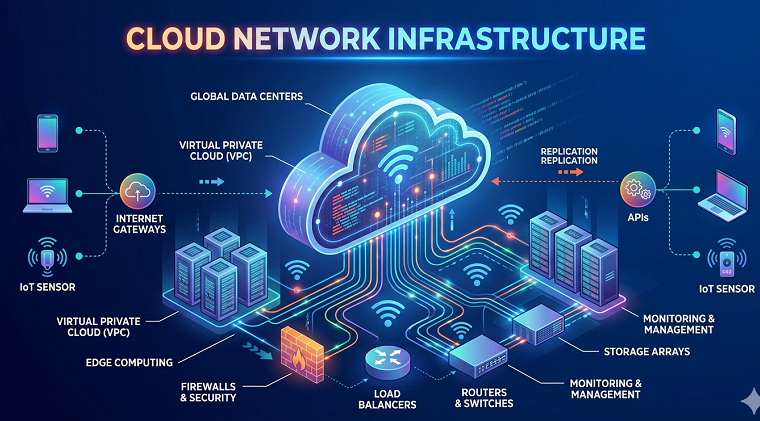
The Integrated Stack of Modern Cloud Networking
In the context of a hyper-scale data center, the term "platform" refers to the entire, integrated stack of hardware and software that creates the network fabric—the high-performance, intelligent mesh that interconnects all compute and storage resources. A Cloud Network Infrastructure Market Platform is not a single product but a cohesive system architecture designed for massive scale, extreme agility, and autonomous operation. Its fundamental purpose is to provide a programmable and resilient foundation that can support the dynamic and demanding workloads of the cloud era. This platform represents a complete departure from traditional, hierarchical network designs. It is built to be flat, fast, and fully automated, enabling the instantaneous creation of virtual networks and the seamless mobility of virtual machines and containers. Understanding the distinct layers of this platform—the physical hardware underlay, the software-defined overlay, and the intelligent management and orchestration layer—is crucial to grasping how modern cloud providers and enterprises achieve the speed and scale that define cloud computing today. This platform is the very blueprint for the data center of the future.
The Physical Underlay: The Spine-Leaf Hardware Foundation
The foundation of the entire platform is the physical underlay, which is the network of physical switches, routers, and cabling that provides the raw connectivity. In virtually all modern cloud data centers, the underlay is built using a "spine-leaf" architecture. This two-tier design consists of a layer of "leaf" switches, to which the servers are directly connected, and a layer of "spine" switches, to which every leaf switch is connected. This topology has several key advantages over traditional three-tier designs. It ensures that any two servers in the data center are only ever a maximum of two "hops" away from each other, drastically reducing latency and providing predictable performance. It also offers massive scalability and resiliency; adding more capacity is as simple as adding more spine or leaf switches, and the failure of any single switch does not bring down the network due to the multiple available paths. The hardware itself consists of high-density, high-speed Ethernet switches, with speeds of 100G, 400G, and now even 800G per port becoming standard, providing the massive bandwidth needed to support the communication-intensive applications running on the servers.
The Software Overlay: Programmable Virtual Networks
While the underlay provides the physical connectivity, the true magic and flexibility of the cloud network platform reside in the software overlay. The overlay uses virtualization techniques to create logical, "virtual" networks that run on top of the physical underlay. This is the domain of Software-Defined Networking (SDN). An SDN controller acts as the central brain, allowing administrators to programmatically define virtual networks, set security policies, and configure services without ever having to touch the physical switches. This enables key cloud features like multi-tenancy, where multiple customers can securely share the same physical infrastructure, each with their own isolated virtual network. It also allows for the incredible agility of the cloud; a developer can use an API call to instantly provision a complete, complex network topology for their application in seconds. Technologies like VXLAN (Virtual Extensible LAN) are used to encapsulate the traffic from these virtual networks, allowing them to be "tunneled" across the physical underlay. The overlay effectively abstracts away the complexity of the physical network, presenting a simple, programmable, and infinitely flexible networking environment to the applications and users.
The Management and Orchestration Layer: The Intelligent Brain
At the very top of the platform stack is the management and orchestration layer. This is the intelligent software that automates and optimizes the entire network fabric. It provides the single pane of glass through which operators can monitor the health, performance, and security of the entire network, from the physical switches to the virtual overlays. This layer collects a massive amount of real-time telemetry data from all network devices. In modern platforms, this data is fed into AIOps (AI for IT Operations) engines. These machine learning algorithms can analyze the data to detect anomalies, predict potential failures (like a failing optic or a congested link) before they impact service, and even recommend configuration changes to optimize performance. The orchestration part of the platform is responsible for automating the entire lifecycle of network services. It integrates with cloud orchestration platforms like OpenStack or Kubernetes, allowing the network to be automatically configured as part of a larger application deployment workflow. This layer transforms network management from a reactive, manual task into a proactive, automated, and data-driven discipline, enabling the operational efficiency required to run a data center at cloud scale.
Explore More Like This in Our Reports:

 English
 Arabic
 French
 Spanish
 Portuguese
 Deutsch
 Turkish
 Dutch
Dutch
 Russian
 Romaian
 Portuguese (Brazil)
 Greek
Greek
