


How Does a Thermal Shock Chamber Improve Product Reliability and Quality Testing for U.S. Manufacturers?
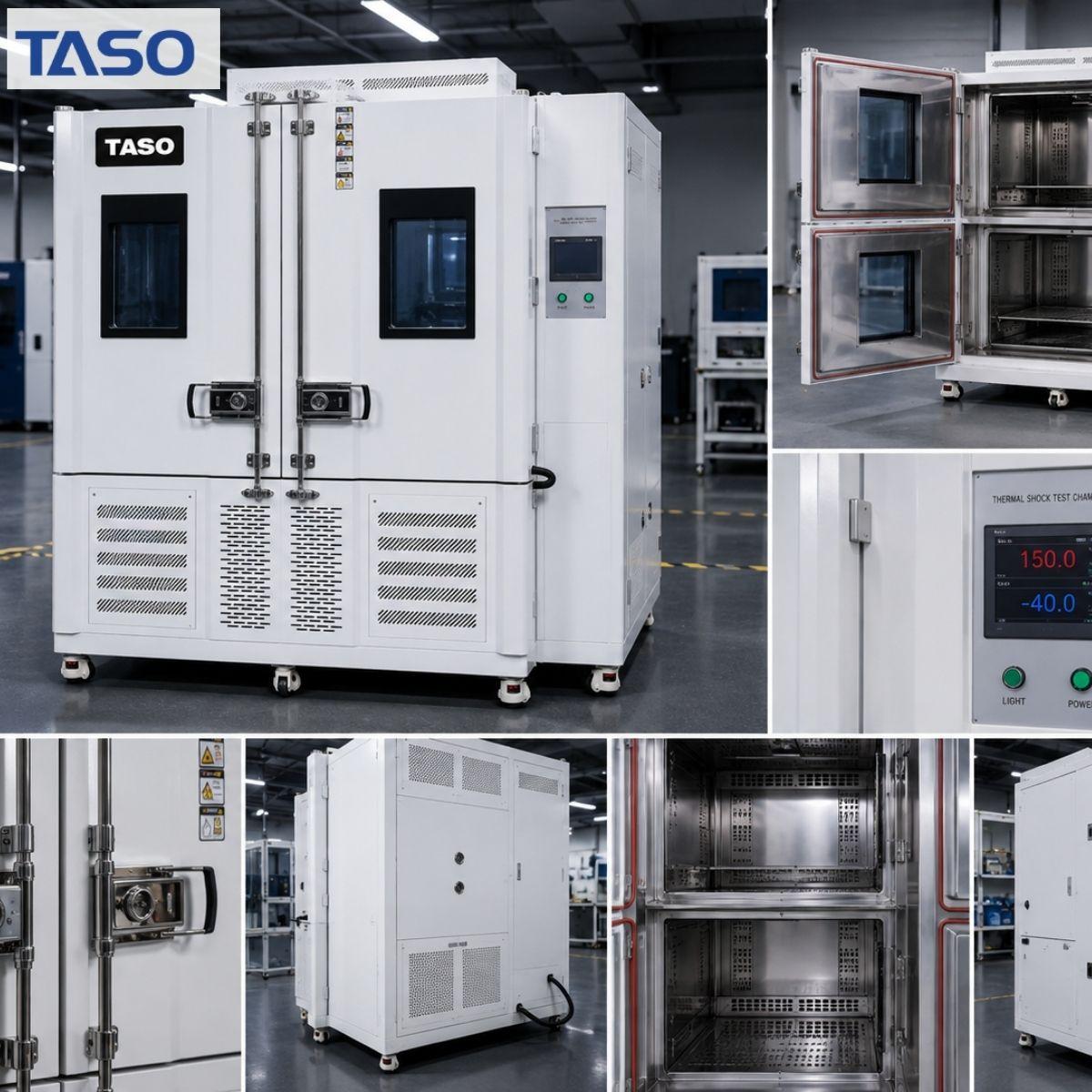
Modern manufacturing involves not only the precision cutting and fabrication of individual components, but the need for products to be reliable even in tough environmental conditions, such as quick changes between hot and cold temperatures. If a manufacturer wants to test how their materials, parts, assemblies and final products react to quick temperature changes, using a thermal shock chamber is one of the best methods for U.S.-based businesses.
Through thermal shock testing, one can identify potential defects in the product, including cracks, deformations, deterioration of the material, delamination and other problems associated with constant thermal expansion and contraction of the product.
TASO Metrology manufactures thermal shock test chambers designed for testing metals, plastics, rubber, electronics, and composite materials. Its current thermal shock chamber range includes models from 100 L to 1,000 L, with selectable temperature ranges extending to -60°C to 100°C and optional higher-temperature configurations.
What Is a Thermal Shock Chamber?
A thermal shock chamber is an environmental testing machine used to subject the test samples to quick variations in terms of temperature.
Thermal shock testing differs from other types of temperature testing in that it concentrates on the consequences of quick temperature variations, whereas in other types of temperature testing the product gradually shifts from one temperature condition to another. This is because there is thermal stress due to differences in expansion and contraction of the materials and components involved.
Thus, a thermal shock chamber is very useful to manufacturers in testing their products which are expected to be subjected to temperature variations at some stage.
Why Is Thermal Shock Testing Important for U.S. Manufacturers?
American companies work in very competitive industries where the quality and reliability of products directly affect customer satisfaction and the image of the company.
The product may function correctly in lab conditions; however, it may malfunction in real life when subjected to thermal shock testing. Thermal shock testing allows manufacturers to understand the potential risk early.
Key benefits include:
-
Identifying thermal-related material failures
-
Evaluating product durability
-
Detecting cracks and structural weaknesses
-
Assessing component reliability
-
Supporting product development and validation
-
Reducing the risk of unexpected field failures
-
Improving manufacturing quality control
-
Generating repeatable laboratory test conditions
Thermal shock testing is used across industries including electronics, automotive, aerospace, defense, telecommunications, consumer products, and industrial manufacturing. Industry testing providers similarly use rapid temperature transitions to identify issues such as cracking, delamination, seal failure, and other thermal-stress-related problems.
How Does a Thermal Shock Chamber Work?
The basic principle behind thermal shock testing is controlled exposure to contrasting temperature environments.
A test specimen is subjected to a predetermined high-temperature condition and then exposed to a low-temperature condition. The rapid transition creates thermal stress within the specimen.
Depending on the chamber design, the test system may use separate hot and cold zones or another controlled method for rapidly changing the temperature surrounding the specimen.
Important test parameters can include:
-
High and low temperature limits
-
Exposure or dwell time
-
Transition time
-
Number of thermal cycles
-
Specimen size and loading
-
Recovery conditions
-
Temperature stability and uniformity
The exact test profile should be selected according to the product, application, customer requirements, and applicable testing specification.
Which Industries Can Benefit From a Thermal Shock Chamber?
Automotive Manufacturing
Automotive components can experience substantial temperature variations throughout their operating life. Electronic modules, sensors, lighting components, plastics, seals, and other parts may need to withstand repeated environmental changes.
A thermal shock chamber can help automotive manufacturers evaluate whether components maintain their structural and functional performance after rapid temperature transitions.
Electronics and Electrical Products
Electronic components can be particularly sensitive to thermal stress. Differences in expansion between materials can place stress on connections, housings, soldered components, coatings, and other structures.
Thermal shock testing can therefore be incorporated into reliability testing for electronic assemblies, components, consumer electronics, and industrial electronic products.
Aerospace and Defense
Aerospace and defense products can encounter demanding environmental conditions. Components may need to operate reliably across significant temperature variations.
Thermal shock testing helps engineers investigate potential weaknesses in materials, electronic assemblies, sensors, and other critical components before deployment.
Plastics, Rubber, and Composite Materials
Materials respond differently to temperature changes. Rapid heating and cooling can reveal changes that may not be visible during ordinary inspection.
Manufacturers can use thermal shock testing to investigate cracking, deformation, bonding problems, and other temperature-related material behavior.
Industrial Products
Industrial equipment and components may be exposed to changing environmental conditions during transportation, storage, or operation.
Testing these products in a controlled thermal environment can provide useful information for product development and quality assurance.
What Features Should You Consider When Choosing a Thermal Shock Chamber?
Choosing the right thermal shock chamber requires more than comparing chamber prices. U.S. manufacturers should evaluate the system according to their actual test requirements.
1. Temperature Range
The required temperature range is one of the most important considerations.
TASO's current thermal shock chamber specifications list standard low-temperature options of -20°C, -40°C, or -60°C with a high-temperature range reaching 100°C, while higher-temperature options up to 130°C, 150°C, and 180°C are available depending on configuration.
2. Chamber Capacity
The chamber should provide sufficient working space for the specimens being tested.
TASO currently lists models ranging from 100 L through 1,000 L, allowing manufacturers to select different capacities according to testing requirements.
3. Temperature Stability and Uniformity
Consistent temperature conditions are important for repeatable testing. A chamber should maintain controlled conditions throughout the test space so that test results can be compared reliably.
4. Heating and Cooling Performance
The speed at which the chamber reaches its target conditions can influence testing efficiency. Manufacturers conducting frequent qualification or reliability testing should consider heating, cooling, recovery, and cycle performance.
5. Safety Protection
Industrial testing equipment should incorporate appropriate protection systems. TASO's listed thermal shock chamber specifications include protection against leakage, over-temperature, motor overheating, compressor overpressure, and short circuits.
6. Controller and Data Management
A practical control system allows operators to establish test programs, monitor temperature conditions, and manage testing procedures more efficiently.
For production environments and laboratories, ease of operation and repeatability can be just as important as the chamber's temperature range.
Can Thermal Shock Testing Be Combined With Dimensional Inspection?
Yes. Environmental testing and dimensional inspection address different aspects of product quality, and using both can provide a more complete understanding of product performance.
For example, a component can first undergo thermal shock testing and then be inspected for dimensional changes, deformation, or other physical variations.
This is where a CNC Vision Measuring System can become valuable.
A CNC vision measuring system uses imaging, optical measurement, automated stage movement, and measurement software to inspect dimensional and geometric features without physical contact. TASO's CNC vision measuring systems are designed for automated optical measurement, while its current vision-measuring solutions include features such as high-resolution cameras, CNC stage movement, image processing, edge detection, LED lighting, CAD comparison, and automated reporting.
For manufacturers, the two technologies can complement each other:
Thermal Shock Chamber → Environmental Stress Testing → CNC Vision Measuring System → Dimensional Inspection → Quality Analysis
This approach can help engineers determine not only whether a component survives thermal stress, but also whether its critical dimensions or geometry have changed after testing.
Why Is a CNC Vision Measuring System Useful in Modern Quality Control?
Traditional manual measurement can become inefficient when manufacturers need to inspect large quantities of precision components.
A CNC Vision Measuring System provides automated, non-contact measurement and can be particularly useful for components with small features, complex profiles, or surfaces that could be difficult to measure using contact-based methods.
Modern vision measuring systems can support:
-
Automated dimensional measurement
-
Non-contact inspection
-
Edge detection
-
Geometric measurement
-
CAD comparison
-
Repeatable inspection routines
-
Automated measurement reports
-
High-volume quality inspection
TASO's current CNC vision measuring system content highlights automation, optical imaging, programmable inspection routines, and automated reporting as important capabilities for modern manufacturing inspection.
How Can Thermal Shock Testing Improve Product Development?
One of the biggest advantages of environmental testing is the ability to discover weaknesses before mass production or commercial deployment.
Instead of waiting for a product to fail in the field, engineers can deliberately expose samples to controlled thermal conditions and analyze their performance.
A typical development process may include:
-
Define the expected environmental conditions.
-
Select appropriate thermal shock test parameters.
-
Place representative specimens inside the chamber.
-
Perform the required thermal cycles.
-
Inspect the specimens for visible or functional failures.
-
Measure critical dimensions where necessary.
-
Compare pre-test and post-test results.
-
Identify design or material improvements.
-
Repeat testing after modifications.
When combined with dimensional inspection equipment such as a CNC vision measuring system, manufacturers can obtain additional measurement data after environmental testing.
What Makes TASO Metrology a Relevant Supplier for Thermal Shock Testing?
TASO Metrology is a China-based manufacturer of metrology and testing equipment with products intended for industrial measurement and environmental testing applications.
Its thermal shock test chamber product range is designed for materials and products including metals, plastics, rubber, electronics, and composite materials. The available configurations include different chamber volumes, temperature ranges, controller options, refrigeration systems, and safety protection features.
For international buyers, selecting equipment should be based on technical requirements, application suitability, configuration, documentation, shipping considerations, installation requirements, and after-sales support.
U.S. companies evaluating a thermal shock chamber should therefore provide their intended application, specimen dimensions, required temperature range, test cycle, chamber capacity, electrical requirements, and any applicable testing specifications when requesting a quotation.
How Should U.S. Manufacturers Select the Right Thermal Shock Chamber?
Before purchasing a thermal shock chamber, create a clear technical requirement list.
Consider asking:
-
What temperature range is required?
-
How large are the test specimens?
-
How many specimens will be tested at once?
-
How quickly must the temperature transition occur?
-
How many cycles will be performed?
-
What industries and products will be tested?
-
What testing specifications must be followed?
-
What power supply is available at the facility?
-
What level of automation is required?
-
What documentation and support are needed?
A well-defined requirement helps the equipment supplier recommend a configuration that matches the actual application instead of simply selecting a chamber based on size or price.
Why Is Thermal Shock Testing Becoming More Important?
As manufacturers develop smaller, more complex, and more performance-sensitive products, reliability testing becomes increasingly important.
A component may have excellent dimensional accuracy but still fail when exposed to environmental stress. Conversely, a product may survive temperature cycling but experience dimensional changes that affect assembly or performance.
This is why modern quality strategies increasingly combine environmental testing, dimensional measurement, and data-driven inspection.
A thermal shock chamber can evaluate environmental durability, while a CNC vision measuring system can provide detailed dimensional inspection. Together, they can support a broader approach to product validation and quality assurance.
Conclusion
A thermal shock chamber is an important testing solution for manufacturers that need to understand how products and materials respond to rapid temperature changes. By exposing specimens to controlled thermal conditions, manufacturers can identify potential weaknesses and improve product reliability before products reach customers.
For U.S. manufacturers in automotive, electronics, aerospace, defense, plastics, rubber, and industrial applications, selecting the right chamber requires careful consideration of temperature range, capacity, temperature stability, heating and cooling performance, controls, safety, and application requirements.
TASO Metrology provides thermal shock testing equipment along with a broader range of precision measurement technologies. Its portfolio also includes CNC vision measuring systems that can complement environmental testing by helping manufacturers inspect dimensions and geometry before and after thermal exposure.
If your company is evaluating a thermal shock chamber for product development, reliability testing, or quality control, TASO Metrology can help you identify a suitable configuration based on your testing requirements.
Frequently Asked Questions
Q.1 What is a thermal shock chamber used for?
A thermal shock chamber is used to expose products, components, and materials to rapid temperature changes to evaluate their durability, reliability, and resistance to thermal stress.
Q.2 What industries use thermal shock chambers?
Thermal shock chambers are commonly used for automotive, aerospace, defense, electronics, telecommunications, industrial materials, plastics, rubber, and consumer product testing.
Q.3 What temperature range does a thermal shock chamber provide?
The required range depends on the chamber configuration. TASO currently lists standard low-temperature options down to -60°C with high-temperature operation up to 100°C and optional higher-temperature configurations.
Q.4 What is a CNC Vision Measuring System?
A CNC Vision Measuring System is an automated optical measurement system that uses cameras, precision movement, and software to measure dimensional and geometric features without physical contact.
Q.5 Can thermal shock testing and dimensional inspection be used together?
Yes. Thermal shock testing can evaluate environmental durability, while a CNC vision measuring system can inspect dimensional or geometric changes before and after thermal exposure.
Q.6 How do I choose the right thermal shock chamber?
Consider the required temperature range, specimen size, chamber capacity, thermal transition requirements, number of cycles, control system, safety features, electrical supply, and applicable testing requirements before selecting a model.

 English
 Arabic
 French
 Portuguese
 Deutsch
 Turkish
 Dutch
Dutch
 Italiano
 Russian
 Romaian
 Portuguese (Brazil)
 Greek
Greek
