


APAC Emerges as Fastest-Growing Region in $46.8B Medical Sensor Market
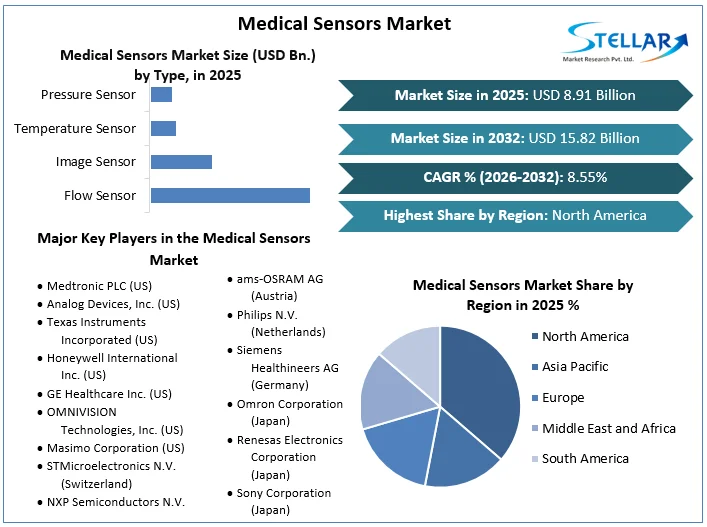
The Medical Sensors Market is undergoing a structural transition as decentralized digital care, continuous biometric monitoring, and edge-level AI analytics redefine global healthcare delivery. According to the latest comprehensive intelligence report by Stellar Market Research, the global medical sensors market was valued at USD 25.10 billion in 2023 and is projected to reach USD 46.80 billion by 2030, expanding at a compound annual growth rate (CAGR) of 9.25% over the forecast period (2024–2030).
This shift is heavily catalyzed by the global surge in chronic conditions, such as cardiovascular diseases, diabetes, and respiratory disorders. Healthcare systems worldwide face severe resource constraints and rising hospital readmission costs, forcing a systemic pivot toward outpatient care, hospital-at-home models, and preventive tele-rheumatology and tele-cardiology platforms. Furthermore, the integration of ultra-low-power microcontrollers, wireless telemetry (BLE 5.4, ultra-wideband), and system-on-chip (SoC) microelectronics is enabling non-invasive and minimally invasive sensors to deliver hospital-grade accuracy outside specialized clinical facilities.
Key Findings from the Report
-
Sensor Type Dominance: Biosensors held the largest market share, commanding over 34% of global revenue, driven by continuous glucose monitoring (CGM) systems, rapid point-of-care infectious disease assays, and wearable blood-chemistry monitors.
-
Technology Leadership: MEMS (Micro-Electro-Mechanical Systems) technology accounted for the dominant market volume owing to extreme miniaturization, low unit-production cost, high sensitivity, and mass integration in disposable pressure sensors and catheter tips.
-
Fastest-Growing Segment: Wearable Sensors (including bio-patches, smart wristwear, and textile-integrated sensors) represent the fastest-growing form factor, expanding at a CAGR exceeding 11.8% due to soaring adoption in remote patient monitoring (RPM) and clinical trial decentralization.
-
Application Benchmark: Monitoring applications generated the majority of demand, led by continuous blood glucose, pulse oximetry ($SpO_2$), body temperature, and multi-lead electrocardiogram (ECG) tracking.
-
Dominant Region: North America led the global market, accounting for over 38% of total revenue, backed by high healthcare expenditure, rapid FDA clearance for digital health tools, and favorable CMS reimbursement policies for remote physiological monitoring.
-
Emerging Frontier: Asia-Pacific is projected to register the highest CAGR during the forecast period, powered by massive healthcare infrastructure expansion, rising medical device manufacturing hubs in China, India, and South Korea, and expanding digital health penetration.
For further information, click the following link:https://www.stellarmr.com/report/req_sample/medical-sensors-market/2331
Market Drivers and Restraints
Market Drivers
-
Surge in Remote Patient Monitoring (RPM) and Hospital-at-Home Programs: Chronic disease management requires continuous biometrics rather than isolated spot-checks. Broadened reimbursement frameworks (such as CPT codes for RPM in North America and Europe) have incentivized healthcare networks to deploy sensor-equipped patches and continuous monitors at scale.
-
Miniaturization and MEMS/NEMS Technological Advances: Breakthroughs in Micro- and Nano-Electro-Mechanical Systems enable sub-millimeter sensors capable of multi-parameter sensing (pressure, temperature, flow, and bio-potential) without compromising battery life or patient comfort.
-
Proliferation of AI-Enabled Edge Analytics: Sensor hardware is increasingly paired with on-chip machine learning algorithms. This allows instant artifact filtering, arrhythmia detection, and predictive clinical alerts at the sensor node before data transmission, dramatically reducing bandwidth and power consumption.
Market Restraints
-
Stringent Regulatory Approvals and Data Privacy Compliance: Developing medical-grade sensors requires rigorous validation under FDA 510(k)/PMA frameworks and EU MDR regulations. Furthermore, compliance with strict data security mandates (HIPAA, GDPR) adds substantial compliance costs and lengthens product launch timelines.
-
Interoperability and High Initial R&D Capital Requirements: Complexities surrounding sensor integration across heterogeneous electronic health record (EHR) systems, alongside high upfront costs for micro-fabrication, bio-compatible material testing, and silicon wafer packaging, create entry barriers for mid-tier medtech developers.
Technology, Regulation, and Sustainability Trends
-
Flexible Bio-Electronics and Printed Sensors: The transition from rigid silicon substrates to biocompatible elastomer, polyimide, and hydrogel matrices is driving the adoption of skin-conformal "epidermal electronics" that move naturally with human tissue.
-
Energy Harvesting and Zero-Power Sensing: R&D investments are accelerating toward self-powered medical sensors that harvest energy from body heat (thermoelectric), kinetic motion (piezoelectric), or ambient RF signals, eliminating hazardous micro-batteries.
-
Regulatory Sandbox and Digital Health Pathways: Regulatory authorities including the FDA (via its TAP program and Software as a Medical Device guidelines) and the European Medicines Agency are offering expedited review pathways for sensor platforms integrated with predictive AI software.
-
Medical Waste Reduction & Eco-Design: With single-use disposable sensors contributing to electronic medical waste, leading manufacturers are shifting toward biodegradable sensor substrates, non-toxic organic electronics, and recyclable plastic enclosures.
Regional Insights
-
North America: Retains its market leadership due to early technology adoption, extensive venture capital funding in digital health, and high demand for home-based cardiac and diabetes care. The U.S. remains the central hub for sensor-based medtech innovation and clinical validation.
-
Europe: Driven by strong healthcare infrastructure in Germany, the UK, and France, combined with national initiatives promoting digital care adoption (such as Germany’s DiGA fast-track for digital health applications).
-
Asia-Pacific: Represents the highest-growth regional market. Rapidly aging demographics in Japan and China, expanding private healthcare coverage in South Asia, and lower-cost sensor fabrication ecosystems position APAC as both a primary consumer market and an export manufacturing engine.
-
Latin America & MEA: Emerging markets displaying accelerated growth due to government investments in tele-health infrastructure to bridge rural healthcare access gaps.
Recent Industry Developments
-
Danaher Corporation (2026): Announced the acquisition of Masimo Corporation for $9.9 billion, consolidating advanced pulse oximetry, optical sensing, and continuous patient monitoring platforms into Danaher's medical diagnostic portfolio.
-
Boston Scientific (2026): Acquired Penumbra for $14.5 billion, integrating specialized micro-sensors and catheter navigation technologies into its neurovascular and interventional cardiovascular devices.
-
Medtronic (2026): Agreed to acquire Scientia Vascular for $550 million, expanding its neurovascular portfolio with micro-guidewire and sensor-enabled catheter systems for precise intra-cranial stroke intervention.
-
Stereotaxis & Robocath (2026): Merged to combine magnetic navigation tech with mechanical robotic systems, creating integrated robotic solutions embedded with real-time force-feedback sensors for endovascular surgery.
-
Piccolo Medical / Spectrum Vascular (2026): Acquired Piccolo Medical to leverage its proprietary blood flow micro-sensing technology, enabling real-time catheter tip placement without confirmatory chest X-rays.
For further information, click the following link:https://www.stellarmr.com/report/req_sample/medical-sensors-market/2331
Competitive Landscape
The global medical sensors market is highly competitive, characterized by continuous capital investment in micro-electronics, strategic M&A, and cross-industry technology partnerships between legacy medtech leaders and semiconductor foundries. Leading companies are focusing on multi-sensor fusion (combining optical, electrochemical, and acoustic sensing on a single chip), miniaturized packaging, and direct cloud integration.
Key Market Players
-
Medtronic plc
-
Abbott Laboratories
-
GE HealthCare
-
Honeywell International Inc.
-
TE Connectivity
-
Analog Devices, Inc.
-
STMicroelectronics
-
Texas Instruments Incorporated
-
Koninklijke Philips N.V.
-
NXP Semiconductors
-
Boston Scientific Corporation
-
Masimo Corporation
-
DexCom, Inc.
-
Microchip Technology Inc.
-
Sensirion AG
Analyst Commentary
"The medical sensors landscape has reached an inflection point where hardware miniaturization is converging directly with edge artificial intelligence," said a Senior Research Analyst at Stellar Market Research. "We are observing a fundamental transition from reactive diagnostic equipment to continuous, predictive biometric loops. Sensor manufacturers that build multi-parameter sensing capabilities directly into low-power, bio-compatible substrates while maintaining strict clinical accuracy will secure a decisive competitive advantage as care models permanently shift toward decentralized, home-based health management."
Future Outlook
Looking toward 2030, the medical sensors market will be anchored by non-invasive multi-biometric sensing arrays, implantable bio-MEMS for targeted drug delivery feedback, and closed-loop therapeutic systems (such as automated insulin delivery systems). As silicon packaging costs decrease and wireless communication protocols become more energy-efficient, medical sensors will continue to expand beyond high-acuity clinical settings into routine consumer health monitoring, blurring the line between clinical diagnostic tools and proactive wellness monitoring.
About Stellar Market Research
Stellar Market Research is a multifaceted market research and consulting company with professionals from several industries. Some of the industries we cover include medical devices, pharmaceutical manufacturers, science and engineering, electronic components, industrial equipment, technology and communication, cars and automobiles, chemical products and substances, general merchandise, beverages, personal care, and automated systems. To mention a few, we provide market-verified industry estimations, technical trend analysis, crucial market research, strategic advice, competition analysis, production and demand analysis, and client impact studies.
Address
Phase 3, Navale IT Zone, S.No. 51/2A/2, Office No. 202, 2nd floor, Near, Navale Brg, Narhe, Pune, Maharashtra 411041
Email
sales@stellarmr.com
Mobile
+91 9607365656

 English
 Arabic
 French
 Spanish
 Portuguese
 Deutsch
 Turkish
 Dutch
Dutch
 Russian
 Romaian
 Portuguese (Brazil)
 Greek
Greek
